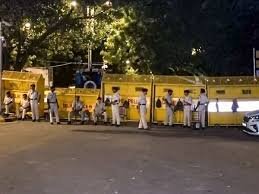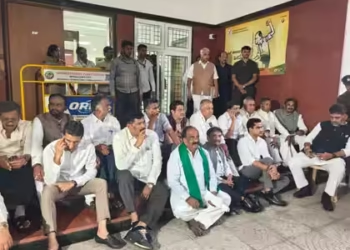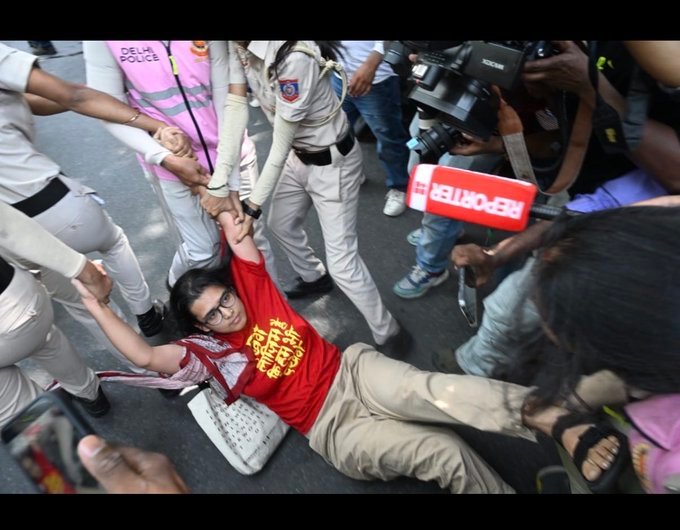
The protest against CEC Gyanesh Kumar turned into a major police operation as demonstrators were intercepted at several points, including North Avenue, Ashoka Road and Firoz Shah Road
BY PC Bureau
NEW DELHI, OCTOBER 2: Hundreds of protesters, including senior Aam Aadmi Party leaders and student activists, were detained by Delhi Police on Friday as a planned Jantar Mantar demonstration against Chief Election Commissioner Gyanesh Kumar and the Special Intensive Revision (SIR) of electoral rolls was stopped amid an unprecedented security clampdown in central Delhi.
Those detained included AAP Delhi chief Saurabh Bharadwaj, Atishi, Sanjeev Jha and Rajya Sabha MP Sanjay Singh, besides All India Students’ Association (AISA), Students’ Federation of India (SFI), National Students’ Union of India (NSUI) and other student activists. AISA national president Neha Bora was also detained.
The police initially put the number of detainees at around 150, but later officials said roughly 500 protesters had been taken into custody from Jantar Mantar and surrounding areas. A police source separately said around 700 SFI members attempting to reach the protest site were stopped at the Ashoka Road roundabout, with many detained.
The crackdown followed the Delhi Police decision to deny permission for the demonstration. Section 163 of the Bharatiya Nagarik Suraksha Sanhita was imposed across the New Delhi district, prohibiting unauthorised assemblies and demonstrations.
Protesters stopped at multiple points
The police operation was not confined to Jantar Mantar. Protesters attempting to approach the site were intercepted at several points in central Delhi.
Police stopped Sanjay Singh at North Avenue before he could proceed towards Jantar Mantar, while SFI activists were intercepted at the Ashoka Road roundabout. Protesters were also seen crossing barricades at Firoz Shah Road before being stopped by security personnel.
The authorities had deployed about 5,000 personnel from Delhi Police, reserve forces, the Rapid Action Force and other Central Armed Police units. Multi-layered barricades were installed on roads leading towards Jantar Mantar, including Tolstoy Marg, Janpath Road and Sansad Marg.
Anti-riot vehicles and drones were deployed as part of the security arrangements. Reports also said internet services were suspended around Jantar Mantar as the mobilisation gathered pace.
Entry and exit at several Metro stations were shut, further restricting access to central Delhi. The measures were accompanied by extensive traffic diversions and restrictions around Parliament Street, Jantar Mantar, Connaught Place and adjoining roads.
Apni Marzi se toh Bilkul detained Nhi hore hai ✅
Aapko zabardasti Karna Hai toh kijiye ! 🚨💯🇮🇳
Neha Bora Detained 🔥💯#DelhiNCR #Delhi #JantarMantar #NehaBora #Protest #Votechor #Gyaneshkumar #Modi #DelhiPolice pic.twitter.com/LFdP98bNj5
— whatsamaaj? (@kyakahegasamaaz) October 2, 2026
AISA president challenges police action
AISA president Neha Bora, who was among those detained, said the protesters were not being taken into custody voluntarily.
In a statement posted on X, Bora invoked Articles 19(1)(a) and 19(1)(b) of the Constitution, dealing with freedom of speech and peaceful assembly, and Article 21, which protects life and personal liberty.
She demanded that police not use lathis, tear gas, pellet guns or water cannons and said personnel deployed at the protest should display their nameplates. She also questioned why protesters were being prevented from demonstrating when Jantar Mantar is a designated protest location.
AAP leader Saurabh Bharadwaj similarly questioned the need for permission to protest at Jantar Mantar. In a video message after his detention, he said the party had written to the authorities about a week earlier seeking permission and argued that protesters were exercising their democratic right to raise concerns.
READ: 11 Metro Stations Shut, Massive Deployment to Foil Jantar Mantar Protest
Protesters lay in groups in front of police buses, holding hands to stop them from carrying away detained demonstrators. Police struggled to clear the way and move the buses near Jantar Mantar. #JantarMantar pic.twitter.com/QehbXZBvJX
— Hemant Rajaura (@hemantrajora_) October 2, 2026
Yogendra Yadav invokes Gandhi
Activist Yogendra Yadav, who had also been detained during the September 25 protest, criticised Friday’s police action.
In a post on X, Yadav described the events on Gandhi Jayanti as a stark reminder of the use of state power against protesters and invoked Mahatma Gandhi’s tradition of satyagraha. He also said the campaign against Gyanesh Kumar had begun on the streets of Delhi.
His remarks were political criticism of the police and government response rather than an independent finding about the legality of the police action.
Second crackdown in a week
Friday’s operation came barely a week after more than 60 people were detained near Jantar Mantar during an earlier demonstration against SIR and Kumar. Those detained on September 25 included Bora, Yadav, activist Anjali Bhardwaj, lawyer Prashant Bhushan and CPI(ML) Liberation general secretary Dipankar Bhattacharya.
That protest, also held without police permission while Section 163 was in force, was stopped before demonstrators could enter Jantar Mantar.
The latest mobilisation was backed by several Opposition parties and student organisations. AAP leaders had urged supporters to join, while AISA, SFI and NSUI activists attempted to reach the protest site.
SIR at the centre of confrontation
The protests are centred on the Election Commission’s SIR exercise, under which electoral rolls are being subjected to intensive verification. Opposition parties and civil-society groups have alleged that the exercise could result in eligible voters being excluded and have demanded action against Kumar.
The Election Commission has rejected allegations that the revision is politically motivated and has defended SIR as an exercise to identify and remove ineligible, duplicate, dead or shifted entries from electoral rolls.
The controversy intensified after an Indian Express investigation reported that Election Commissioners Sukhbir Singh Sandhu and Vivek Joshi had raised objections on at least 14 occasions over roughly 10 months to decisions taken in the Commission’s name without their knowledge. The reported objections included issues concerning Form 6, additions and deletions from electoral rolls, appeals and control of the electoral-roll database.
The political dispute has now spilled onto the streets, with the October 2 protest producing a significantly larger police operation than the September 25 mobilisation.
By Friday afternoon, more than 500 people had been detained, internet access around the protest zone had reportedly been suspended, several Metro stations remained closed and central Delhi was under heavy police and paramilitary deployment.