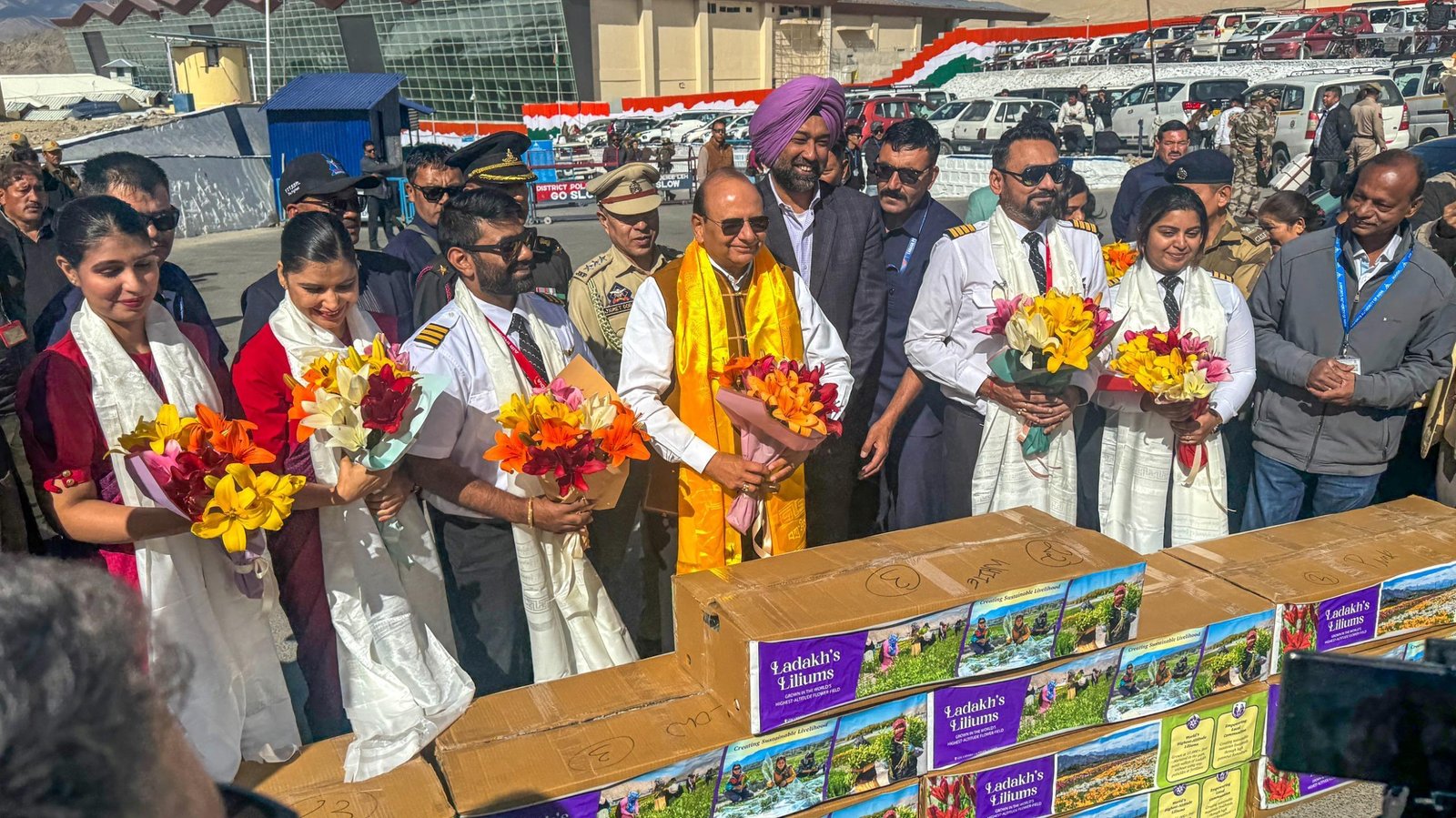
Lieutenant Governor Vinai Kumar Saxena has called the planting a test of whether saffron can grow in Ladakh’s cold desert and give farmers a high-value crop beyond the Lilium and Gladiolus fields already under way in Leh.
BY PC Bureau
October 2: A stretch of land in Leh that was barren three months ago is set to produce saffron for the first time in Ladakh, after nearly 800 kg of premium Iranian corms were planted over about 4,000 square metres under a pilot led by the Union Territory administration.
Lieutenant Governor Vinai Kumar Saxena has framed the trial as the next step after the administration’s floriculture push, which has already expanded Lilium and Gladiolus cultivation in Leh. Officials said about 90,000 corms, each with a circumference of 8–10 cm, a diameter of 2.5–3 cm or more, and a weight of at least 10 grams, were planted at Command Area Gate No. 27 at Spituk Pharka. Agriculture experts involved in the project said the corms are expected to yield a good quantity of saffron.
The site forms part of roughly 800 acres being restored in Leh by diverting unused or excess water from the recently operationalised Igoo–Phey irrigation canal. Four ponds built under Project Him Sarovar sit next to the plantation and together hold about 24 million litres.
READ: Under Fire Over Mass Voter Deletions, EC Orders Fresh Enrolment Drive in 20 States
Saxena said the trial is meant to test whether saffron can be grown under Ladakh’s high-altitude conditions and to show that degraded land can be brought back into production. “Our endeavour is to transform degraded and barren land into productive assets and create new opportunities for our farmers,” he said. “The introduction of saffron is another important experiment in crop diversification, which can open a new avenue for enhancing farmers’ incomes through a premium-value crop.”
Jammu and Kashmir accounts for about 90 per cent of India’s saffron output. The Ladakh planting is being run as a pilot to judge climatic suitability and market potential before any wider rollout. The administration has linked the effort to Prime Minister Narendra Modi’s emphasis on diversifying traditional agriculture to improve farm incomes and create work for local youth, self-help groups and entrepreneurs.
The administration is treating the Spituk Pharka plot as a test of both crop and land. Officials said the planting is meant to check whether premium saffron can take under Ladakh’s high-altitude conditions, and to challenge the view that the crop cannot be grown in the cold desert or that degraded land cannot be brought back into use. A successful harvest, they said, would add a premium-priced crop to the floriculture work already under way with Lilium and Gladiolus, and open another income line for farmers, self-help groups and local entrepreneurs.