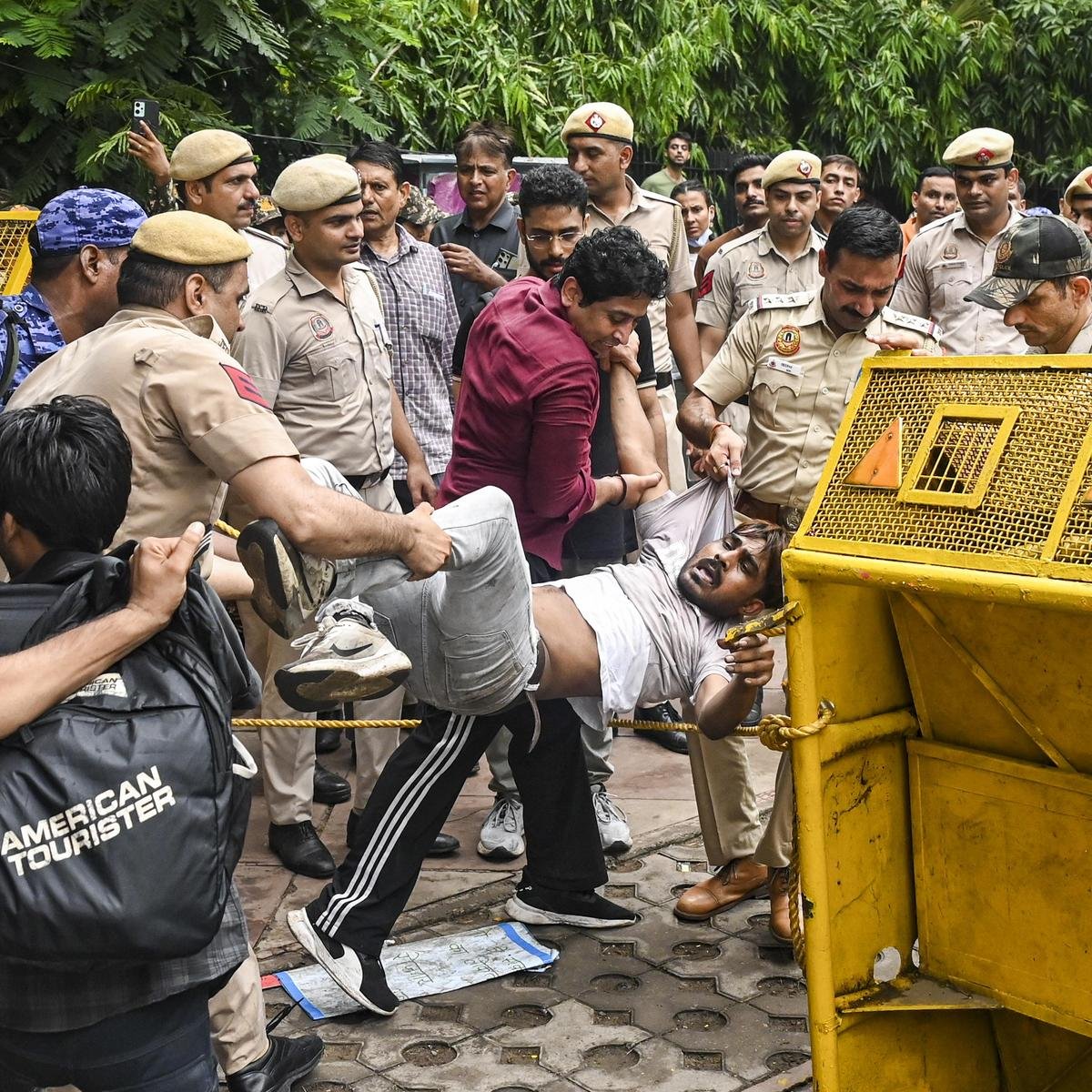
While democracies worldwide recognise reasonable restrictions for public safety, international human rights standards reject blanket limitations on protest timings and arbitrary restrictions on peaceful gatherings. Delhi Police’s proposed rules risk turning a fundamental right into an administrative privilege.
BY Navin Upadhyay
New Delhi/ November 14: In a democracy, a protest cannot be reduced to a seven-hour appointment, with the police deciding how many citizens can assemble and when they must go home. Yet that is the direction in which Delhi Police appears to be moving with its proposed new Standard Operating Procedure (SOP) for demonstrations at Ramlila Ground.
The Delhi police’s draft guidelines reportedly cap gatherings at 50,000 people and restrict protests, rallies and public meetings to a seven-hour window, between 10 am and 5 pm. Organisers must apply at least 10 days in advance and obtain a venue availability certificate from the Municipal Corporation of Delhi (MCD).
The Delhi police’s competent authority will determine the final number of participants permitted at individual events, taking into account the nature of the gathering, expected attendance and security arrangements.
Presented as a framework for maintaining public order, the Delhi police’s proposals raise a more fundamental question: is the purpose of regulating protests to facilitate the exercise of a constitutional right or to make dissent manageable, predictable and subject to administrative convenience?
A protest is not a government-sponsored public function. Nor is it a cultural event that must finish before the venue closes. It is an instrument through which citizens challenge authority, demand accountability and bring neglected grievances into public view. Its duration and scale can be integral to its political message.
Seven hours for dissent: Who decides when a protest must end?
The proposed 10 am to 5 pm restriction is particularly troubling.
Political movements do not operate according to office hours. A demonstration may gather momentum in the evening, continue through the night or evolve into a sustained sit-in because the authorities have failed to respond to the demands of protesters.
The farmers’ movement, the CJP protest at Jantar Mantar, the anti-CAA protests, and the prolonged demonstrations at Delhi’s borders illustrated how duration can become an essential part of peaceful political mobilisation.
A seven-hour ceiling effectively removes that option from the outset at Ramlila Ground.
There is also a question of proportionality. If a gathering remains peaceful, why should it automatically be required to disperse at 5 pm? If a specific security or public-order concern emerges, the authorities can address it through proportionate measures. A blanket time restriction assumes that every protest presents the same risks, irrespective of its size, purpose and conduct.
How democratic countries approach the right to protest
The international approach to peaceful assembly is fundamentally different from treating demonstrations as activities that must fit within a predetermined administrative timetable.
This does not mean that democracies elsewhere impose no restrictions. Countries regulate traffic, protect emergency routes, prohibit violence and impose reasonable conditions where public safety requires them. But international human rights standards insist that restrictions must be justified individually, rather than imposed as blanket limitations.
The United Nations Human Rights Committee’s General Comment No. 37 (2020), interpreting Article 21 of the International Covenant on Civil and Political Rights, provides an important benchmark.
It states that restrictions on peaceful assemblies must be lawful, necessary and proportionate. Authorities must demonstrate why a particular restriction is required rather than simply invoke administrative convenience.
More significantly, paragraph 54 says peaceful assemblies should generally be allowed to end by themselves. Restrictions on the precise time of day or date of demonstrations raise concerns about their compatibility with the Covenant.
The Committee also recognises that the timing, duration and frequency of a demonstration may be central to achieving its objectives.
The principle is equally important when it comes to crowd size. International standards do not prescribe a universal numerical ceiling for peaceful demonstrations. A limit may be justified where the physical capacity of a particular site or a demonstrable safety concern requires it. But an arbitrary ceiling, detached from an individual assessment, risks undermining the right itself.
The UN framework also says that public squares and streets are legitimate spaces for peaceful assemblies. Demonstrators should not be confined to remote locations where their message cannot effectively reach its intended audience.
In other words, democratic policing is expected to facilitate protests, not simply contain them.
United States, Britain and Europe: Restrictions are not a licence to suppress
In the United States, the constitutional protection of peaceful assembly under the First Amendment allows governments to impose reasonable time, place and manner restrictions. Authorities can regulate traffic, protect public safety and impose narrowly tailored conditions. But they cannot use these powers to suppress a demonstration simply because its message is inconvenient or its presence causes political discomfort.
Britain also regulates public demonstrations through notification requirements and police powers under public-order legislation. Police can impose conditions on routes, locations and duration in specified circumstances. However, such powers are subject to legal safeguards and judicial scrutiny.
Across European democracies, the general principle is that peaceful assemblies should be facilitated, with restrictions justified by specific and proportionate concerns. The OSCE and Venice Commission’s guidelines on freedom of peaceful assembly similarly emphasise the state’s obligation to enable demonstrations rather than impose unnecessary barriers.
The important distinction is not that other countries have no protest regulations. They do. It is that democratic standards do not treat a fixed crowd ceiling or a universal daily closing time as an automatic substitute for an individual assessment of public safety.
The 50,000-person ceiling: Safety or administrative control?
The proposed maximum capacity of 50,000 people also deserves scrutiny.
The Delhi police’s bosses should know that Ramlila Ground is a large public venue with a history of hosting major political rallies and mass demonstrations. Crowd management, emergency access, medical facilities, fire safety and traffic arrangements are legitimate concerns. No one disputes the need to prevent overcrowding or stampedes.
But why should 50,000 become a predetermined ceiling for every event?
A gathering of 50,000 people seated in organised enclosures is different from a standing demonstration spread across the available ground. The actual safe capacity depends on the layout, entry and exit arrangements, stage structures, emergency corridors and other facilities.
If the concern is physical safety, the permitted number should be determined through a transparent, event-specific assessment. A blanket ceiling, without publicly available technical justification, risks turning crowd management into crowd control.
There is another concern: the draft reportedly leaves the final permitted attendance to the competent authority. This creates considerable administrative discretion. Unless clear criteria and an appeal mechanism are provided, organisers may have little certainty about how many people they will actually be allowed to bring.
From Jantar Mantar to Ramlila Ground: Is Delhi shrinking the space for dissent?
The proposed SOP must also be viewed against the broader restructuring of protest venues in the national capital.
On October 11, Delhi Police issued a standing order de-notifying Jantar Mantar as a designated protest venue and identifying Ramlila Ground, Burari Ground and CBD Ground in east Delhi as alternatives.
The shift has raised concerns about whether Delhi is moving towards confining public demonstrations to a small number of designated spaces.
Jantar Mantar had long served as a prominent location for political and civil society protests. Its accessibility and proximity to the seat of government gave demonstrations there considerable visibility.
The UN Human Rights Committee has specifically cautioned against blanket restrictions that confine peaceful assemblies to a single designated location or relegate them to places where they cannot effectively communicate their message.
The question, therefore, is not merely how many people can assemble at Ramlila Ground or how late they can remain there. It is whether citizens retain meaningful access to public spaces from which they can make their demands heard.
READ: US Air Travel Resumes After ATC Outage, Normalcy May Take Days
Traffic cannot become a permanent argument against protest
The Delhi Police’s argument about traffic management and public order cannot be dismissed outright. Large demonstrations can disrupt roads, affect businesses and inconvenience commuters. Emergency access must remain protected.
The proposed SOP also prohibits the blocking of roads, footpaths and emergency routes and restricts weapons, inflammable materials and unauthorised drone operations.
These are legitimate safety concerns. But there is a difference between preventing dangerous obstruction and making the exercise of a fundamental right conditional on the absence of inconvenience.
The UN Human Rights Committee has explicitly recognised that peaceful assemblies may disrupt ordinary life and that society must accommodate a reasonable degree of such disruption. States are also expected to redirect traffic, provide security and make practical arrangements to facilitate demonstrations.
A democratic administration cannot promise citizens the right to protest while simultaneously designing a system in which protests must never inconvenience anyone.
A permission regime risks turning a right into a privilege
The requirement to apply 10 days in advance and secure a venue availability certificate from the MCD adds another layer of bureaucracy.
Advance notification can help authorities arrange security and traffic management. But notification should not become an elaborate permission system in which the right to assemble depends on administrative approval.
The UN Human Rights Committee has warned that authorisation systems should, in practice, function as notification mechanisms, with permission granted as a matter of course unless compelling reasons justify restrictions. Excessive bureaucratic requirements can undermine the very idea of peaceful assembly as a fundamental right.
The Delhi Police’s 10-day requirement also raises a practical problem for spontaneous demonstrations. Protests often emerge in response to sudden political developments, controversial government decisions, arrests, violence or public emergencies. Requiring organisers to plan every demonstration well in advance could make immediate public mobilisation difficult.
The question Delhi Police must answer
The proposed SOP may be defended as an effort to bring uniformity to protest management. But uniformity cannot come at the expense of constitutional freedoms.
Article 19(1)(a) guarantees freedom of speech and expression, while Article 19(1)(b) protects the right to assemble peaceably and without arms. These rights are subject to reasonable restrictions, but such restrictions must meet constitutional standards. They cannot be curtailed merely because unrestricted demonstrations are inconvenient for the administration.
The Supreme Court has also recognised that the right to protest must be balanced with the rights of other citizens, without extinguishing the right itself.
Delhi Police must therefore explain the technical and legal basis for the 50,000-person ceiling, the necessity of the 10 am to 5 pm window and the criteria by which individual gatherings will be assessed.
It must also clarify whether spontaneous protests and peaceful overnight demonstrations can be accommodated in exceptional circumstances.
The larger issue is one of democratic philosophy. A government confident of its legitimacy should not be anxious about citizens assembling in large numbers or remaining in a public space to demand answers.
Protests are not an administrative inconvenience to be eliminated. They are an essential part of democratic accountability.
The Delhi police’s bosses must realise a democracy cannot put dissent on a seven-hour shift and expect citizens to accept that as the full measure of their freedom.ealise