Despite a massive security presence, armed groups remain active, perpetrators of violence remain at large, and allegations of selective enforcement continue to deepen mistrust.
BY Navin Upadhyay
Manipur does not need another political arrangement on paper. It needs a government capable of enforcing the law.
More than three years after ethnic violence erupted on May 3, 2023, the state remains trapped in a cycle of killings, displacement, armed mobilisation and deep communal mistrust. The restoration of an elected government in February 2026 was supposed to mark a return to constitutional normalcy. Seven months later, normalcy remains elusive.
The question is no longer whether Manipur should have an elected government. It should. The question is whether the present government can perform the most basic functions of constitutional governance: protect life and property, enforce the law impartially and maintain security across the state.
In my view, Manipur has again reached the point where President’s Rule should be reimposed.
President’s Rule was imposed on February 13, 2025, after Chief Minister N. Biren Singh resigned amid the prolonged Meitei-Kuki conflict. It was revoked on February 4, 2026, when a BJP-led government headed by Yumnam Khemchand Singh took office, with Nemcha Kipgen and Losii Dikho as deputy chief ministers representing Kuki-Zo and Naga communities.
That political arrangement was significant. But representation in a cabinet is not the same as security on the ground.
Thousands of security personnel, but perpetrators remain at large
The most damning feature of the present situation is the mismatch between the scale of the security deployment and the state’s inability to prevent or conclusively investigate attacks.
Manipur has state police, Central Armed Police Forces, Assam Rifles, Army units and specialised forces, including CoBRA battalions. Yet armed attacks continue.
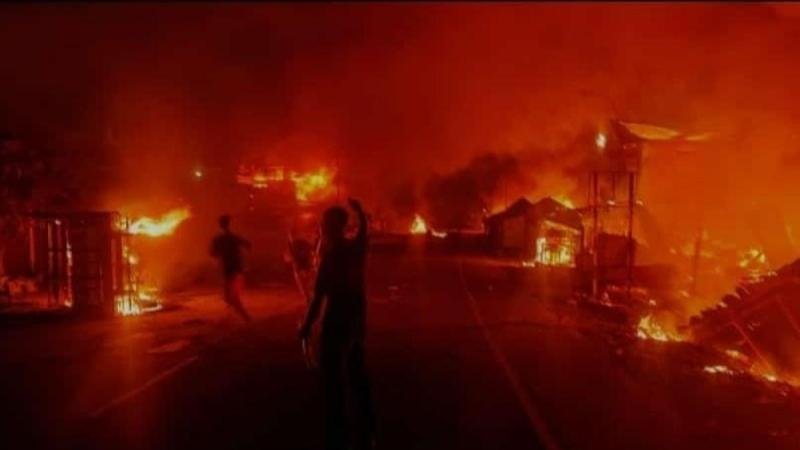
On September 13, four people, including two women, were killed in attacks on Kuki settlements in Tamenglong district. Two more Kuki-Zo women were subsequently killed in Tamenglong.
The central question remains: how many more civilians must be killed before the state can demonstrate that perpetrators will be identified and brought before the law?
A state cannot claim normalcy simply because security forces are deployed in large numbers. The real measure of state authority is whether citizens can live without being attacked or killed—and whether those responsible are actually held accountable.
The Arambai Tenggol question exposes the deeper problem
The government’s handling of Arambai Tenggol is particularly revealing.
On September 7, Chief Minister Yumnam Khemchand Singh told the Assembly that Arambai Tenggol and village volunteer groups had not been declared banned organisations. He said police cases were based on individual criminal activity rather than affiliation with the groups.
There is a legitimate legal distinction here: membership of an organisation cannot automatically establish an individual’s guilt. Anyone accused of murder, arson or attacks on security forces must be investigated and prosecuted on evidence.
But that principle cannot become an excuse for administrative paralysis.
The NIA has investigated serious cases involving alleged members associated with Arambai Tenggol. In June 2026, three alleged Arambai Tenggol members were among 10 people arrested in coordinated NIA, Manipur Police and CRPF operations involving cases of murder, arms looting, kidnapping, attacks on security forces and other offences.
An arrest is not proof of guilt. That must be established through investigation and trial.
But the principle is simple:
The state must investigate. It must arrest where evidence warrants it. It must prosecute. And courts must decide guilt.
What is unacceptable is a situation in which armed organisations acquire enormous influence, weapons circulate, civilians are killed and the political establishment appears more concerned with explaining why organisations should not be banned than with demonstrating that perpetrators will face the law.
READ: No National Outrage, No Prime-Time Debate: Who Cares for Manipur’s Dead?
And then there is the NSCN-IM question
The same test of equal enforcement must apply to Naga insurgent groups operating in Manipur.
The National Socialist Council of Nagalim (Isak-Muivah), or NSCN-IM, appears to have considerable operational space in the state. Kuki-Zo organisations have repeatedly accused NSCN-IM cadres of involvement in attacks on Kuki-Zo civilians and the burning of their homes.
Those allegations require investigation and should not be treated as established fact without evidence.
But a fundamental question remains: if armed cadres belonging to an insurgent organisation are operating inside Manipur, why has the state not demonstrated the same level of visible enforcement against them?
Kuki-Zo organisations have alleged that several NSCN-IM-linked camps operate in Manipur. If such camps are illegal or being used for armed activity, extortion, training or attacks on civilians, they should be investigated and dismantled.
If they operate under some political arrangement with the Centre, the government should explain the legal basis for their presence and the limits placed on their activities.
The Centre’s peace dialogue with NSCN-IM cannot, by itself, confer immunity for criminal acts committed in Manipur.
If an NSCN-IM cadre is credibly implicated in murder, arson, kidnapping or an attack on security forces, that person should face investigation and prosecution like any other accused.
The same standard must apply to every armed formation.
The Chief Minister and Home Minister therefore need to answer a straightforward question: what is the government doing about alleged NSCN-IM camps and cadres operating in Manipur?
Silence is not a security policy.
Violence has changed shape, not disappeared
The original Meitei-Kuki violence produced hundreds of deaths and displaced tens of thousands. State Home Minister Govindas Konthoujam told the Assembly in September that 306 people had been killed and 49 remained missing as of August 31, 2026.
Now violence involving Kuki-Zo and Naga communities has emerged as another serious security challenge.
Kuki-Zo organisations have blamed Naga armed groups for some recent attacks. Those allegations remain contested and require investigation. Earlier violence had also claimed Naga civilian lives.
The danger is that a conflict that began primarily as a Meitei-Kuki confrontation could develop into a wider cycle of ethnic retaliation.
That is precisely when the state needs to demonstrate that it alone controls the instruments of law and security.
The President’s Rule comparison matters
The 2025-26 period of President’s Rule did not solve Manipur’s political crisis. It did, however, produce a significant security intervention.
During that period, security forces recovered thousands of looted weapons, ammunition and explosives and dismantled hundreds of bunkers. By early 2026, the government reported the recovery of 7,313 weapons, more than 83,000 rounds of ammunition and 5,195 explosives, along with the dismantling of 549 offensive bunkers.
The Centre also maintained a heavy security presence.
This did not produce reconciliation or resolve displacement and political disputes.
But it demonstrated that a centralised security response could create greater space for weapons recovery, area domination and enforcement.
The lesson is not that President’s Rule magically produced peace. It did not.
The lesson is that a concentrated security administration was able to recover weapons and exercise greater control over the security environment.
That effort now needs to be renewed.
⚠️ Kangpokpi situation remains tense today. People advised to avoid travelling to Kangpokpi until the situation stabilises.#Manipur #Kangpokpi #TravelAlert #SecurityUpdate #BreakingNews #CurrentAffairs #PaomiToday pic.twitter.com/dct8gaw4L6
— Paomi Today – Manipur (@PaomiToday) September 16, 2026
This is about the state’s monopoly over force
Every functioning constitutional state rests on a basic principle: the government alone can legitimately exercise coercive power, subject to law.
Manipur increasingly resembles a place where communities organise their own armed protection because they do not trust the state to protect them.
When armed groups can mobilise large numbers of cadres, weapons looted from police armouries remain in circulation, illegal camps are alleged to operate without effective state action, highways become contested spaces and civilians are killed without perpetrators being swiftly brought to justice, the state’s monopoly over force is under strain.
The response cannot be to normalise this condition.
Article 356 and constitutional breakdown
Manipur’s problem is not that the Khemchand government lacks a majority. It has one.
The problem is whether a government can be considered constitutionally effective when citizens continue to be killed in ethnic attacks, armed formations retain influence, communities remain displaced and the state’s ability to enforce the law is repeatedly questioned.
Article 356 does not exist merely to remove a politically inconvenient government. The Supreme Court’s S.R. Bommai judgment rightly placed substantial limits on its use.
But Article 356 also recognises the possibility that the government of a state may become incapable of being carried on in accordance with the Constitution.
That is the question Manipur now presents.
Two Kuki women were brutally killed in Leisangphai Village by NSCN-IM terrorists, state involvement in the incident is something we cannot tolerate gaianst our Minorties
How many more Kuki Christan lives must be lost before the State & Central government act? pic.twitter.com/OtoPoXDJ2x
— Jyoti Kumar (@jyoti_kumarkf) September 16, 2026
President’s Rule must have a purpose
Another spell of President’s Rule should not be open-ended. The Assembly should remain in suspended animation. The administration should have clear and measurable objectives:
Recover the remaining looted weapons.
Identify and prosecute perpetrators of civilian killings.
Dismantle illegal armed structures and camps, irrespective of ethnic or political affiliation.
Protect vulnerable villages and strategic highways.
Ensure security operations are conducted without ethnic or political favour.
Strengthen the police and restore public confidence in the criminal-justice system.
Create conditions for genuine political dialogue among Meitei, Kuki-Zo and Naga representatives.
The aim should be to return Manipur to elected constitutional government—not to replace democracy permanently with central rule.
President’s Rule is an extraordinary constitutional measure. It should not become a convenient instrument for the Union government to bypass an elected state government.
But democracy also requires the state to protect its citizens.
More than 300 people have been killed since 2023. Tens of thousands have been displaced. Large quantities of weapons have been looted and recovered. Armed groups continue to be accused of violence. New ethnic fault lines have opened. Civilians are still being killed.
And despite the presence of a vast security apparatus, the state has repeatedly struggled to demonstrate that perpetrators will be brought to justice.
That is not merely a failure of policing.
It is a failure of governance.
The Union government should stop treating the restoration of an elected ministry as synonymous with the restoration of normalcy.
Manipur needs an administration that can demonstrate, on the ground and not merely in Assembly statements, that the law applies equally to everyone.
Until that happens, reimposition of President’s Rule should be considered as a temporary constitutional intervention—not as an alternative to democracy, but as an attempt to restore the conditions in which democracy can function again.