Barely a handful of Manipur’s 60 MLAs have spoken after the latest killings, while political leaders, opinion-makers and civil society across the country remain largely silent.
BY Navin Upadhyay
September 16: There is something deeply disturbing about what has happened to India’s conscience over Manipur.
People are being killed every day. Homes and hearths are being set on fire. Pregnant women have been shot dead while trying to protect their children. Newborns have been killed. Old and helpless women have been gunned down. Families have been destroyed.
Yet outside Manipur, the killings have largely become background noise.
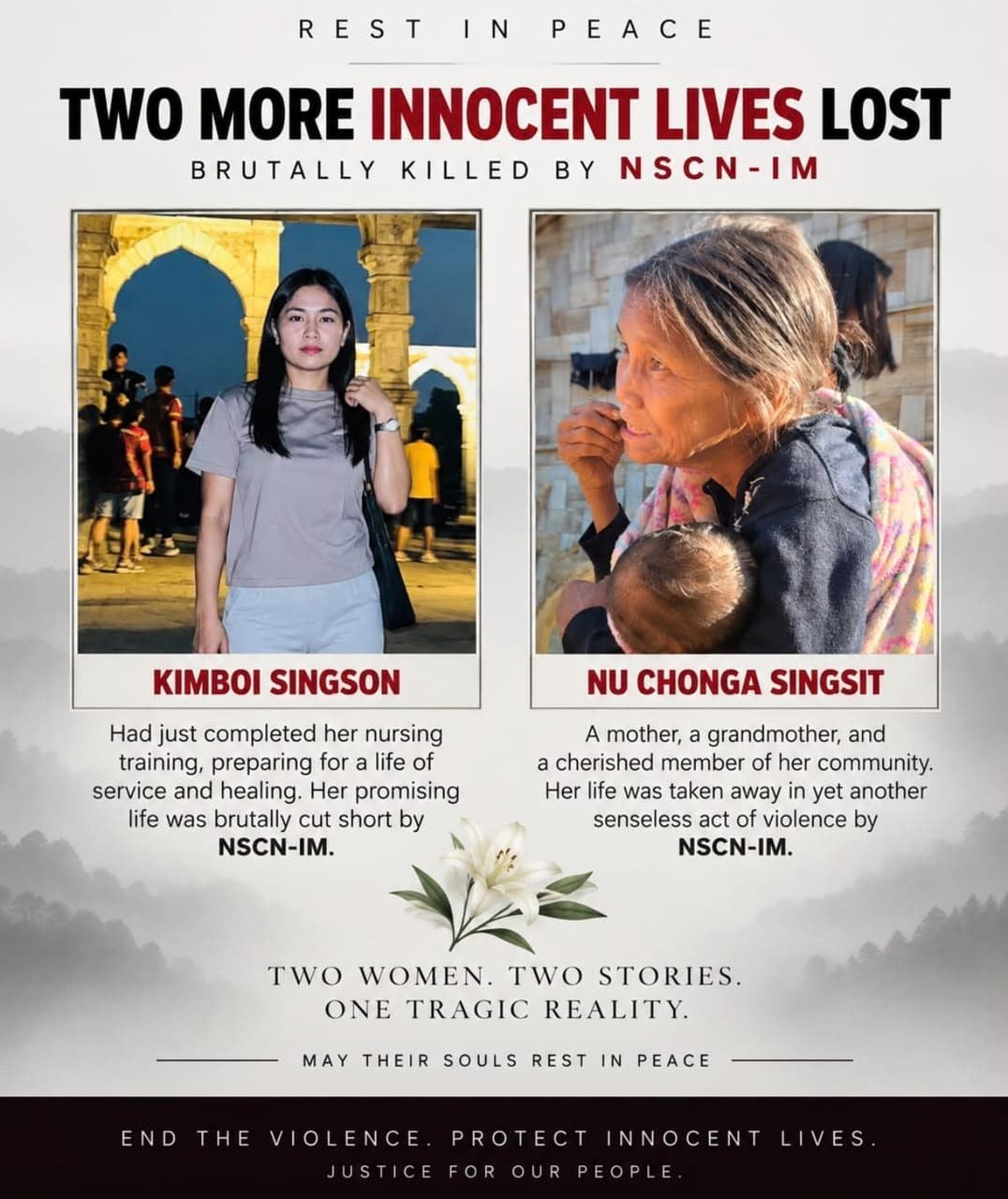
A pregnant Kuki-Zo woman was killed. A six-year-old boy was left without his parents after gunmen killed them. A 78-year-old woman was shot dead while gathering firewood. A 28-year-old woman who had recently completed her nursing course came home to help her parents in the fields and was killed.
These were not combatants. They were ordinary people living ordinary lives in a place that has been trapped in violence for more than three years.
What is perhaps more disturbing than the killings themselves is how little they seem to matter to the rest of India.
A six-year-old does not understand ethnic fault lines, armed groups, ceasefire agreements or political negotiations. He understands only that his mother and father were there—and then they were gone.
Forever.
That should be enough to break the heart of any society.
BREAKING: Two women were shot dead in Manipur yesterday. Several farmhouses were also torched in separate incidents. pic.twitter.com/mIL4DaezyR
— qpzm news (@qpzmnews) September 16, 2026
But it hasn’t.
In Manipur, barely a handful of the state’s 60 MLAs have spoken after the latest killings, offering the familiar expressions of grief and condemnation. The rest have largely remained silent.
And across the country, where is the outrage?
Where is the Prime Minister? Where is the Home Minister? Where is the Leader of the Opposition? Where are the chief ministers and national political leaders who routinely speak with passion about injustice elsewhere? Where are the self-proclaimed humanists, intellectuals, civil society voices and television opinion-makers?
Where is everyone?
India can erupt in anger when a dog is run over or a cow’s tail is twisted. Social media fills with outrage. Television debates run for hours. Politicians rush to respond.
There is nothing wrong with caring about animals. But there is something profoundly wrong when the killing of a pregnant woman, an old woman or a child fails to produce anything close to the same moral reaction.
Why does the death of a Kuki-Zo woman in a remote village barely register on the national conscience?
Perhaps Manipur is too far away. Perhaps it sends only two MPs to the Lok Sabha. Perhaps its victims are too tribal. Perhaps its conflict is too complicated. Perhaps people are simply tired of hearing about it.
None of these is an acceptable excuse.
Manipur’s conflict is undeniably complicated. Civilians from different communities have suffered. Armed groups have been accused of killing people on different sides. But complexity does not diminish the value of a human life.
A civilian is a civilian.
A child is a child.
READ: No One Touches the Killers of Kuki-Zo Civilians in Manipur. Where Is the State?
A pregnant woman is a mother, a daughter, a wife, a sister—not a footnote in an ethnic conflict.
The most frightening thing about Manipur may be that the killings have become routine. A body is recovered. There is condemnation. An investigation is announced. And then the country moves on until the next body is found.
That is how a national tragedy becomes normal.
The victims gradually disappear from public memory. Their names are forgotten. Their families are left to live with the absence. Children grow up in relief camps and broken homes, trying to understand a loss they are too young to comprehend.
Meanwhile, India’s political class carries on.
There are 60 MLAs in Manipur. There is a Prime Minister, a Home Minister and a President. There are Opposition parties, journalists, activists, academics and public intellectuals.
Surely the suffering of an Indian citizen cannot be allowed to become somebody else’s problem simply because it happens in a remote corner of the country.
The question is no longer whether India knows that Manipur is suffering. It does.
The question is whether India still cares.
A country cannot claim that every life matters while remaining unmoved by the killing of civilians because those civilians belong to a distant, tribal and politically inconvenient part of the country.
The silence is becoming its own form of tragedy.
For the people of Manipur, these are not statistics. They are empty beds, abandoned homes, photographs on walls and children waiting for parents who will never return.
And for the rest of India, they should be a test of something much more fundamental than politics:
Do we still recognise the suffering of people we do not know, in places we may never visit, as our own?