



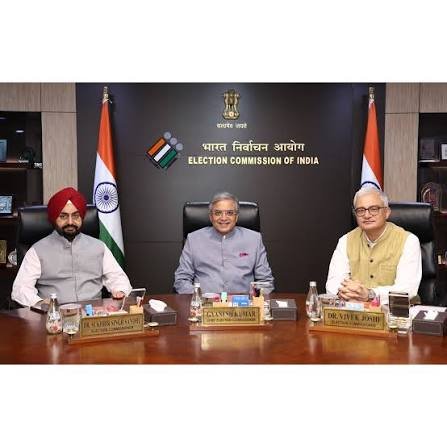
A comparison with Germany, France, Italy, the UK, US, Canada and Australia finds no obvious equivalent to India’s Section 16, which protects both serving and former Election Commissioners from criminal as well as civil proceedings.
BY Navin Upadhyay
New Delhi, October 6, 2026 — India has given its Election Commissioners a form of legal protection that appears to have no comparable equivalent among the major democracies examined — an immunity that bars courts from entertaining or continuing both civil and criminal proceedings against a serving or former Election Commissioner for acts, words or things done while acting, or purporting to act, in the discharge of official functions.
The protection is contained in Section 16 of the Chief Election Commissioner and Other Election Commissioners (Appointment, Conditions of Service and Term of Office) Act, 2023, which came into force in February 2024.
The provision says that, notwithstanding anything contained in any other law, “no Court shall entertain or continue any civil or criminal proceedings” against anyone who is or was a Chief Election Commissioner or Election Commissioner for an act, thing or word committed, done or spoken while acting or purporting to act in the discharge of official duty or function.
The significance of the provision lies not merely in protecting election officials from liability for bona-fide decisions. It potentially prevents a court from even entertaining or continuing a civil or criminal proceeding in the first place.
That makes Section 16 fundamentally different from the narrower forms of protection available to election officials in countries such as Germany, France, Italy, Britain, Australia, Canada and the United States.
An unusually broad shield
There are three features of India’s provision that stand out.
First, it expressly covers criminal proceedings, not merely civil claims.
Second, the protection applies not only to serving commissioners but also to anyone who “is or was” a CEC or EC.
Third, it covers acts done while “acting or purporting to act” in the discharge of official duty or function.
The last phrase is particularly significant. It raises a fundamental question: where an Election Commissioner is accused of acting unlawfully, arbitrarily, dishonestly or beyond statutory authority, who determines whether the disputed act was an official act protected by Section 16?
If a criminal court cannot even entertain the proceeding, the issue of accountability may never reach the stage at which evidence is tested.
This is much more than the ordinary protection that public officials receive for bona-fide decisions made in good faith.
READ: Opposition MPs Barred From Reaching ECI, Sit on Dharna
Germany: election offences remain prosecutable
Germany provides a revealing contrast.
The German electoral system has a Federal Returning Officer and a network of election bodies, but German electoral law expressly recognises the possibility of investigations into suspected electoral offences.
The Federal Electoral Regulations permit electoral information to be supplied to authorities and courts where it is required in connection with electoral scrutiny or the investigation of suspected electoral offences. Electoral documents can also be retained when they may be relevant to prosecutors investigating an electoral offence.
Germany’s Federal Returning Officer also lists a range of election-related offences under the Criminal Code, including disruption of the electoral process, falsification of election results and documents, violation of electoral secrecy, voter intimidation, voter deception and bribery.
There is no comparable provision identified in the German framework saying that courts cannot entertain or continue criminal proceedings against a current or former senior election official because the alleged conduct occurred while performing, or purporting to perform, official duties.
France: election officials are not placed beyond criminal law
France provides another important contrast.
French electoral law expressly criminalises conduct by public officials and election personnel that interferes with the integrity of elections. The Electoral Code provides criminal penalties where a person serving in an administrative or municipal commission, polling station or public administration deliberately violates electoral law or commits fraudulent acts affecting the secrecy or fairness of the vote.
Indeed, where the offender is a public official, government agent or president of a polling station, the prescribed punishment can be doubled. The law also criminalises fraudulent registration, removal or retention of voters on electoral lists.
In other words, French electoral law does not create a general wall between election officials and criminal accountability.
France does have constitutional immunities for certain office-holders, but these are specific and carefully defined. Even members of Parliament’s constitutional protection is not equivalent to a blanket prohibition on criminal proceedings. Article 26 of the French Constitution protects parliamentary opinions and votes but separately regulates arrest and other restrictions on liberty.
The French constitutional framework also provides a mechanism for prosecuting members of the Government for criminal acts committed in the exercise of their functions through the Cour de justice de la République.
There is therefore no obvious French equivalent of India’s Section 16 protecting present and former election commissioners from both civil and criminal proceedings.
Italy: even high constitutional offices do not enjoy such a permanent shield
Italy too offers no apparent equivalent.
Italian constitutional law provides certain protections to parliamentarians, including protection for opinions expressed and votes cast in the exercise of parliamentary functions, as well as procedural safeguards concerning arrest, searches and interception. But these are not the same as immunity from criminal prosecution.
Article 68 of the Italian Constitution expressly distinguishes protection for parliamentary opinions and votes from procedural restrictions concerning criminal investigations and coercive measures.
Italy has also previously experimented with much broader immunity from criminal proceedings for some of the country’s highest constitutional office-holders. A 2003 law temporarily suspended criminal proceedings against several senior office-holders while they remained in office.
But Italy’s Constitutional Court struck down those provisions in 2004.
The Italian example is therefore instructive: even when the Italian legislature attempted to provide a broad shield to senior constitutional office-holders, the measure did not survive constitutional scrutiny.
There is no corresponding Italian provision identified that gives election officials the India-style protection against courts entertaining or continuing criminal proceedings for official acts.
Britain, Australia, Canada and the US
The pattern is similar in other major democracies.
Britain’s Electoral Commission operates within a framework of parliamentary accountability and does not enjoy an immunity comparable to Section 16.
Australia provides certain statutory protections to electoral officials, particularly for actions undertaken in good faith, but these are not equivalent to a blanket bar on criminal proceedings.
Canada also provides legal protections to election officials for specified official acts, but the Canadian system retains mechanisms for investigating and prosecuting election offences.
The United States has various forms of official immunity, particularly in civil litigation, but there is no equivalent blanket statutory provision shielding Federal Election Commission members from criminal proceedings for official acts.
The distinction matters.
Official immunity is not the same thing as immunity from prosecution.
A public servant being protected against a lawsuit for a bona-fide decision is one thing. A law declaring that a court cannot “entertain or continue” criminal proceedings against a serving or former election commissioner is something considerably broader.
A global anomaly?
The available comparison with major democracies points to an important conclusion.
Germany permits investigation of suspected electoral offences. France expressly criminalises interference with the integrity of elections by public officials. Italy’s constitutional framework does not place public office-holders permanently beyond criminal proceedings. The United Kingdom, Australia, Canada and the United States have various forms of official protection but no obvious equivalent to India’s Section 16.
India therefore appears to have created an exceptionally broad statutory shield around its top election officials.
And that leaves a question that goes to the heart of democratic accountability:
Who watches the election watchdog when the law says a court cannot even entertain a criminal case against the watchdog for conduct undertaken in the name of official duty?








Comments 1