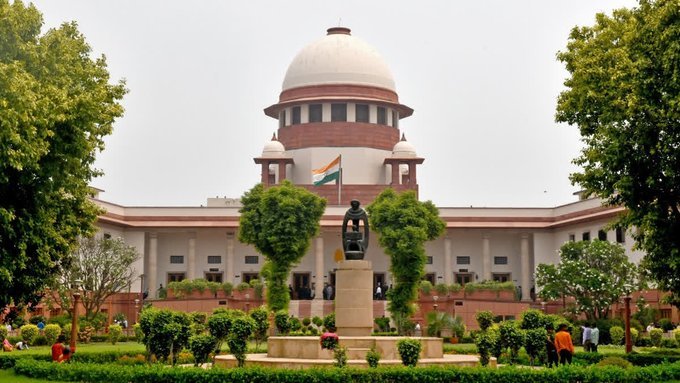
Justice Datta stressed that preventive detention is not punitive and said the NSA “cannot be invoked as a mantra” to defeat every challenge. The SC directed the state to respond by Wednesday on whether a police-custody confession can form the basis of preventive detention
BY PC Bureau
September 8, 2026: The Supreme Court’s questioning of Uttar Pradesh’s case against Mulla Afroz centred on a basic legal issue on Tuesday: can a National Security Act detention order be sustained on the basis of an alleged confession made in police custody? The Court reserved its order after probing the evidentiary foundation of Afroz’s preventive detention in the November 2024 Sambhal violence case.
A Bench of Justice Dipankar Datta and Justice Sheel Nagu examined the alleged custodial confession and questioned whether such a statement could provide the “subjective satisfaction” required for an NSA detention order.
Afroz is accused of being the mastermind of the violence that followed a court-ordered survey of the Shahi Jama Masjid in Sambhal, in which four people died. Police arrested him about 54 days after the incident, reportedly on the basis of a confession allegedly made while he was in custody. The Allahabad High Court subsequently granted him bail.
Despite this, the Uttar Pradesh government issued an NSA detention order against Afroz on October 13, 2025. The High Court later upheld the detention, prompting Afroz to approach the Supreme Court.
Bench probes basis of detention
Before the apex court, Afroz’s counsel argued that the police themselves had opened fire during the violence and that the allegation had not been properly investigated. He sought liberty to file a protest petition on the issue.
The defence also argued that a confession made while a person is in police custody is inadmissible in law and cannot form the basis of an arrest.
On preventive detention, counsel submitted that the existence of several criminal cases against a person cannot, by itself, justify detention under the NSA. The detaining authority, he argued, must reach a genuine and informed subjective satisfaction on the basis of adequate and cogent material.
Relying on the Supreme Court’s judgments in Rekha v. State of Tamil Nadu and Ameena Begum v. State of Telangana, the petitioner argued that a mere possibility that a person might commit an offence in the future cannot sustain preventive detention without sufficient supporting material.
READ: Delhi: Rahul Gandhi, Manipur CM Join Outrage Over Killing of Manipuri Musician
Confession becomes central issue
Justice Datta repeatedly questioned the State about the material relied upon by the detaining authority.
The Bench asked whether a confession recorded in police custody could constitute the foundation of an NSA detention order and whether such a statement could even be treated as a “fact” for arriving at the required subjective satisfaction.
The judges also pointed to an apparent contradiction in the State’s material. The government claimed that Afroz had deleted messages from his phone, while at the same time relying on an alleged message to establish his involvement in the violence.
The Court questioned how the message had been obtained if the messages had already been deleted.
The Bench also asked whether a “strong possibility of recreating an atmosphere of terror” was, on its own, sufficient to invoke preventive detention.
State cites threat to public order
The Uttar Pradesh government defended the detention on the ground that there was a likelihood of Afroz causing violence or disturbing public order in the future.
The State argued that where the material before the detaining authority demonstrated such a likelihood, preventive detention could be justified.
On the alleged confession, the State maintained that questions relating to its relevance belonged to other proceedings. The Bench, however, questioned that position because the confession appeared to be a central, if not foundational, component of the detention order.
Justice Datta stressed that preventive detention is preventive rather than punitive and observed that the NSA “cannot be invoked as a mantra” to defeat every challenge.
There must, he said, be material capable of supporting the subjective satisfaction required under the law. At one stage, Justice Datta told the State: “Your entire detention order is based on the confession.”
Court questions 54-day arrest delay
The Bench also questioned the delay in Afroz’s arrest.
Justice Datta asked why Afroz was arrested and made an accused approximately 54 days after the Sambhal violence when CCTV footage was available from the first day.
The judges further asked why that CCTV material was not cited in support of the NSA detention order.
Referring again to Ameena Begum, Justice Datta noted that preventive detention is an administrative rather than a judicial act and must comply with applicable safeguards and guidelines.
Even in the absence of specific guidelines, he said, the detaining authority must act reasonably and fairly.
“Is this the way you pass a detention order?” the judge asked.
The Court directed the State to file a reply by Wednesday morning specifically on whether a confession made in custody can be relied upon for passing a preventive detention order.
The Bench reserved its order on Afroz’s petition.