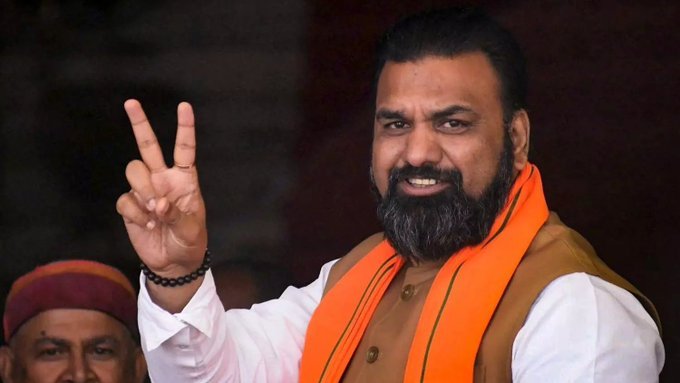
As Bihar enters a new political phase, the key test for Samrat Choudhary will be balancing governance expectations with the BJP’s broader ideological and electoral ambitions.
By PC Bureau
April 15, 2026
The swearing-in of Samrat Choudhary as Chief Minister of Bihar marks far more than a routine leadership transition. It represents a decisive restructuring of political power in one of India’s most complex and caste-sensitive states — and signals the Bharatiya Janata Party’s arrival as the undisputed fulcrum of governance in Bihar.
For decades, Bihar’s political landscape has been shaped by towering regional figures and fluid coalition arrangements. The departure of Nitish Kumar — arguably the most dominant political figure in the state over the past two decades — marks the end of an era defined by calibrated alliances, caste balancing, and a governance-first narrative branded as “Sushasan.”
What follows is not merely succession, but transformation.
From Coalition Dependency to BJP Dominance
Until now, the BJP’s role in Bihar was that of a powerful yet dependent partner — reliant on Nitish Kumar’s Janata Dal (United) to anchor governance and provide a broader social coalition. Even at the peak of its national dominance, the BJP stopped short of claiming Bihar’s top post.
That hesitation has now ended.
With Choudhary’s elevation, Bihar becomes the final major Hindi heartland state where the BJP has installed its own Chief Minister. The symbolism is unmistakable: the party is no longer content with influence — it seeks ownership.
This shift also reflects a deeper strategic confidence. The BJP appears willing to test whether its electoral machinery, ideological messaging, and welfare-driven governance model can sustain power in Bihar without the moderating presence of a regional heavyweight like Nitish Kumar.
The End of the Nitish Model?
Nitish Kumar’s tenure was marked by a unique blend of pragmatism and adaptability. He navigated alliances with both the BJP and Lalu Prasad Yadav’s Rashtriya Janata Dal (RJD), often positioning himself as the pivot around which Bihar’s politics revolved.
His “Sushasan” model emphasized infrastructure development, improved law and order, and targeted welfare schemes — helping Bihar shed some of its historical image of administrative stagnation.
But the model was also personality-driven.
With Nitish stepping aside, the key question is whether “Sushasan” can survive without its principal architect — or whether it will be subsumed into the BJP’s broader governance template, which combines welfare delivery with stronger ideological positioning.
Caste Calculus: The Kushwaha Gambit
If the political shift is structural, the social calculation behind it is equally deliberate.
Samrat Choudhary belongs to the Kushwaha (Koeri) community — one of Bihar’s most significant Other Backward Class (OBC) groups. While numerically smaller than the Yadavs, the Kushwahas are politically influential and have often been a swing constituency.
By elevating a Kushwaha leader, the BJP is executing a layered strategy:
- Expanding its appeal among non-Yadav OBCs
- Weakening the RJD’s traditional MY (Muslim-Yadav) base
- Filling the representational space left by Nitish Kumar’s broader coalition politics
This is not merely symbolic representation. It is an attempt to redraw Bihar’s caste equations in a way that benefits the BJP in the long term.
Notably, Janata Dal (United) (JD(U)) is understood to have supported the move — suggesting that the transition was negotiated, even if it ultimately cements BJP primacy within the alliance.
A Politician of Many Journeys
Choudhary’s own political trajectory mirrors Bihar’s shifting alliances.
He began his career with the RJD under Lalu Prasad Yadav, later moved to JD(U), and eventually joined the BJP in 2017. This cross-party journey has given him exposure to multiple political styles — from RJD’s social justice politics to JD(U)’s governance focus and the BJP’s organizational discipline.
His lineage also matters. As the son of veteran leader Shakuni Choudhary, he inherits both a political network and grassroots credibility.
Yet, this fluidity also raises a key question: can Choudhary craft a distinct ideological and administrative identity, or will he remain primarily an instrument of the BJP’s central strategy?
READ: Iran Campaign Will Continue Until Regime Falls: Mossad
Implications for NDA and the Opposition
Within the NDA, the balance of power has clearly shifted.
While Nitish Kumar has pledged “full cooperation and guidance,” the reality is that JD(U)’s leverage has diminished. The BJP is now the senior partner not just numerically, but symbolically and structurally.
For the opposition — especially the RJD — this transition presents both a challenge and an opportunity.
On one hand, the BJP’s direct leadership removes a familiar political rival (Nitish) and replaces him with a less tested figure. On the other, it forces the opposition to recalibrate its strategy against a more assertive and centralized political force.
Expect sharper contestation over:
- OBC vote fragmentation
- Welfare vs identity politics
- Narrative battles over governance and representation
Governance Test: Beyond Symbolism
The immediate challenge before Choudhary is governance.
Bihar remains a state with significant developmental gaps — in employment, industrialization, and human development indicators. While Nitish Kumar’s tenure brought relative stability, expectations for rapid progress remain high.
Choudhary must navigate:
- Administrative continuity vs policy innovation
- Coalition management within the NDA
- Rising political scrutiny from both allies and critics
He will also have to demonstrate that his leadership is not merely a political experiment, but a viable governing model.
The National Lens
Beyond Bihar, this development carries national implications.
For the BJP, securing Bihar under its own Chief Minister strengthens its narrative of dominance across northern India. It also provides a critical political and electoral base ahead of future national contests.
For Indian politics at large, it signals a gradual decline of regional kingmakers and the rise of centralized party structures — a trend that has been unfolding over the past decade.
A Defining Moment
The rise of Samrat Choudhary marks the beginning of a new chapter — one that could redefine Bihar’s political grammar.
Whether this new power order brings stability and consolidation or triggers fresh churn will depend on how effectively the BJP balances ambition with accommodation, and how Choudhary evolves from a political appointee into a leader with an independent mandate.
For now, one thing is clear: Bihar is no longer the exception in the BJP’s Hindi heartland map — it is the newest frontier of its political experiment.