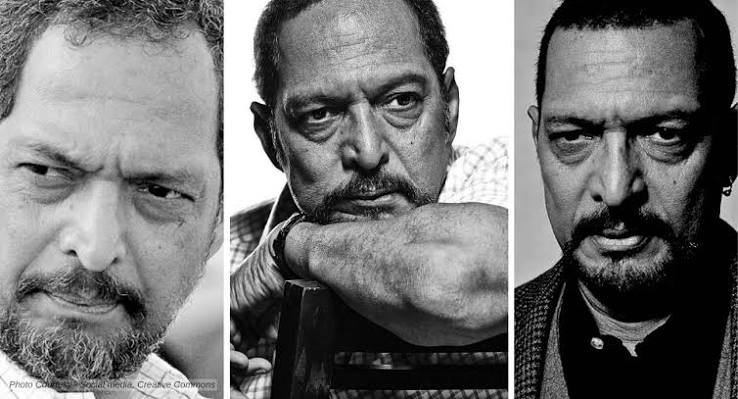
The actor, whose career spanned Hindi and Marathi cinema for nearly five decades, was known for Parinda, Krantiveer, Ab Tak Chhappan and Natsamrat. He was a three-time National Award winner and a Padma Shri recipient.
BY PC Bureau
Nana Patekar, the actor whose voice could cut through a room and whose silences often said more than dialogue, died on Thursday at Manipal Hospital in Goa. He was 75.
Patekar was found unconscious at his residence in Dona Paula early in the morning and rushed to the hospital, where doctors declared him dead at 5:20 a.m. Preliminary findings pointed to a severe cardiac arrest. Medical staff performed cardiopulmonary resuscitation for about 45 minutes after he was brought in, but could not revive him.
Dr Shekhar Salkar, chief of the oncology department at Manipal Hospital, told the news agency ANI that a medico-legal case had been registered and that a post-mortem would be conducted. At the time of writing, family members and authorities had not issued a detailed statement on the circumstances of his death.
Born Vishwanath Patekar on January 1, 1951, in Murud-Janjira, then part of Bombay State, he grew up in a household shaped by painting and theatre. His father, Dinkar Patekar, was a painter with a love for plays and took his son to watch performances. His mother was Sanjana.
That early exposure to the stage stayed with him. Patekar studied at the Sir J. J. Institute of Applied Arts in Mumbai and began his career in Marathi theatre before moving into cinema. His screen debut came in 1978 with Muzaffar Ali’s Gaman. Wider recognition followed with Mira Nair’s Salaam Bombay! and, decisively, with Vidhu Vinod Chopra’s Parinda (1989), in which his performance as the gangster Anna Seth won him the National Film Award for Best Supporting Actor and a Filmfare Award.
READ: Ladakh launches India’s first high-altitude snow leopard safari
What followed was a career that resisted easy classification. Patekar could play the coiled menace of Angaar, for which he won the Filmfare Award for Best Villain, or the wounded moral force of Krantiveer (1994), which earned him the National Film Award for Best Actor as well as another Filmfare Award. In Natsamrat, he brought a different kind of intensity to the role of an ageing stage actor confronting the cruelties of old age and abandonment.
He also stepped behind the camera. In Prahaar: The Final Attack (1991), which he directed and starred in, he drew on his understanding of military discipline to make a stark film about soldiers, duty and violence. Years later, as encounter specialist Sadhu Agashe in Ab Tak Chhappan, he gave popular cinema another of its indelible Patekar figures: terse, unsentimental and morally complicated.
His filmography ranged widely, from Tirangaa, Agni Sakshi and Apaharan to Raajneeti and Welcome. He also appeared in the Tamil film Kaala and lent his voice to Shere Khan in the Hindi version of The Jungle Book. Few Indian actors could match his unusual awards record: he won Filmfare honours for Best Actor, Best Supporting Actor and Best Villain. In 2013, he was awarded the Padma Shri.
Patekar’s life outside cinema was almost as varied. He held the honorary rank of lieutenant colonel in the Territorial Army and served with the Maratha Light Infantry, including during the Kargil conflict. After witnessing the devastation caused by drought and farmer distress in Maharashtra, he and fellow actor Makarand Anaspure founded the Naam Foundation to support affected farming families.
He married Neelkanti in 1978, and they had a son, Malhar. Patekar had also spoken publicly about the death of an earlier child and about losing his father to a heart attack when he was still young.
There was always something unsettled about Patekar, both as an actor and as a public figure. Directors and co-stars often described a man who worked on his own terms, who could walk away when he felt his time was being wasted and who could change the temperature of a set with a sentence. The intensity that could make him difficult was also the source of his power as an actor.
On screen, his face often appeared to be in a permanent argument with the world. His delivery could make even an ordinary line sound impatient, wounded or dangerous. He did not merely speak dialogue; he seemed to wrestle with it. A pause, a stare or a sudden change in volume could carry as much weight as a page of script.
In Hindi and Marathi cinema, Patekar occupied an unusual space between the mass actor and the serious artist. He could command a commercial film without surrendering the rough edges that made him distinctive, and he could bring theatrical intensity to characters that might otherwise have remained familiar types.
For nearly five decades, that voice, that face and that restless intensity were unmistakably his own.
He is survived by his wife and son. Funeral arrangements had not been announced at the time of writing.