



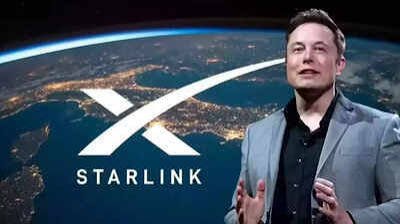
Musk’s attack came hours after Starlink said it was ready to launch in India once it secures the remaining government approvals. The company hopes to begin operations by 2027.
BY PC Bureau
October 8: SpaceX CEO Elon Musk has alleged that “certain oligarchs” are blocking Starlink from starting commercial operations in India to protect their hold over the telecom market. India has denied the charges.
Musk made the claim on X on Wednesday in response to a post highlighting gaps in rural mobile and broadband coverage. “Unfortunately, we are being blocked by certain oligarchs in order to maintain their monopolistic chokehold on the Indian people,” he wrote. “This is a crime against the people of India!” He named neither the individuals nor companies he was referring to and provided no evidence.
The Ministry of Communications has rejected the suggestion that India’s regulatory framework for satellite communications is discriminatory. In a statement, the ministry said a social-media post was being circulated questioning the fairness of the framework and suggesting that it was being applied selectively. The government said it had put in place a “fair and non-discriminatory authorisation framework” for all telecommunications services, including satellite communications.
#CNBCTV18Alert | Govt says, India’s #satellite communication framework is fair and transparent. All three licensed entities are currently at the same regulatory stage undergoing necessary security assessments
A post is being circulated in social media regarding the fairness of India’s regulatory framework for satellite communication services and suggesting that it is being applied in a discriminatory manner. Government has put in place a fair and non-discriminatory authorisation framework for all telecommunication services, including satellite communication services
#Starlink @elonmusk
— CNBC-TV18 (@CNBCTV18Live) October 8, 2026
Musk’s remarks came hours after Lauren Dreyer, SpaceX vice-president for Starlink business operations, told the India Mobile Congress that the company was ready to launch once it secured the remaining government approvals. She said Starlink had spent about five years working with regulators, operators and state governments, built 20 gateway sites and hundreds of antennas, and designed its India network to keep user data within the country. She said the company hoped to launch by 2027.
Starlink in India would enable high-speed, affordable Internet connectivity for those who can’t afford current prices or who don’t have a connection at all!
— Elon Musk (@elonmusk) October 7, 2026
Where the approvals stand
Starlink Satellite Communications Private Limited received a Unified Licence with GMPCS authorisation from the Department of Telecommunications in June 2025. It has also secured IN-SPACe approval for its existing constellation and resubmitted an application in August for its next-generation Gen 2 network.
The approvals do not yet permit commercial service. Starlink still needs security clearance and spectrum assignment. The Ministry of Home Affairs has not given final security clearance, according to officials and industry reports.
Security requirements have tightened, including rules requiring operators to disable terminals bought outside India, prevent India-sold terminals from operating abroad and comply with lawful-interception and data-localisation requirements. Starlink’s fully foreign-owned structure has also been raised as an issue.
Starlink is not alone. Bharti-backed Eutelsat OneWeb and Jio Satellite Communications also hold GMPCS licences but are awaiting security clearance. Amazon’s Project Leo has yet to obtain a GMPCS licence. None has begun commercial satellite broadband in India.
The spectrum dispute
A separate battle over satellite spectrum has complicated the rollout. Unlike terrestrial mobile spectrum, satellite spectrum is generally assigned administratively for a fee in most countries.
Indian telecom operators, led by Reliance Jio, have opposed that approach and argued that spectrum should be auctioned, citing the Supreme Court’s 2012 2G spectrum judgment. They have also circulated legal opinions supporting their position.
The government has moved towards administrative allocation. Last month, the Digital Communications Commission approved a spectrum usage charge of 5% of adjusted gross revenue for satellite services, with a one-percentage-point reduction for operators serving notified hard-to-connect areas, subject to Cabinet approval. Operators would also pay the standard 8% licence fee.
READ: Nana Patekar’s last wish: The Malayalam film he never got to make
The rural gap
The post that Musk responded to cited gaps in India’s rural connectivity, including 11,256 villages without 4G coverage as of May 2026 and the fact that only 4.26% of internet subscriptions were wired connections in March.
BharatNet has laid hundreds of thousands of kilometres of fibre and made more than 2 lakh gram panchayats service-ready, but operational connectivity remains considerably lower. The government has acknowledged delays caused by tendering, right-of-way and forest clearances and difficult terrain.
Mobile coverage has expanded substantially, but border, hill, island and other remote areas remain difficult and expensive to serve through towers and fibre alone.
That is the gap satellite operators hope to fill — connecting households, schools, healthcare facilities and other users beyond the reach of conventional networks.
For now, however, Starlink remains on the ground in India. Whether Musk’s company, OneWeb, Jio Satellite or Amazon reaches those underserved areas first will depend not only on technology and demand, but on the regulatory clearances still pending.








Comments 1