Kuki organisations deny knowledge of the missing individuals, welcome the release of 14 Kuki-Zo hostages, and urge the Manipur Government to determine the whereabouts of the missing Nagas.
BY PC Bureau
June 10, 2026: Manipur have intensified dramatically after the Naga Village Guard (NVG) issued what it described as a “final and non-negotiable ultimatum” demanding immediate accountability for six Naga boys who remain missing amid escalating inter-community hostilities.
The ultimatum comes just a day after the release of 14 Kuki-Zo civilians who had been held captive for nearly four weeks, a development that had briefly raised hopes of de-escalation in the troubled region.
In an official press release (Ref. No. NVG/PRESS/003/2026) issued at noon on June 10, the Naga Village Guard stated that the unconditional release of the 14 Kuki hostages demonstrated its commitment to peace and restraint and placed the responsibility for the next steps squarely on Kuki organisations and the state government.
“This is a final and non-negotiable ultimatum from the Naga Village Guard. Demonstrating our commitment to peace and restraint, 14 Kuki hostages are being released unconditionally. Now, the responsibility falls squarely on you,” the statement said.
NVG Demands Answers on Missing Naga Youths
The NVG alleged that the six missing Naga boys were taken captive by Kuki Village Volunteers and associated elements linked to Leilon Vaiphei Village. The organisation demanded immediate clarification regarding their fate and issued a 24-hour deadline for action.
According to the statement, if the six youths are alive, they must be released immediately and returned safely to their families.
If they have been killed, the NVG demanded that their bodies be handed over with dignity and that those responsible be identified and surrendered for accountability.
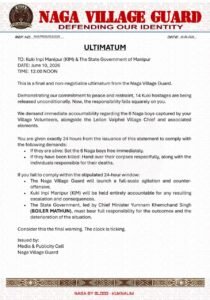
The organisation warned that failure to comply within the stipulated period would trigger what it termed a “full-scale agitation and counter-offensive.”
“Kuki Inpi Manipur will be held entirely accountable for any resulting escalation and consequences,” the statement warned.
The NVG also placed responsibility on the Manipur Government, led by Chief Minister Yumnam Khemchand Singh, stating that the administration would bear responsibility for any deterioration in the law-and-order situation if the matter remains unresolved.
Concluding its statement with a stark warning, the organisation declared:
“Consider this the final warning. The clock is ticking.”
Kuki CSO Working Committee Welcomes Hostage Release
Responding to the developments, the Working Committee of Kuki Civil Society Organisations (WCKCSOs–Ukhrul) issued a statement on June 9 welcoming the release of the 14 Kuki-Zo civilians after 27 days in captivity.
The committee described the release as a humanitarian gesture that reflected “the language of humanity, restraint and moral responsibility” and expressed relief that the hostages had safely returned to their families.
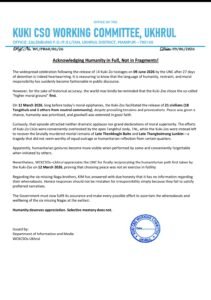
At the same time, the organisation sought to highlight what it described as earlier humanitarian efforts by Kuki-Zo organisations. It recalled that on March 12, 2026, Kuki-Zo civil society groups facilitated the release of 21 civilians, including 18 Tangkhul Nagas and three individuals from other neutral communities.
According to the committee, that gesture received comparatively little public recognition despite helping to reduce tensions at the time.
Kuki Bodies Deny Knowledge of Missing Nagas
Addressing the central issue of the six missing Naga youths, the Kuki CSO Working Committee said that Kuki Inpi Manipur (KIM) had already stated that it possesses no information regarding their whereabouts.
“Regarding the six missing Naga brothers, KIM has answered with due honesty that it has no information regarding their whereabouts. Honest responses should not be mistaken for irresponsibility simply because they fail to satisfy preferred narratives,” the statement said.
The committee urged the Manipur Government to honour its commitment to investigate the disappearances and make every effort to determine the whereabouts and wellbeing of the missing individuals.
It concluded with an appeal against selective recognition of humanitarian actions.
“Humanity deserves appreciation. Selective memory does not.”
KIM Condemns Killing of Kuki Civilian
In a separate statement issued on June 9 , Kuki Inpi Manipur strongly condemned the killing of a Kuki civilian identified as Haogin Lhouvum, son of Khupkam and a resident of Lasan Village in Tamenglong district.
According to KIM, the victim was shot dead at approximately 1 p.m. on June 9.
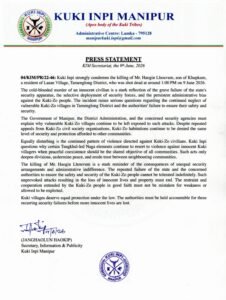
The apex Kuki tribal body described the incident as a “cold-blooded murder of an innocent civilian” and accused the state administration of failing to provide adequate security to Kuki-Zo settlements.
KIM argued that Kuki villages remain vulnerable to repeated attacks and questioned why they are not afforded the same level of protection available to other communities in the state.
The organisation demanded an explanation from the state government, district authorities and security agencies regarding the circumstances surrounding the killing and called for immediate measures to prevent further attacks.
It also warned that the continued restraint shown by the Kuki-Zo community should not be interpreted as weakness.
A Fragile Situation
The latest exchange of statements highlights the deep mistrust that continues to define relations between sections of the Naga and Kuki-Zo communities amid ongoing ethnic tensions in Manipur.
While the release of the 14 hostages was widely welcomed as a positive development, the unresolved case of the six missing Naga youths, coupled with fresh allegations of killings and security failures, has kept tensions dangerously high.
With the NVG’s 24-hour deadline now in effect, pressure is mounting on the Manipur Government to intervene decisively, establish the facts surrounding the disappearances, and prevent the situation from spiralling into another cycle of confrontation.
As both sides issue competing narratives and demands, community leaders and civil society organisations continue to call for accountability, transparency, and urgent action to ensure that further violence is avoided.