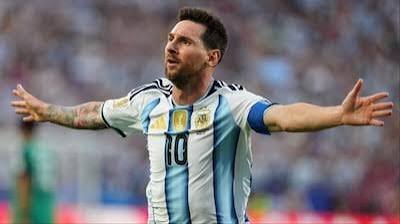
Argentina secured a 2-0 win over Austria to book their place in the Round of 32, but the spotlight quickly shifted to Messi’s historic opener and growing questions over the use of VAR.
BY PC Bureau
June 23, 2026: Lionel Messi’s historic night at the FIFA World Cup has been overshadowed by a growing refereeing controversy after his record-breaking goal against Austria triggered widespread debate over the role of VAR.
The Argentine captain scored twice in Argentina’s 2-0 victory over Austria at Dallas Stadium in Arlington, Texas, on Monday, helping the reigning world champions secure qualification for the Round of 32 with a game to spare. The result moved Argentina to six points in Group J and guaranteed their place in the knockout stages.
However, while the result itself was largely straightforward, the circumstances surrounding Messi’s opening goal have become the dominant talking point.
Goal That Made History
Messi’s first strike of the evening carried enormous significance. The goal moved him past German legend Miroslav Klose to become the outright leading scorer in FIFA World Cup history, adding another remarkable achievement to an already unparalleled career.
The record-breaking moment was celebrated by Argentina’s players and supporters, but it quickly came under scrutiny from pundits and former players who believed the move should have been stopped before the ball reached Messi.
BREAKING: Lionel Messi sets World Cup scoring record with 17th goal pic.twitter.com/TR5VOLh4vP
— Trader Caesar (@peter7831380956) June 22, 2026
Schmeichel Leads Criticism
Among the strongest critics was former Manchester United and Denmark goalkeeper Peter Schmeichel.
Speaking on Fox Sports after the match, Schmeichel argued that the attacking move should never have been allowed to continue because of an earlier challenge involving Alexis Mac Allister and Austrian midfielder Xaver Schlager.
“I don’t think that goal should have stood,” Schmeichel said.
“Think about how they get the penalty — this is a kick from behind through Xaver Schlager. This is a free kick. Mac Allister has kicked the player down. That should have been a free-kick. VAR should have taken that back. That is a clear and obvious mistake by the referee. And for that I feel a little bit frustrated.”
His comments have since fuelled debate across social media, with many fans questioning whether officials correctly applied VAR protocols in the build-up to the goal.
READ: Oracle Bets Big on AI, Slashes 21,000 Jobs Worldwide
VAR Protocol Under Scrutiny
The controversy centres on whether the challenge on Schlager constituted a foul during the attacking phase of play.
Under FIFA’s VAR guidelines, video review can intervene if there is a “clear and obvious error” in situations involving goals, penalties, direct red cards or mistaken identity. For goals, VAR is permitted to review the entire attacking phase leading up to the strike to determine whether an infringement occurred.
Critics argue that if Mac Allister committed a foul in the build-up, the goal should have been overturned following a VAR review.
Supporters of the decision, however, contend that officials either did not consider the contact sufficient to warrant a foul or judged it to be outside the reviewable phase that directly led to the goal.
The incident has reignited discussion over the consistency of VAR decisions and the threshold required for intervention in major tournament matches.
Second Officiating Debate Involving Messi
The dispute follows another contentious incident involving Messi earlier in the tournament.
During Argentina’s opening group-stage match against Algeria, the 38-year-old came under scrutiny after a studs-up challenge on defender Aissa Mandi. Despite appeals from Algerian players, neither the referee nor VAR deemed the challenge worthy of a red card review.
The Algerian Football Federation later lodged a formal complaint with FIFA, claiming several incidents had been overlooked, including two alleged elbow challenges.
Those complaints added to ongoing concerns about officiating standards at the tournament and have intensified scrutiny following the latest controversy.
Klose’s Record Finally Falls
Messi’s goal also marked the end of one of the most enduring records in World Cup history.
Miroslav Klose established himself as the tournament’s leading scorer during Germany’s triumphant 2014 World Cup campaign. The striker finished his international career with 16 World Cup goals, surpassing Brazil’s Ronaldo, who had held the previous record with 15.
Klose reached his tally across four World Cups between 2002 and 2014, combining remarkable consistency with Germany’s deep runs in multiple tournaments.
For more than a decade, the record appeared untouchable. Yet Messi’s longevity, combined with Argentina’s repeated appearances on football’s biggest stage, eventually enabled him to surpass the German forward and claim the top spot for himself.
Argentina March On
Lost amid the controversy was another commanding performance from Argentina.
Messi’s brace secured a comfortable 2-0 victory over Austria and ensured Argentina finished the day at the top of Group J. The South Americans now advance to the knockout rounds with momentum firmly on their side.
Whether the debate over Messi’s historic goal fades quickly or develops into another major talking point for FIFA remains to be seen. For now, Argentina have secured their place in the next round, while football continues to argue over one of the tournament’s most significant moments.