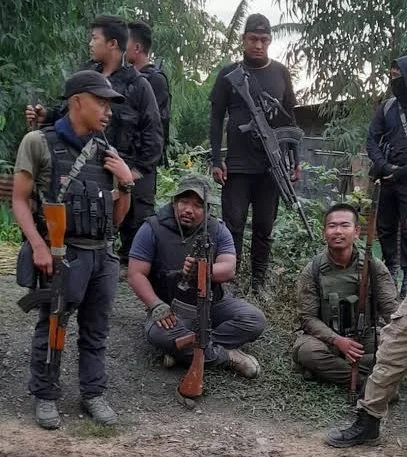
Arambai Tenggol demanded measures such as implementation of the NRC to restore peace and revive coexistence, warning that public patience has reached its limit while asserting that “the time for action is now.”
By PC Bureau
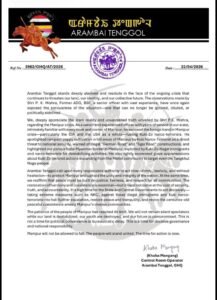
April 23, 2026 — The controevrsial Meitie outfit, Arambai Tenggol, has demanded decisive action to safeguard Manipur’s land, identity, and collective future amid the ongoing ethnic crisis. In a statement the outfit has expressed deep concern over the prolonged unrest while calling for urgent and firm intervention by authorities.
The organisation expressed alarm over the prevailing situation and praised observations made by P.K. Mishra, former Additional Director General (ADG) of the Border Security Force (BSF). Describing him as a senior officer with “vast experience” and intimate knowledge of “every nook and corner of Manipur,” the statement claims that Mishra has brought out the “stark reality and unvarnished truth” surrounding the crisis.
According to the release, Mishra alleged the presence of a foreign hand in the conflict, specifically accusing the CIA and the United States of fuelling what it termed “Kuki-Zo narco-terrorists.” It further highlights his claims regarding large-scale poppy cultivation in the hill areas by Kuki narco-terrorists, describing it as a direct threat to national security. The statement also refers to warnings about alleged illegal construction of routes dubbed the “German Road” and “Tiger Road,” and the exploitation of the porous India–Myanmar border by Kuki-Zo illegal immigrants and narco-terrorists for destabilising activities. It adds that concerns have been raised about the expansion of violence—initially targeting the Meitei community—to now include the Tangkhul Naga population.
READ: Kuki Liberation Army-L Demands AFSPA Re-Imposition in Imphal
Building on these assertions, Arambai Tenggol urged all responsible authorities, both at the state and central levels, to act “firmly, lawfully, and without hesitation.” It called for measures such as the implementation of the National Register of Citizens (NRC) to halt escalation, restore peace, and revive what it described as “centuries-old peaceful coexistence” among Manipur’s diverse communities. Stressing that peace must rest on “justice, fairness, and respect,” the group warned that public patience has reached its limit, concluding with a defiant message: “Manipur will not be allowed to fall. The people will stand united. The time for action is now.”
On the surface, the statement presents a principled appeal for truth, accountability, and national integrity. However, this rhetoric stands in sharp contrast to serious criminal allegations facing the organisation’s own leadership—issues that the release does not address.
Arambai Tenggol’s Commander-in-Chief, Korounganba Khuman, also known as Tyson Ngangbam, is named in multiple high-profile cases investigated by the National Investigation Agency (NIA). In February 2024, the NIA registered two major cases linked to the violent incidents of November 1, 2023, in Imphal. According to the agency, Khuman allegedly led a large group of Arambai Tenggol cadres who assembled at the Palace Compound in Imphal East.
The group is accused of engaging in armed confrontation with police, firing upon security personnel, attacking the 1st Manipur Rifles Battalion, ransacking government property, and looting firearms and ammunition. Charges reportedly include armed rioting, obstruction of public servants, robbery, criminal conspiracy, terrorist acts under the Unlawful Activities (Prevention) Act (UAPA), and unauthorised use of police and defence uniforms.
In November 2024, the Supreme Court ordered the transfer of these cases from Imphal to a special NIA court in Guwahati, citing security concerns. The organisation and its members have also been named in several other FIRs related to violence and arms-related incidents during the ethnic conflict that erupted in May 2023.
Critics argue that such selective narratives are emblematic of Manipur’s deeply polarised environment, where competing sides accuse one another of violence and foreign-backed interference while deflecting scrutiny from their own actions. In this context, the NIA investigations into Khuman and Arambai Tenggol represent a significant institutional effort to examine specific allegations, including direct attacks on security forces, amid the broader conflict.
As fresh violence, protests, and mutual recriminations continue to grip the state, the latest statement from Arambai Tenggol underscores a persistent paradox: calls for decisive governance and unvarnished truth carry far greater moral weight when applied uniformly—including within one’s own ranks. With investigations ongoing, the people of Manipur, after nearly three years of turmoil, continue to seek clarity, accountability, and a path toward lasting peace.