In any comparable hostage crisis, the expectation is clear: the state asserts monopoly over coercive force, avoids legitimising non-state armed actors, and works to recover captives through intelligence-led operations and coordinated security action.
BY NAVIN UPADHYAY
May 17, 2026: It has now been several days since a disturbing hostage-taking episode unfolded in the hill districts of Manipur, following the killing of three tribal church leaders in an ambush attributed to suspected armed elements linked to Naga militant groups. What began as a targeted act of violence has rapidly escalated into a wider cycle of abductions and counter-abductions, further inflaming already fragile relations between the Kuki-Zo and Naga communities.
In no other part of India—or indeed the world—would a state machinery have dealt with such a grim situation in such a supine manner, approaching the hostage-takers virtually on its knees and supplicating for the release of captives. Rather than asserting authority through decisive security operations, the government and authorities appear to have engaged in negotiations that lend legitimacy to the perpetrators or their civilian proxies.
Time has come when the state should allow commandos and guns to do the talking.
The crisis has once again exposed the region’s deep ethnic fissures while raising serious questions about the effectiveness, neutrality, and decisiveness of the state’s law-and-order response in a situation that has now moved far beyond a routine security incident.
READ: NSCN Faction Calls India ‘Foreign Occupier’, Issues Grim Warning
The Trigger: Ambush and Retaliatory Killings
On May 13, 2026, suspected armed militants ambushed a convoy carrying leaders of the Thadou Baptist Association in Kangpokpi district along Tiger Road. Among those killed were:
- Reverend Vumthang Sitlhou (President, Thadou Baptist Association of India)
- Reverend Kaigoulun Lhouvum (Finance Secretary)
- Pastor Paogoulen Sitlhou
Four others sustained injuries in the attack.
Within hours, tensions spread further when a Naga civilian, Wilson Thanga, was killed in Noney district, an incident that intensified retaliatory sentiments on both sides.
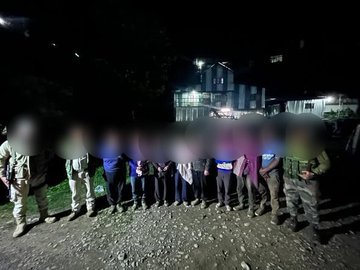
What followed was a rapid and alarming escalation: reports emerged of coordinated abductions of civilians from both Kuki-Zo and Naga communities across Kangpokpi and Senapati districts. Estimates vary, but around 44-45 individuals are believed to have been taken hostage in the unfolding standoff.
A Rapid Spiral Into Mutual Hostage-Taking
Unlike conventional insurgency incidents, the crisis quickly evolved into a decentralized and community-driven hostage standoff. Civil society groups and village volunteers from both communities have reportedly played direct roles in holding, negotiating, or mediating releases.
The negotiations had resulted in the release of 31 captives, including women and minors. However, a core group of around Kuki-Zo 14 individuals is still believed to remain in custody, with competing claims about who is holding whom and under what conditions. The Naga CSOs have not denied this claim,
Hundreds of Kuki-Zo church leaders broke their silence and joined the protest calling for justice for the 3 Kuki Baptist pastors who were killed in Manipur on May 13, 2026.@BaptistWorld @Evan_Focus @WEA_UN @realDonaldTrump @EmmanuelMacron @GiorgiaMeloni @cnalive @ChristianPost https://t.co/LcTbKGsM9V pic.twitter.com/mWv1en7CGb
— Sumkawn (@Sumkawn) May 16, 2026
But what has added twist in the drama is the case of six missing naga men.. While the United naga council says they were taken hostage by the Kuki-Zo groups, the Kukis completely deny this. The Kuki national organisatyion anf United pople front, two kuki armed groups engaged in suspension of operation agreement with the centre, claimed that only 12 naga men were held hostagges. All of them have been released.
So whuile the search for the missing naga men continues, the situation has effectively turned into a fragile and volatile exchange mechanism—one in which civilian lives are being used as bargaining leverage.
Governance Under Strain: Questions Over State Response
The response of the state apparatus has drawn sharp criticism from observers and civil society groups, who argue that the administration has appeared reactive rather than authoritative.
In any comparable hostage crisis, the expectation is clear: the state asserts monopoly over coercive force, avoids legitimising non-state armed actors, and works to recover captives through intelligence-led operations and coordinated security action.
However, in this case, reports suggest that negotiations have increasingly involved not only state authorities but also community-based organisations acting as intermediaries for armed or semi-armed actors. Critics argue that this approach risks normalising the role of non-state groups in matters of law enforcement, effectively blurring the line between mediator and perpetrator.
Such a framework, they warn, can unintentionally grant legitimacy to armed actors and their civilian proxies, undermining the principle of rule of law and weakening institutional authority at a critical moment.
In the absence of independent verification, demands for proof—such as photographic evidence or verified lists of captives—have intensified. Meanwhile, families of those still missing remain in a state of uncertainty, with little clarity on timelines or conditions for release.
The Shadow of Past Violence
The current crisis is also shaped by the memory of earlier episodes of abduction and killings in the region, where captives in similar situations were reportedly executed. These precedents have deepened mistrust and increased fears that the present standoff could again turn fatal if not resolved swiftly.
This cycle of retaliation, abduction, and counter-abduction has become one of the most dangerous dynamics in the ongoing ethnic conflict in Manipur’s hill districts, where state authority has often struggled to fully reassert control.
A State Under Pressure: Demands for Decisive Action
The inability to quickly stabilise the situation has intensified calls for a more forceful security response. Security experts argue that prolonged reliance on informal negotiations risks further entrenching non-state actors as parallel authorities.
Manipur’s political leadership, under Chief Minister Yumnam Khemchand Singh Yumnam Khemchand Singh, faces growing pressure to demonstrate control over the evolving crisis, particularly by ensuring:
- Immediate and verifiable release of all remaining hostages
- Deployment of coordinated central and state security operations
- Disruption of armed networks and civilian facilitation chains
- Restoration of public order in affected districts
At the same time, security forces are expected to navigate a highly sensitive environment where heavy-handed operations risk further inflaming ethnic tensions.
The Larger Context: Fragile Peace in the Hills
This crisis cannot be viewed in isolation. Manipur’s hill districts have long been shaped by overlapping ethnic grievances, competing territorial claims, and unresolved political demands. The ongoing tensions between Kuki-Zo and Meitei communities, combined with intra-tribal friction involving Naga groups, have created a multi-layered conflict landscape.
Civil society organisations on both sides have intermittently attempted to contain escalation through negotiated releases, but such mechanisms—while temporarily effective—do not address the structural conditions that allow cycles of violence to persist.
The current hostage crisis underscores a fundamental challenge: the erosion of clear state authority in moments of acute ethnic conflict. While community-led interventions may offer short-term relief, they cannot substitute for enforceable law and institutional legitimacy.
Manipur now stands at a critical juncture. Without decisive, coordinated, and transparent action, the risk is not merely a continuation of the current standoff—but the normalization of hostage-taking as a political instrument.
The people of the state are caught in a cycle where violence triggers retaliation, retaliation produces bargaining, and bargaining replaces accountability. Breaking this cycle will require more than negotiation. It will require the state to decisively reassert that civilian lives are not negotiable currency in ethnic disputes, and that the rule of law must prevail over armed coercion in all its forms.