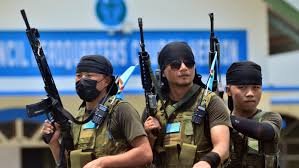
NSCN It warned the Naga people against “diversionary tactics” and urged unity in pursuing the long-standing demand for sovereignty and territorial integrity.
PC Bureau
May 16, 2026 — In one of its strongest statements in recent years, the National Socialist Council of Nagalim (NSCN-Nikki) has labelled India a “foreign occupier” and accused New Delhi of orchestrating a proxy war using the Kuki community to undermine Naga sovereignty.
The detailed press statement, issued by the Ministry of Information & Publicity (MIP) of the self-proclaimed Government of the People’s Republic of Nagaland (GPRN/NSCN), was released from its headquarters in Oking and dated 16/05/26 (Ref. No. SN-26/CW1-MIP).
At the outset, the outfit expressed deep anguish over recent violence, stating that it was “alarming and disheartening to see or hear about the loss of innocent lives in southern Nagaland (UNC),” and called for collective efforts to defend Naga people and land from what it described as inimical forces.
The statement directly targets what it calls “foreign occupiers” — a reference to the Government of India — and alleges that they are using proxy actors to weaken Naga political aspirations. It further claims that the political issue is being deliberately reduced to a law-and-order and communal problem to undermine sovereign rights.
READ: Kuki-Zo Protests Sweep Manipur Hills Over Pastors’ Killing, Hostage Crisis
“Despite the foreign occupiers believing that it is their long-term hidden agenda, it is an open secret that the Kukis have traditionally been used by foreign occupiers to water down/undermine the sovereign Naga rights. The foreign occupiers, having lost their stranglehold over the Nagas on all moral/political grounds, have now resorted to proxy war by trying to relegate the political issue to a communal, law and order problem so as to undermine/downplay our sovereign rights,” it said.
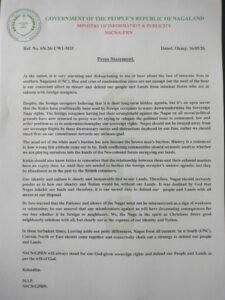
The statement draws a sharp historical parallel between colonial rule and the current situation, using strongly worded language:
“The mindset of the white man’s burden has now become the brown man’s burden; history is a testament to how wrong this attitude turned out to be. Both conflicting communities should seriously analyse whether we are playing ourselves into the hands of neo-colonial forces occupying our lands.”
It further cautioned the Kuki community about their alleged alliance:
“Kukis should also know better and remember that the relationship between them and their colonial masters has an expiry date, i.e., until they are needed to further the foreign occupier’s sinister agenda; lest they be abandoned as in the past by the British colonisers.”
NSCN-IM warned the Naga people not to be distracted by what it described as diversionary tactics and urged them to remain focused on the core demand for sovereignty.
The statement also drew a historical parallel between colonial rule and the present situation, arguing that neo-colonial forces continue to influence events in the region. It cautioned both communities and external actors against misreading the situation or underestimating Naga resolve.
A major portion of the statement focused on land and identity, asserting that Naga culture and identity are inseparable from their ancestral territories and must be defended at all costs. It also warned that continued provocation could have serious consequences, while reiterating that silence should not be mistaken for weakness.
Despite its hardline tone, the group said it seeks peaceful coexistence, stating that it desires “good neighbourly relations with all, but clearly not at the expense of our identity and nation.”
In a call for unity, the NSCN-IM urged Nagas across regions to set aside differences and collectively defend their land and political future.
The statement concluded with a reaffirmation of its commitment to Naga sovereignty and self-determination, ending with the traditional salutation “Kuknalim.”
The NSCN-IM has been engaged in peace talks with the Government of India since the signing of the Framework Agreement in 2015. However, differences over the interpretation of “shared sovereignty,” the demand for a separate Naga flag and constitution, and the integration of all Naga-inhabited areas have prevented a final settlement.
Tensions between Naga and Kuki communities have periodically flared in Manipur and southern Nagaland, with both sides accusing each other of encroachment and violence. The current statement appears to be linked to recent clashes reported in southern Nagaland under the United Naga Council (UNC) jurisdiction.
Security analysts say this is among the most aggressive public statements from NSCN-IM in recent years, marked by heightened rhetoric and strong political messaging. The repeated reference to India as a “foreign occupier” signals a sharper tone in its public communication.
The NSCN-IM remains one of the most influential Naga insurgent groups, with significant presence across Nagaland, Manipur, Assam, and Arunachal Pradesh. Its positioning will remain critical to the future of ongoing peace negotiations.
The statement is expected to add further complexity to the already fragile peace process in the Northeast.