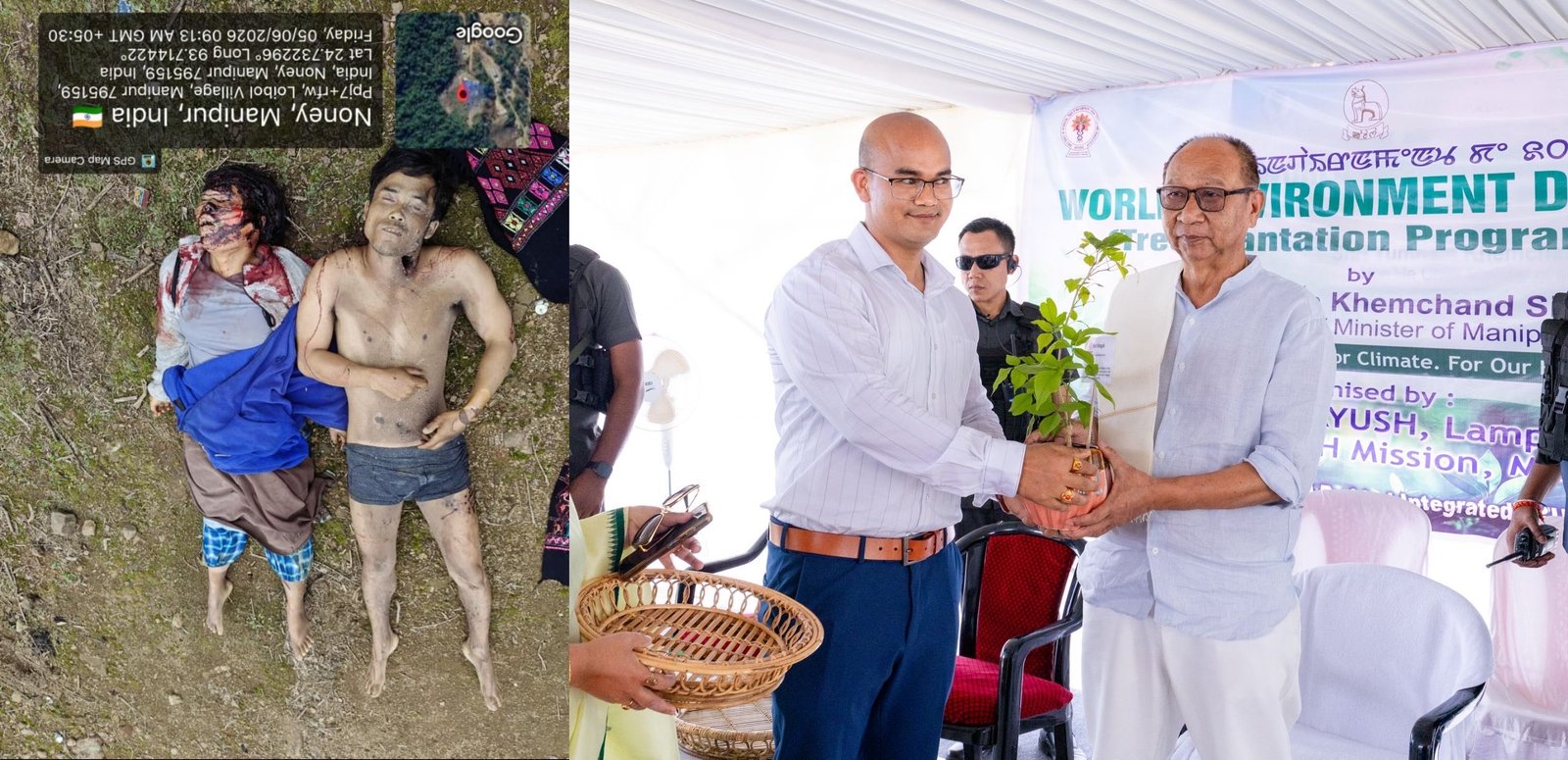
The Manipur Chief Minister participated in a sapling plantation programme in Imphal while the state continues to await an official update on the reported killing of three villagers.
By PC Bureau
June 5, 2026: More than ten hours after a brutal attack on a Kuki village in Kangpokpi district left three civilians dead and several homes destroyed, Manipur Chief Minister Yumnam Khemchand Singh had yet to publicly condemn the incident or express condolences to the families of the victims.
According to local reports and statements issued by Kuki organisations, suspected NSCN (I-M) and ZUF (Kamsung) militants attacked Loibol Khunou village in the early hours of Thursday, killing three civilians and setting multiple houses on fire. The victims were reportedly found with bullet wounds, while large sections of the village suffered extensive damage.
The village lies barely 45 kilometres from Imphal. Yet, as of the time of writing, there has been no public visit by the Chief Minister to the affected area, nor any statement directly addressing the killings.
The silence has drawn criticism, particularly because the Chief Minister remained active on social media throughout the day. Among his posts was one highlighting Union Home Minister Amit Shah’s visit to Border Security Force personnel at the Lankamura Border Outpost on the India-Bangladesh border in Tripura.
Manipur: 3 Civilians Killed, Houses Torched in Kangpokpi Attack by a combined force of suspected insurgent groups NSCN-IM & ZUF (Kamson )militants, targeting the Kuki village. pic.twitter.com/tbtXg2AgW9
— Mapping Conflicts NorthEast (@MappingNEast) June 5, 2026
READ: The SIR Exercise in Manipur: A Risky Path to Deeper Division and Disenfranchisement
In another post marking World Environment Day, the Chief Minister wrote:
“On World Environment Day 2026, I planted saplings at Ayush Hospital, Lamphel, reaffirming our commitment to protecting nature and strengthening our fight against climate change. Trees, wetlands, and healthy ecosystems are vital for a sustainable future.”
While environmental initiatives are undoubtedly important, critics argue that the absence of any public acknowledgement of the killings has sent a troubling message to the affected community.
For many Kuki-Zo groups, this perceived indifference is not an isolated incident. They point to what they view as a pattern of selective responses by the state government to acts of violence affecting different communities.
Questions have previously been raised over the state’s handling of high-profile cases, including investigations into missing persons and abductions. Kuki organisations have repeatedly alleged that attacks on Kuki-Zo civilians have not received the same urgency or attention as incidents involving other communities.
Since the outbreak of ethnic violence in May 2023, hundreds of homes have been destroyed and numerous civilians killed across conflict-affected areas. Yet, community leaders often complain that few perpetrators have been brought to justice, contributing to a growing sense of insecurity and alienation.
Whether fair or not, such perceptions matter in a conflict-ridden state. Trust in institutions is built not only through policy decisions but also through symbolic acts of empathy and leadership during moments of tragedy.
Meanwhile, Manipur Deputy Chief Minister Nemcha Kipgen publicly condemned the attack.
“I am deeply saddened by what has happened at Loibol Khunou today. The killing of three innocent persons and the burning of homes by unknown armed miscreants is a tragic and unacceptable act,” she wrote on X.
Kipgen expressed condolences to the bereaved families and assured that the government was taking the incident seriously. She stated that necessary steps were being taken and appealed for calm, urging people not to be provoked by those seeking to create fear and division.
Her statement stood in contrast to the silence that critics say has characterised the response from the state’s highest office.
Several tribal leaders and elected representatives, including MLA Kimneo Haokip and Haiokholet Kipgen, have also condemned the attack and demanded justice for the victims.
At a time when Manipur continues to struggle with ethnic tensions, displacement, and recurring violence, the state’s response to such incidents carries significance far beyond immediate law-and-order concerns. For affected communities, acknowledgment, empathy, and visible leadership are often seen as the first steps toward restoring confidence in government institutions.
The tragedy at Loibol Khunou has once again raised uncomfortable questions about whether all citizens of Manipur receive equal attention when violence strikes—and whether silence, in moments like these, can be as consequential as words.