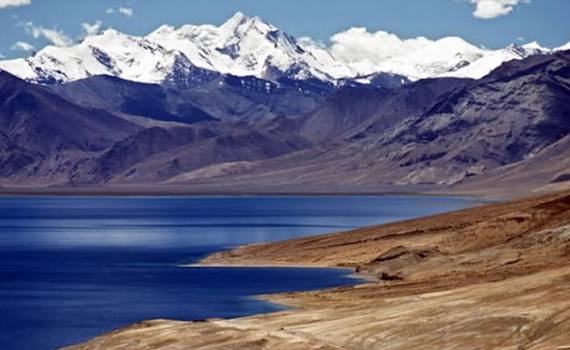
The initiative aims to restore one of Ladakh’s most iconic high-altitude lakes, which has lost nearly 70 per cent of its area over the past decade.
Located at an altitude of around 15,000 feet, Tso Kar originally covered nearly 11,000 acres. Its area has now fallen to about 3,200 acres.
The shrinking lake has also affected its birdlife. Once a thriving habitat for migratory species, including the Black-Necked Crane, Tso Kar has witnessed a sharp decline in bird populations, with large dry patches now visible where water once stood.
The project will divert an average of 132 cusecs, or about 320 million litres a day, of unused glacier water from the Rupsho Kharnak stream.
The stream lies at an altitude of around 18,045 feet, approximately 11.5 km from Tso Kar, with a height difference of about 3,000 feet. The water currently flows unused into the Sindhu River.
The project will use three natural depressions along the stream’s route as temporary water-holding areas.
Water will first enter a 270-acre depression, followed by a 24-acre and then a 10-acre depression. Check dams fitted with RCC pipes at each outlet will regulate the flow and allow sediment to settle.
From the third depression, located just 400 metres from Tso Kar, the water will flow into the lake by gravity through simple earthen works.
No new concrete channels are being constructed.
Work began on September 2, 2026. By September 9, around 20 cusecs of water had reached the first depression, which had filled to about 20 per cent within four days.
The three new water bodies together have a storage capacity of nearly 1,230 million litres.
Water is expected to reach Tso Kar in the first week of October 2026, with the complete revival of the lake targeted within a year, by October 2027.
The new wetlands, which will be visible from the Leh-Manali Highway, are expected to create additional freshwater habitats for birds and could also become new tourist attractions.
The project is also expected to help restore grasslands used by Pashmina goat herders.
Many herders have reportedly been forced to travel 50–75 km from their homes in search of grazing land. Restoration of the lake and surrounding pastures could allow them to return and strengthen local livelihoods.
Saxena first visited Tso Kar on August 10, 2026. Local villagers and the nambardar told him that the lake had receded dramatically, affecting both birdlife and grazing land.
READ: Modi’s Classmate Turns to Him Over Mumbai Land Dispute
A survey report was submitted on August 30.
The original proposal called for an 11-km RCC channel, but Saxena directed officials to use simple earthen channels instead, with the aim of avoiding new concrete construction and limiting ecological disturbance.
Work was started immediately because winter freezing conditions were approaching.
The project involves no capital expenditure beyond the deployment of JCB machines. It follows the earlier diversion of 90 million litres of water per day from Stok Glacier for irrigation near Leh.
Saxena said the success of the Stok Glacier project had demonstrated that large-scale water management could be undertaken in Ladakh’s cold desert using relatively simple engineering.
“By redirecting the Rupsho Kharnak stream, we aim at bringing life back into Tso Kar Lake. The project stands as a vital blueprint for high-altitude ecological restoration,” he said.
The initiative has been described as the first attempt of its kind in India to revive a high-altitude lake under such extreme conditions, where summer temperatures can remain below 10°C and winter temperatures can fall to minus 20°C to minus 30°C.
Tso Kar Lake
Fact Sheet
- Altitude: 15,000 feet
- Original area: 11,000 acres
- Current area: 3200 acres
- Shrinkage of Lake: Upto 70%
- LG VK Saxena’s 1st visit: 10 August 2026
- 1st survey report submitted to LG: 30 August 2026
- Initiative conceived and decision taken to channelize untapped glacier meltwater of Rupsho Kharnak stream to Tso Kar Lake by LG Shri Saxena: 30 August 2026
- Altitude of Rupsho Kharnak glacier stream: 18,045 feet.
- Distance from Rupsho Kharnak stream to Tso Kar Lake: 11.5 km (approx)
- Height difference between Rupsho Kharnak stream and Tso Kar Lake: 3000 feet (approx)
- Work started to create earthen channel from Rupsho Kharnak stream to first depression: 2 September 2026.
- Quantity of glacier water available in Rupsho Kharnak stream: 132 cusecs ( 320 million litres per day) presently flowing unutililized into Sindhu River.13. Water channelized to the first depression/ pond at present: 20 cusecs.
- Water reached the first depression: 9 September 2026
- Area so far filled in 4 days in the first depression: 20%
- Total water holding capacity of 3 water bodies/ depressions: 1230 million litres
- Expected time of water reaching Tso Kar Lake: 1st week of October.
- Cost of project: No Capital cost involved. Currently only JCB machines are used.
- Expected time to fully revive the Tso Kar Lake: 1 year (October 2027)
- First of its kind initiative and the only attempt of this nature to revive a dying lake at this high altitude and in such harsh conditions.