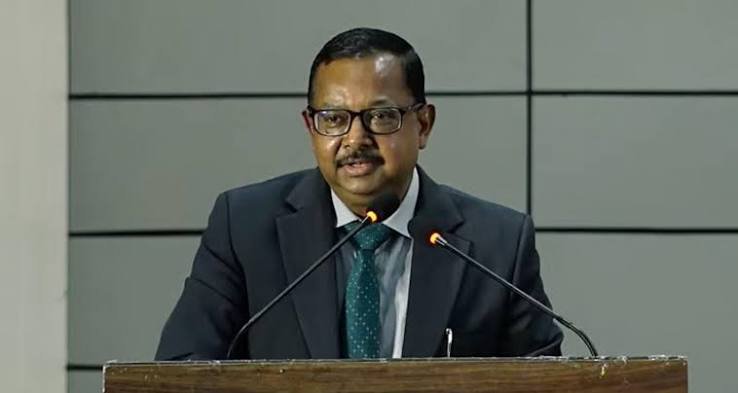
Supreme Court judge Justice Ujjal Bhuyan has questioned the practice of retired judges accepting political appointments, saying it undermines the constitutional principle of separation of powers and could erode public trust in the judiciary.
BY PC Bureau
New Delhi/ July 27, 2026: Supreme Court judge Justice Ujjal Bhuyan has voiced strong reservations over retired judges accepting political positions, warning that such appointments can blur the constitutional separation between the judiciary and the executive and diminish public confidence in judicial independence.
Addressing a function in Bhopal, Justice Bhuyan said the constitutional doctrine of separation of powers leaves no room for the idea that a retired Chief Justice of India should act as a link between the judiciary and the government by entering Parliament.
“Our Constitution envisages three independent pillars—the legislature, the executive and the judiciary. Each has a distinct role and must function within its own constitutional sphere,” he said.
“It is fundamentally wrong. Completely wrong.”
Justice Ujjal Bhuyan delivered a sharp constitutional critique of the idea that a former Chief Justice of India should join the Rajya Sabha to “bridge the gap” between the judiciary and the executive. pic.twitter.com/T8gklEQZuV— Sujeet Samrat (BSP) (@SujeetSamratBSP) July 26, 2026
Explaining the principle, Justice Bhuyan used the analogy of a three-legged stool.
“If we have two legs at one place, the stool will fall apart. This is the fundamental principle. Therefore, when a former Chief Justice of India says he is going to the Rajya Sabha to bridge the gap between the judiciary and the executive, it is fundamentally wrong,” he remarked.
READ: 19-Year-Old NEET Aspirant Dies by Suicide in Maharashtra
Justice Bhuyan maintained that there is no constitutional “gap” between the judiciary and the executive that requires bridging. Instead, the Constitution establishes a system in which each institution functions independently while keeping the others in check through a carefully balanced framework.
He said this is why post-retirement political appointments of judges continue to raise constitutional concerns. Such appointments, he argued, risk creating a perception that the judiciary is not sufficiently insulated from the executive, potentially affecting public trust in the impartiality of judicial institutions.
According to Justice Bhuyan, judicial independence is measured not only by the fairness of judicial decisions but also by the public’s confidence that judges remain free from political considerations, both during their tenure and after retirement.
His remarks have revived the long-standing debate over post-retirement appointments of judges, with legal experts and constitutional scholars divided on whether retired judges should accept political or executive offices. While some argue that experienced jurists can continue to serve the nation in public roles, others contend that such appointments risk compromising the perceived independence of the judiciary.
Justice Bhuyan’s observations have once again brought into focus the need to preserve the constitutional separation of powers and uphold the credibility and impartiality of India’s judicial system.