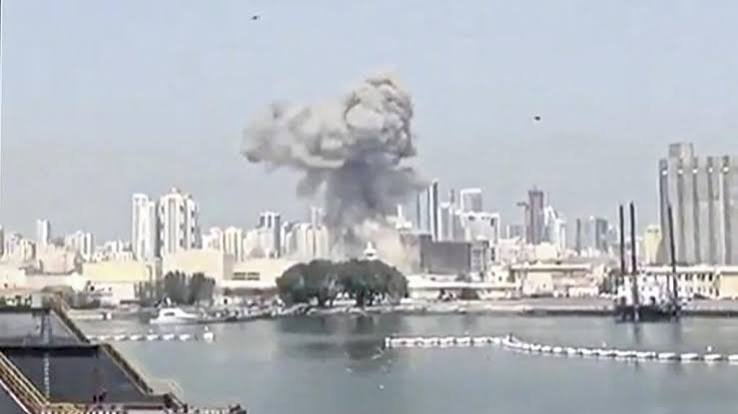
The escalation came a day after the US struck Iranian military targets, accusing Tehran of attacking the Panama-flagged oil tanker M/T Kiku in the Strait of Hormuz.
BY PC Bureau
June 28, 2026: West Asia moved closer to a wider regional conflict early Sunday after Iran claimed it had launched coordinated missile and drone strikes on US military bases in Kuwait and Bahrain in retaliation for fresh American attacks on Iranian military infrastructure. The exchange marked the second straight day of direct military confrontation between Washington and Tehran, raising fears that the fragile ceasefire could unravel completely.
In a statement, Iran’s Islamic Revolutionary Guard Corps (IRGC) said its Aerospace Force and Navy jointly targeted eight key US military installations, including the Ali Al Salem Air Base in Kuwait and the US Navy’s Fifth Fleet headquarters in Bahrain’s Port Salman.
The IRGC claimed the operation was carried out in response to US strikes on Iranian missile and drone storage facilities, coastal radar sites and other military infrastructure on Saturday.
“Any enemy aggression, whatever the pretext, even against insignificant targets, will receive a crushing response,” the Guards said, warning that Iran would respond forcefully to any further military action.
Iran attacked Bahrain
Just a while ago, Iran launched a large wave of missiles & drones against Bahrain . Air defence is working while some impacts are reported. pic.twitter.com/cgRKC8OGgG
— IRGC NEWS (@IRGC_IRAN_News) June 28, 2026
Iran calls strikes retaliation
According to the IRGC, the operation was a direct response to the latest round of US airstrikes inside Iran. Iranian state-affiliated media alleged that American forces targeted five sites along Iran’s southern coast after citing an attack on a commercial tanker in the Strait of Hormuz as justification for the operation.
The latest escalation followed Washington’s accusation that Tehran violated the ceasefire by launching a one-way attack drone at the Panama-flagged oil tanker M/T Kiku, which was transporting more than two million barrels of crude through the Strait of Hormuz.
Kuwait, Bahrain activate air defences
Kuwait’s military said its air defence systems intercepted several missiles and drones that entered the country’s airspace. Air raid sirens were activated across Kuwait, while neighbouring Bahrain also sounded warning sirens and advised residents to remain alert.
There was no immediate confirmation from US officials regarding casualties or damage at the targeted military installations.
READ: US Pounds Iran Again After Alleged Hormuz Tanker Attack
Tehran warns ceasefire under threat
The IRGC accused the United States of breaching the ceasefire and warned that continued violations of the Islamabad Memorandum of Understanding could derail ongoing diplomatic efforts.
Iran also issued a fresh warning to vessels operating in the Strait of Hormuz, saying ships that failed to comply with its directives would face stricter enforcement measures. It reiterated that any future “enemy aggression” would invite what it described as a “crushing response.”
US links strikes to tanker attack
Earlier on Saturday, the US launched strikes on 10 Iranian military targets after accusing Tehran of attacking the M/T Kiku. According to the US Central Command (CENTCOM), the operation targeted missile and drone storage facilities, surveillance systems, communication infrastructure, coastal radar installations and minelayer capabilities.
CENTCOM said the strikes were ordered by President Donald Trump after Iran allegedly violated the ceasefire for a second consecutive day.
Iranian media reported explosions near Sirik along the Strait of Hormuz and claimed US projectiles struck a village on Qeshm Island during the military operation. Iranian authorities did not immediately provide details on casualties or damage.
Trump warns of stronger military response
Following the strikes, US President Donald Trump warned that Washington could intensify military operations if Iran continued what he called repeated ceasefire violations.
In a post on Truth Social, Trump said the United States had targeted Iranian missile depots, drone facilities and coastal radar sites because Tehran had “once again” breached the ceasefire agreement. He warned that if Iran persisted, the US could be forced to “militarily complete the job,” adding that the Islamic Republic “will no longer exist” if such action became necessary.
The latest exchange has heightened concerns that the US-Iran confrontation could expand into a broader regional conflict, threatening security across the Gulf and disrupting one of the world’s most strategically important energy corridors.