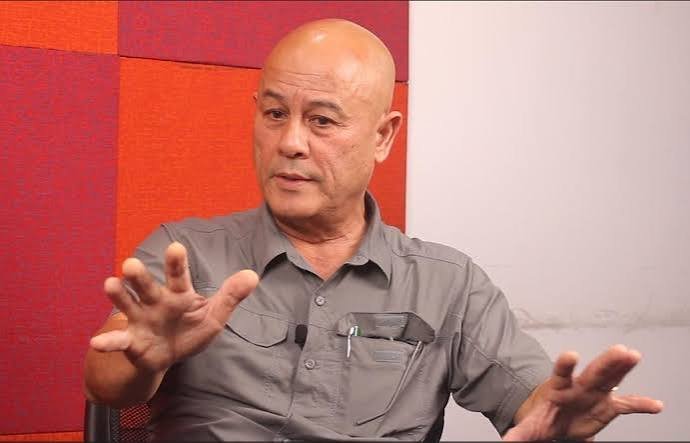
Haokip alleged that NSCN-IM and ZUF-Kamsong cadres had killed nearly two dozen Kuki-Zo civilians in recent months and accused authorities of selective enforcement against armed groups.
By Navin Upadhyay
September 15, 2026: Dr Seilen Haokip, a senior leader of the Kuki National Organisation (KNO), has faulted the Centre and Manipur Government for turning a blind eye to what he described as the National Socialist Council of Nagalim-Isak Muivah (NSCN-IM)’s violations of its ceasefire understanding with the Centre, its alleged infringement of the ceasefire line into Manipur, its maintaining unauthorised armed camps in the state, and its alleged targeting of Kuki-Zo civilians.
In an exclusive interview, Haokip alleged that the NSCN-IM was exploiting the security vacuum in Manipur to expand its influence through violence, while the Centre and the Manipur government had failed to take comparable action against its cadres. He questioned why the authorities continued to tolerate what he described as the NSCN-IM’s “illegal” armed presence in Manipur, while security forces were conducting operations against Kuki groups covered by the Suspension of Operations (SoO) agreement with the Centre.
“What evidence does the authorities need? The NSCN (I-M) camps are there. Their armed cadres are everywhere. There are viral videos showing them moving around Manipur with sophisticated weapons,” Haokip said.
“They kill innocent women and children and burn their homes. Such brutality is their modus operandi and reminiscent of 1992-1997; it’s simply a way to reassert terror and force people to accept their leadership.”
Haokip alleged that the NSCN-IM’s activities had fuelled the recent escalation of violence in Manipur and further alleged that the group’s aim was to incite reprisals by Kuki groups and use the resulting conflict to advance the idea of pan-Naga unification, which he said was currently threatened by multiple fractures.
‘Why is there no action against NSCN-IM?’
Haokip alleged that the NSCN-IM and its ally, the ZUF-Kamsong faction, operating in Noney and Kangpokpi districts, had killed nearly two dozen Kuki-Zo civilians over the past five to six months.
“Nearly two dozen Kuki-Zo civilians, including women and children and three pastors, have been butchered by the NSCN-IM and its ally. Why are these perpetrators never arrested? Why is there such immunity for them?” he asked.
Haokip said the lack of visible action against the NSCN-IM raised serious questions about how armed groups were being treated in Manipur.
“Everyone knows about these illegal camps. Has anyone ever heard of action being taken against them, and presently by CRPF, CoBRA? Do you need any other evidence to establish how the Manipur government has treated the NSCN-IM?” he said.
He alleged that political interests had resulted in selective enforcement.
“It suits the political agenda of some people in power in Manipur to allow the NSCN-IM to carry out violence against Kuki-Zo people. That is why you never hear of any action against them,” he alleged.
‘NSCN-IM is not above the ceasefire’
Haokip said the Centre could not claim to be committed to a peace process while ignoring alleged violations by one of the region’s most prominent insurgent groups.
“If the NSCN-IM is under a ceasefire understanding with the Government of India, on what basis can it maintain armed camps and cadres in another state and engage in violence?” he asked.
He said the Centre needed to explain why the rules governing armed groups appeared to be applied differently.
The KNO leader contrasted what he described as the freedom enjoyed by NSCN-IM cadres with repeated operations, arrests and harassment of Kuki cadres covered by the SoO agreement.
ALSO READ INTERVIEW OF UPF LEADER AARON KIPGEN:
Interview — ‘No Option But to Walk Out’: Kuki-Zo Leader Warns Centre https://t.co/mLdgUDKCdb #ManipurConflict #KukiZo #SoOAgreement#ManipurPeaceTalks #NRCManipur #KukiZoPolitics
— POWER CORRIDORS (@power_corridors) September 11, 2026
‘SoO cadres are being targeted while NSCN-IM camps remain’
Haokip slammed the recent security operation at a Kuki Liberation Army (KLA) camp in Gampum, Kangpokpi, describing it as a violation of the SoO framework.
“This is outrageous. According to the SoO framework, such raids are not allowed. Any inspection can take place only with the assistance of the district police. In this case, the police were not present and KLA cadres were arrested,” he said.
He rejected the suggestion that the KLA camp had suddenly emerged as an unauthorised armed establishment.
According to Haokip, the designated Camp Gamnom was inadequate to accommodate both KRA and KLA/KLO. Repeated requests to repair and upgrade the camp had gone unanswered. Therefore, KLA/KLO had to build their own camp at Gampum in the vicinity to accommodate the cadres, and inspections were regularly carried out there over the years. He claimed that local authorities and residents had known about the arrangement for years.
READ: UPI Above ₹2,000: What the New Govt Notification Means
“The police did the headcount of the cadres and regularly supervised the camp. There was nothing illegal about it,” he said.
“Have they woken up to it only now?” he added. “Is there no coordination among the SFs?”
“Why has the SoO camp been suddenly subjected to an unwarranted investigation without consulting the leadership? This is a serious breach of the SoO ground rules by the Security Forces.”
In a similar scenario concerning the alleged apathy towards USRA, a constituent of the KNO, Haokip said its cadres could not stay in the designated camp. He said the cadres had been forced to stay in jungle areas because their designated camp was dilapidated and lacked basic facilities. Repeated requests for repairs had not been addressed.
“Where should they go?” he asked.
The KNO leader demanded an immediate end to what he described as harassment, intimidation and selective targeting of cadres covered by the SoO agreement.
He called on the Joint Monitoring Group overseeing the pact to ensure the safety of designated cadres, prevent selective enforcement and maintain transparent monitoring.
Haokip said the Centre’s handling of armed groups would ultimately determine whether the existing peace process could retain any credibility.
“If the government is serious about peace, it cannot have one set of rules for us and another for the NSCN-IM,” he said.
“The NSCN-IM cannot be allowed to operate armed camps, move with weapons and allegedly attack civilians in Manipur while our cadres are arrested in the name of maintaining security.”
Haokip said the KNO was not seeking confrontation with the Centre but wanted the same standards applied to every armed organisation operating in Manipur. “The question is very simple: the law must be equally applied.”
‘Return to pre-2023 arrangement is no longer possible’
Haokip said the KNO remained committed to the SoO process and to finding a political settlement within the Constitution.
He argued that the situation on the ground had fundamentally changed since the outbreak of violence in May 2023.
“The communities have been physically separated. Thousands have been displaced, homes and churches have been destroyed, and people have lost faith in the existing security and administrative arrangements,” he said.
He maintained that a return to the political arrangement that existed before the conflict was therefore no longer realistic.
From territorial council to Union Territory
Haokip said the Kuki groups’ earlier demand for a territorial council within Manipur was no longer sufficient.
He cited the physical separation of communities, large-scale displacement, destruction of homes and churches and what he described as the failure of the existing state machinery to protect Kuki-Zo people.
The KNO leader said the groups were now seeking a Union Territory with a legislature modelled under Article 239A of the Constitution, similar to the constitutional arrangement for Puducherry.
He said the proposed arrangement should safeguard hill land, customary practices, community rights, culture and identity while providing an elected government with legislative powers.
He stressed that the demand was not for separation from India.
“We are not asking for secession. We want a constitutional political settlement within the Indian Union,” he said.
‘No NRC before Census’
Haokip also rejected demands for an NRC in Manipur using 1951 as the base year before completion of the Census.
The Manipur Assembly has recently renewed its demand for an NRC based on the 1951 baseline, citing concerns over alleged illegal immigration and demographic changes.
Haokip argued that the Census must precede any citizenship exercise.
“If the Census takes place, delimitation will follow. That will increase the number of seats in the hills by three. The Meiteis do not want it,” he said.
He rejected the 1951 baseline and warned that the Kuki-Zo community could consider boycotting an NRC conducted on that basis.
“We are not going to accept any such decision of the government and may even think of boycotting the NRC,” he said.
Haokip argued that a citizenship exercise should be based on comprehensive and officially verified population data rather than a historical baseline that, he claimed, could disadvantage remote hill communities that had limited access to government offices and formal enumeration in 1951.
The Centre has deferred Census operations in Manipur amid continuing political and security tensions.
For Haokip, however, the dispute over the Census and NRC is part of a larger question of trust between the Centre and the Kuki groups.
He said the government’s handling of the NSCN-IM would be a crucial test of whether it was prepared to apply its security and ceasefire policies consistently across Manipur.
“The real test is whether the same law, the same security standards and the same accountability will apply to everyone. If the NSCN-IM can maintain armed camps and operate with weapons without facing action, while SoO cadres are arrested and their camps raided, then the government itself is undermining the credibility of the peace process.”
For the KNO leader, therefore, the issue is no longer simply about individual arrests or camps. It is about whether the Centre can enforce a single standard for all armed groups and restore enough trust for political dialogue to have any chance of producing a settlement in Manipur.