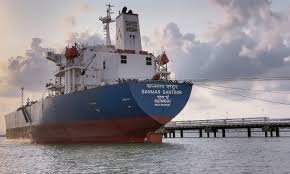
The tanker, carrying nearly two million barrels of crude oil bound for India, reportedly paid in Tether (USDT) after receiving what appeared to be official approval documents. A second Indian vessel, Jag Arnav, was also targeted during the incident.
BY PC Bureau
April 22, 2026 — In a striking convergence of maritime insecurity, cyber fraud, and geopolitical tension, the Indian-flagged oil tanker Sanmar Herald was targeted in a sophisticated scam before coming under live fire from Iranian forces in the strategically critical Strait of Hormuz.
The vessel, a Very Large Crude Carrier (VLCC) carrying nearly two million barrels of Iraqi crude bound for India, was among at least two ships caught in the incident over the weekend of April 18–19. A second vessel, the bulk carrier Jag Arnav, also came under fire. No injuries were reported, and both ships retreated after warning shots were fired by gunboats linked to Iran’s Islamic Revolutionary Guard Corps (IRGC).
Audio from the Sanmar Herald’s distress call, widely circulated online, captured the captain’s confusion as he insisted he had received prior clearance. “You gave me clearance to go… you are firing now… let me turn back,” he pleaded, referring to the IRGC Navy, also known as “Sepah Navy.”
Alleged Crypto Scam
According to maritime security reports, the tanker had days earlier been contacted by an individual posing as an IRGC official. The caller allegedly offered safe passage through the strait in exchange for payment in Tether (USDT). The captain reportedly transferred a significant sum and received documentation indicating the vessel had been approved for transit.
NEW:
🇮🇷🇮🇳 The Indian-flagged oil tanker ‘SANMAR HERALD’, which was fired upon by Iranian gunboats last Sunday, fell victim to a crypto scam
Reportedly, the ship was contacted by an Indian man claiming to represent the IRGC Navy. The captain then transfered a large amount of… pic.twitter.com/iTebktpkk4
— Megatron (@Megatron_ron) April 22, 2026
READ: Iran Seizes Two Ships in Strait of Hormuz Amid Rising Tensions
Believing the clearance to be legitimate, the Sanmar Herald proceeded—only to encounter actual IRGC patrol boats approximately 20–25 nautical miles northeast of Oman, where warning shots forced it to turn back.
Greek maritime risk firm MARISKS later issued an alert warning of fraudulent messages sent to vessels stranded near the strait. The firm said scammers were impersonating Iranian authorities, demanding cryptocurrency payments after a fake “security assessment,” and promising guaranteed passage.
“These messages are a scam and not sent by Iranian authorities,” MARISKS said, adding that at least one targeted vessel appeared to have fallen victim.
Rising Risks in a Chokepoint
The scam unfolded amid heightened tensions in the region, where Iran has tightened control over the strait—a key global energy artery handling roughly one-fifth of the world’s oil and gas shipments. A prolonged blockade has left hundreds of vessels waiting and thousands of sailors stranded, creating conditions ripe for exploitation.
The United Kingdom Maritime Trade Operations (UKMTO) confirmed that ships in the area had come under fire but did not directly address the fraud allegations. Iranian authorities have not publicly commented on the reported impersonation scheme.
India Protests, Seeks Assurances
India lodged a formal protest, summoning Iran’s ambassador to express concern over the incident and to demand assurances for the safety of Indian-flagged and India-bound vessels. Diplomatic channels remain engaged as New Delhi pushes for the restoration of secure maritime transit.
Other incidents reported the same day—including damage to a French container ship from an unidentified projectile—highlight the volatility in the region.
A New Maritime Threat Landscape
Security experts say the episode underscores a growing overlap between cybercrime and conventional conflict. Fraudsters are exploiting encrypted communications, forged documents, and the anonymity of digital currencies to target high-value vessels operating in uncertain conditions.
For the global shipping industry, the risks are no longer limited to physical threats. As one maritime analyst noted, in today’s conflict zones, “a fraudulent clearance message can be as dangerous as a missile.”