



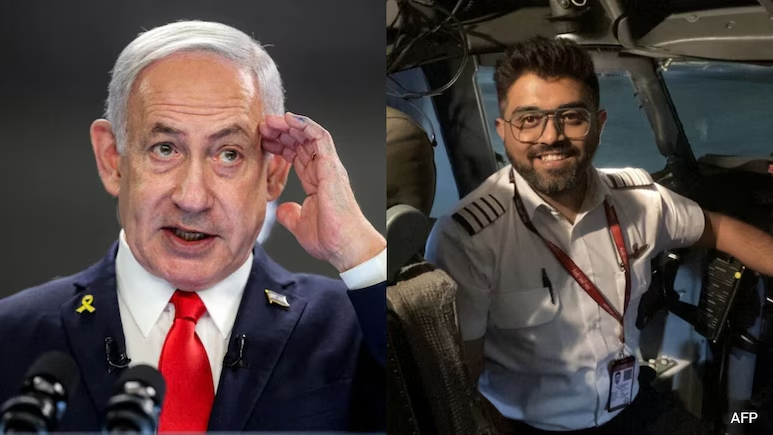
Israeli Prime Minister Benjamin Netanyahu has turned the heroics of Indian Flydubai pilot Smit Machchhar into a high-profile national moment, inviting him and Prime Minister Narendra Modi to Israel’s Independence Day ceremony as he campaigns ahead of the October 27 election.
BY Navin Upadhyay
What began as a terrifying cockpit attack aboard a Flydubai flight has rapidly become something much larger in Israel: a political story about heroism, terrorism, national security and Israel’s place in the world — all in the final weeks of Benjamin Netanyahu’s election campaign.
The Israeli prime minister has now personally spoken to Indian pilot Captain Smit Machchhar, praised him as a hero of Israel, India and the world, and invited him and Prime Minister Narendra Modi to light a ceremonial flame at Israel’s Independence Day celebrations.
The timing is difficult to ignore.
Israel is due to hold its national election on October 27, with Netanyahu fighting to retain power after years of war, political turmoil and intense criticism over the security failures surrounding the October 7, 2023 Hamas attack. Recent polling has shown a closely contested race, with neither bloc having a clear path to a parliamentary majority.
Against that backdrop, the Flydubai incident offers Netanyahu precisely the kind of narrative that has long been central to his political message: an attack, an Israel-bound aircraft, an apparent terrorist threat and ordinary people displaying extraordinary courage to prevent catastrophe.
Netanyahu has embraced that narrative almost immediately.
Prime Minister Benjamin Netanyahu in a conversation with the Indian pilot from the flight from Dubai, Captain Smit Machchhar:
“You are a hero for Israel, India, and the entire world. I invite Prime Minister @NarendraModi and you to light a flame on Israeli Independence Day.” 🇮🇱🇮🇳During the emotional conversation that took place this evening, the Prime Minister asked Captain Machchhar how it all started, and Machchhar revealed new details about the terrifying moments in the cockpit.
— Prime Minister of Israel (@IsraeliPM) October 3, 2026
From cockpit attack to national story
Flydubai Flight FZ1073 was flying from Dubai to Tel Aviv when the co-pilot attacked Machchhar inside the cockpit. The aircraft went into a steep descent before Machchhar, despite his injuries, managed to open the cockpit door. Passengers and crew then intervened and the aircraft was eventually diverted to Tabuk, Saudi Arabia. All 174 people aboard survived. UAE authorities have described the incident as a terrorist act, while the investigation into the motive remains underway.
Machchhar later described the attack to Netanyahu in a video call.
He said the flight had initially been completely normal. The co-pilot asked to pray, something Machchhar said he regarded as routine among local crew. Out of courtesy, he looked towards the front rather than watching the co-pilot.
Four or five minutes later, he was struck violently on the back of the head.
At first, he thought the aircraft itself had suffered catastrophic damage. Then he realised that he was being attacked inside the cockpit.
Dazed and with blurred vision, Machchhar felt the aircraft descending sharply. He eventually realised that his only chance was to get the cockpit door open.
“I had that one last fight left in me… if I don’t do it, I’m gonna die,” he told Netanyahu.
He pushed himself towards the door, reached the manual handle and opened it. The people waiting outside were then able to enter, overpower the attacker and help restore control of the aircraft.
Netanyahu responded not merely by thanking him but by placing the incident inside a much broader political and national narrative.
“You’re a hero of Israel, you’re a hero of India, you’re a hero of the entire world,” Netanyahu told him. He said Machchhar had not merely saved lives but had demonstrated that courage could overcome what he called evil.
Why the Modi invitation?
This is where the political symbolism becomes more interesting.
Netanyahu did not stop at inviting Machchhar to Israel. He invited Modi and Machchhar together to light a celebratory flame at Israel’s Independence Day ceremony.
That raises an obvious question: why Modi?
Modi did not fly the aircraft. He was not involved in the rescue. He was not aboard the plane. He did, however, speak to Machchhar shortly after the incident and publicly praised the pilot’s courage.
The Modi invitation therefore appears to be about something larger than the Flydubai rescue itself: the political and diplomatic relationship between Netanyahu and the Indian prime minister.
Netanyahu explicitly described Modi as a “great friend” while extending the invitation. Israeli and Indian ties have deepened substantially in recent years, particularly in defence, technology, trade and strategic cooperation.
But turning that diplomatic relationship into part of an Israeli Independence Day ceremony is symbolically different from simply inviting Modi for a bilateral visit.
It places the Indian prime minister alongside an Indian pilot being celebrated for saving an Israel-bound aircraft — and allows Netanyahu to connect three narratives at once: Israeli vulnerability, civilian heroism and Israel’s friendship with India.
An election-friendly story
Netanyahu has long built his political identity around security. Reuters reported days before the Flydubai incident that, with the October 27 election approaching, he was again presenting himself as Israel’s protector amid regional threats.
The Flydubai episode fits naturally into that framework.
The threat came aboard a flight headed to Israel. The passengers who intervened included Israelis. The pilot who made the decisive move was Indian. The aircraft survived. Netanyahu then appeared personally with the pilot and described the episode in almost civilisational terms.
For an incumbent campaigning on security, it is an extraordinarily potent story.
But there is another side to it.
The very incident Netanyahu is celebrating also raises uncomfortable questions about security failures.
How did a co-pilot who allegedly had a history that investigators are examining end up in the cockpit of a flight bound for Israel? What checks were carried out before he was employed? What did aviation authorities know? And why was the aircraft able to descend so dramatically before the attack was brought under control?
Those questions have not disappeared because Machchhar behaved heroically.
Indeed, they are arguably more important in determining what the incident says about aviation security than the political symbolism surrounding the rescue.
The torch Netanyahu cannot simply give away
There is also a small but significant problem with the language of Netanyahu’s invitation.
Netanyahu presented the torch-lighting as an extraordinary honour, saying it was normally reserved for Israeli citizens but that Machchhar would be welcomed by Israelis.
The ceremony is indeed one of Israel’s most prominent national rituals. Twelve torches are traditionally lit on Independence Day eve, symbolising the 12 tribes of Israel. But the selection of torch-lighters is not simply a matter for the prime minister.
According to the Knesset, candidates are recommended through a public advisory committee established under the government’s framework for the ceremony. The candidates are then selected according to the theme and criteria established for that year’s ceremony. The rules generally call for Israeli citizens or residents, although an exception can be made for a non-citizen or non-resident associated with the ceremony’s theme.
The Times of Israel therefore pointed out an important detail that was largely absent from the celebratory coverage: Netanyahu does not have unilateral authority to decide who will light the torches.
That makes his announcement politically significant even if the formal selection still has to follow the established process.
The Indian connection is useful to Netanyahu
The Modi element may be even more politically useful than the pilot himself.
India is a major international partner for Israel, and Modi is one of the foreign leaders with whom Netanyahu has cultivated a highly visible personal relationship.
By inviting Modi to share the stage with an Indian pilot hailed as a hero for saving an Israel-bound aircraft, Netanyahu can project an image of international solidarity around Israel at a time when his government faces diplomatic pressure over the wars and continuing criticism at home over security failures.
It also gives the story an Indian dimension at precisely the moment when Netanyahu wants the central message to be about Israel’s security and the international recognition of its struggle against what he portrays as terrorism.
None of this diminishes Machchhar’s achievement.
The pilot’s actions can be recognised independently of the politics surrounding them. He was severely injured, the aircraft was in danger and he took a decision that enabled people outside the cockpit to intervene.
But Machchhar’s heroism and Netanyahu’s political use of that heroism are two separate questions.







Comments 1