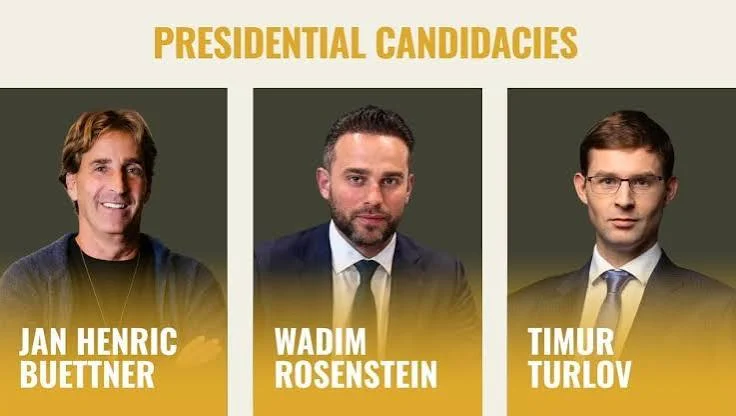
Chess was once a game of parks, clubs and coffee houses. But at the top of the sport, a new power structure has emerged. The three contenders for the 2026 FIDE presidency were businessmen who had already deployed substantial private wealth in professional chess. Timur Turlov’s victory in Samarkand marks the clearest expression yet of that transformation.
BY Navin Upadhyay
Chess once lived in parks, clubs and cheap cafés. A board, a clock and time were enough.
On September 26, 2026, in Samarkand, the contest for the presidency of the International Chess Federation (FIDE) showed how far the game’s summit has moved.
The three men on the ballot were not traditional federation administrators. They were entrepreneurs who had already built businesses around finance, engineering, technology, luxury hospitality and chess itself. Their fortunes had funded tournaments, teams, school programmes, training centres and new commercial formats.
Timur Turlov won the presidency, defeating Wadim Rosenstein 110-85 in the second round. Jan Henric Buettner was eliminated in the first round with 20 votes. Turlov’s ticket included five-time world champion Viswanathan Anand, who was elected deputy president. The election ended Arkady Dvorkovich’s eight-year presidency and installed a 38-year-old financial entrepreneur at the head of the world chess body.
The result does not by itself establish that money bought the presidency. But it does illustrate a striking transformation in chess politics: private capital is no longer merely financing the game. Its most prominent patrons are now competing to govern it.
That transformation has a history.
After Russia’s invasion of Ukraine in 2022, some traditional Russian corporate sponsorship disappeared from international chess. At the same time, FIDE’s event economy expanded rapidly. FIDE’s audited accounts show income from FIDE events rising to €15.87 million in 2023, from €8.16 million in 2022. In 2024, major events generated €12.5 million in income against about €10 million in operational costs.
FIDE is not a financially opaque organisation in the basic accounting sense. It publishes budgets and audited financial statements and has a Verification Commission; Ernst & Young has served as its external auditor. Its General Assembly approves the Treasurer’s and Verification Commission’s reports.
But the more interesting question is not whether FIDE publishes accounts. It is whether its governance and disclosure mechanisms have kept pace with the growing role of private wealth in the sport.
That is the question posed by Samarkand.
The coffee house still exists.
The playground at the top has changed.
Timur Turlov: the listed-company billionaire who won
Timur Ruslanovich Turlov, born in Moscow on November 13, 1987, built his fortune in financial services. He founded what became Freedom Finance in 2008, when he was 21, and expanded the business into Freedom Holding Corp., a retail brokerage and financial-services group that began trading on Nasdaq in 2019. Turlov remains its founder, CEO and controlling shareholder.
Forbes estimated his fortune at $6.9 billion in September 2026, placing him among the world’s billionaires. Forbes identifies his source of wealth as stock brokerage and his residence and citizenship as Kazakhstan.
Turlov moved from business into chess administration in 2023, when he became president of the Kazakhstan Chess Federation. Under his leadership, Kazakhstan expanded its hosting of major tournaments and its investment in elite, women’s and youth chess. He has also headed the International School Chess Federation.
Freedom Holding became increasingly prominent in international chess. The company sponsored major events, including the 2022 World Rapid and Blitz Championships and the 2023 world championship match in Astana.
In April 2026, FIDE and Freedom Holding signed a cooperation agreement covering international tournaments, financial and material support for players and coaches, training centres, educational programmes and talent scouting. FIDE described it as the beginning of a broader long-term relationship.
The relationship deepened further this month when Freedom Holding became general partner of the 2026 FIDE World Championship match.
In April, Freedom also acquired ChessBase, one of the world’s best-known chess software, database and content companies, in a deal in which it said it expected to invest about €5 million.
Turlov therefore entered the FIDE presidency not as an outsider discovering chess, but as an entrepreneur already deeply embedded in its commercial and institutional ecosystem.
He had also publicly addressed the potential conflict. His FIDE campaign says that any future sponsorship contracts between FIDE and Freedom Holding will be decided by the FIDE Management Board or Council and that Turlov will abstain from voting on those matters. It similarly says he will not vote on hosting bids from the Kazakhstan Chess Federation.
Those safeguards are important because the question is no longer hypothetical: the president of FIDE is also the controlling shareholder of a company that is a major FIDE partner.
At 38, Turlov became the eighth FIDE president and, according to FIDE, the youngest ever elected.
🎙️ @TurlovforChess shares his first words after being elected FIDE President. pic.twitter.com/T5tmIectuA
— International Chess Federation (@FIDE_chess) September 26, 2026
Wadim Rosenstein: the latecomer with a global business and a chess brand
Wadim Rosenstein, born in 1990 in Ukraine’s Zhytomyr region and raised in Germany after his family moved there in 2000, built his career in engineering, logistics and project services.
He founded his first company while still a student and established WR Group in 2014. The group says it now operates in more than 70 countries, with interests spanning logistics, heavy engineering, IT, real estate and sports initiatives.
Chess became a significant part of the business strategy.
Rosenstein backed the WR Chess Masters, established WR Chess Juniors and supported youth championships. His organisation also became involved in major team and elite events, helping create a commercial chess brand around the WR name.
He entered the FIDE race with Singaporean businessman Gordon Tang as his deputy candidate. His campaign presented itself as a reform programme centred on stronger federations and a more commercially sustainable FIDE.
Rosenstein led Turlov after the first round — 76 votes to 96 — while Buettner received 20. He then lost the runoff 85-110.
His rapid rise illustrates the same structural change: a businessman with a relatively recent history in elite chess could build enough influence to challenge for control of the world’s governing body.
Jan Henric Buettner: internet fortune, luxury estate, Freestyle Chess
Jan Henric Buettner represents a different generation of entrepreneurial wealth.
Born in Hamburg in 1964, he built his career in telecommunications, internet technology and venture capital. He helped establish AOL Europe and later founded BV Capital, now Headline Ventures. He subsequently moved into luxury hospitality, developing the Weissenhaus estate on Germany’s Baltic coast.
His return to chess came through a different route: turning chess into premium entertainment.
Buettner co-founded Freestyle Chess with Magnus Carlsen. The project developed the Chess960 format into a commercial circuit involving leading players, major venues, sponsors and substantial investment.
FIDE subsequently brought Freestyle Chess into its official competitive framework. In February 2026, FIDE and Freestyle Chess launched the first official FIDE Freestyle Chess World Championship at Weissenhaus, with a $300,000 prize fund and qualification implications for the following cycle.
FIDE had already described its agreement with Freestyle Chess as establishing a “clear and transparent sporting framework” for the format.
Buettner entered the presidential race with English chess administrator Malcolm Pein. His campaign emphasised commercial growth, sponsorship, media rights and revenue-sharing with federations. FIDE’s candidate profile describes his objective as building a stronger and more transparent federation while increasing revenues from sponsorship and media.
He received 20 votes and was eliminated in the first round. He subsequently backed Turlov.
Buettner’s story represents another route into modern chess power: an established technology and investment fortune used to create a new commercial product around the game.
What the money changed
The three men did not come from the same business world.
Turlov built a publicly listed financial-services empire.
Rosenstein built a private engineering and logistics group.
Buettner made his fortune in the early internet and venture capital before moving into luxury hospitality and sports entertainment.
But their paths into chess share a common feature.
They did not begin by rising through the federation hierarchy.
They arrived with something FIDE and its federations increasingly need: capital, commercial networks, events, technology and the ability to attract sponsors.
That does not make their involvement inherently improper. In fact, the money has produced tangible benefits. More events can be staged. Players can be paid. Youth programmes can be expanded. New formats can be developed. Federations that struggle to finance international activity can gain access to private resources.
FIDE’s own accounts demonstrate why this matters. The organisation’s income is heavily tied to events and commercial activity, while sponsorship income has also been identified by FIDE as an area requiring attention. In 2023, FIDE reported record revenue and a net income of €1.04 million, but its Verification Commission also warned about declining sponsorship revenue and the need for alternative income streams.
This is the paradox.
The more successfully chess becomes a commercial product, the more valuable private capital becomes to its governing institutions. And the more valuable that capital becomes, the greater the need for transparent rules separating sponsorship, commercial interests and governance.
READ: India Crushes Uzbekistan 2, Stay Alive in Chess Olympiad Gold Race
The transparency question
FIDE does have formal financial controls.
Its website publishes annual budgets and audited financial statements going back years. Its financial system includes external audits and a Verification Commission, and the General Assembly formally approves the relevant financial reports.
But audited accounts answer only part of the transparency question.
They show the organisation’s income and expenditure. They do not necessarily tell an outsider, in sufficient commercial detail, who negotiated each major sponsorship, what competing offers existed, how commercial rights were valued, or how relationships involving senior officials are managed.
That distinction becomes more important under the new FIDE leadership.
Turlov is both the controlling shareholder of Freedom Holding and now president of FIDE. Freedom is already a FIDE partner and has become general partner of the 2026 World Championship. Turlov’s own campaign has therefore had to spell out recusal arrangements for future FIDE-Freedom agreements.
That is not evidence of wrongdoing.
It is evidence that the governance problem has become sufficiently real to require explicit rules.
And it points to a question FIDE will increasingly have to answer:
When the sponsor becomes the president, who guards the line between private capital and public sporting authority?
From patron to power
For decades, chess depended on governments, federations, foundations and a relatively small circle of corporate sponsors.
The new model is different.
A billionaire can sponsor a championship, build a school programme, acquire a chess technology company, create a professional circuit, finance elite players, become a national federation president — and then run for the presidency of the world federation.
That does not mean chess has been “bought”.
But it does mean that the centre of gravity has shifted.
The board in the café remains the same: 64 squares, 32 pieces and two players.
At the top of the sport, however, chess has become something much larger — an international commercial ecosystem in which money does not merely follow power. Increasingly, money can become a route to power.