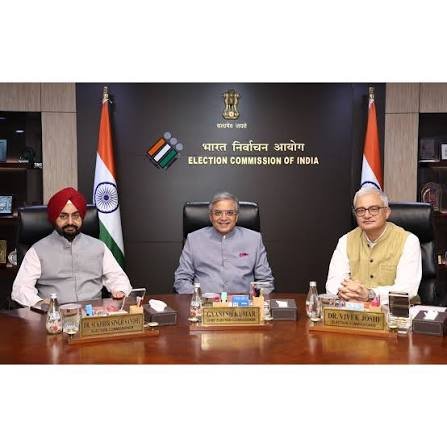
In a counter-affidavit responding to a writ petition challenging the functioning of Kumar and the legality of certain Commission decisions, the ECI rejected claims that the Chief Election Commissioner acted alone despite objections from the other two Election Commissioners.
The affidavit was filed in response to a petition by Rakesh Kumar Singh, in which the Supreme Court had issued notice to the ECI, the CEC and other officials. The plea relied on an Indian Express report alleging that 14 key decisions concerning the SIR exercise were issued in the Commission’s name despite recorded objections from Election Commissioners Sukhbir Singh Sandhu and Vivek Joshi.
The ECI said its three SIR-related orders, dated June 24, 2025, October 27, 2025, and May 14, 2026, were unanimous decisions. The counter-affidavit, filed by Deputy Election Commissioner Bhanu Prakash Yeturu, was also approved unanimously by the CEC and both Election Commissioners.
READ: UP Police Form SIT to Probe Rahul Gandhi’s Convoy Accident
The Commission argued that the petition relied solely on a newspaper report and that the petitioner had not independently verified the allegations with the respondents. On that basis, it contended that the petition was not maintainable. It also said the ECI had neither released nor authorised the release of any internal note or file to the media.
Internal notes are not Commission decisions
The ECI maintained that notes, queries, suggestions and observations recorded by the CEC or other Election Commissioners while a file is being processed do not, by themselves, constitute decisions of the Commission.
According to the affidavit, files ordinarily move first to one Election Commissioner, then to the other, and finally to the CEC. The Commission said the decisions in question complied with Section 18 of the Chief Election Commissioner and Other Election Commissioners (Appointment, Conditions of Service and Term of Office) Act, 2023. The provision requires decisions to be taken unanimously as far as practicable and, where unanimity is not possible, by majority.
ECI denies amending Form 6
The Commission also rejected the allegation that its SIR orders had amended Form 6, the prescribed application form for inclusion of names in electoral rolls. It argued that only the Central Government can amend the form prescribed under the Registration of Electors Rules, 1960.
The declaration required for the SIR exercise, the ECI said, is a separate document and does not constitute an amendment to Form 6.
The controversy followed a report alleging that Sandhu and Joshi had objected to requirements for applicants to establish links between themselves or their parents or grandparents and earlier intensive electoral rolls.
The ECI acknowledged that the way the declaration appeared on the online application platform could give the impression that Form 6 had been modified. To remove the ambiguity, the online process was divided into two separate components from October 21, 2026: Form 6 and the SIR declaration. The arrangement, it said, mirrors the procedure followed for physical applications.
The Commission maintained that the declaration was introduced only to facilitate the mapping of applicants against previous electoral rolls and did not alter the statutory form.
Unmapped voters ordinarily need not attend hearings
In a move it described as intended to promote inclusion and ease the SIR process, the ECI said voters whose names could not be mapped to earlier electoral rolls would not ordinarily be required to attend hearings in person.
Booth Level Officers would collect the necessary documents from their homes and upload them to the ECINet platform for consideration by the Electoral Registration Officer (ERO). Hearings would be required only in exceptional cases and should preferably be conducted online, the Commission said.
The ECI also clarified that no name could be added to or deleted from an electoral roll through ECINet without an order from the competent ERO.
It informed the Court that a committee of experts from IIT Madras and the Indian Institute of Science, Bengaluru, had been constituted to examine compliance and review the platform’s functioning.
ECI challenges plea against CEC
The Commission argued that the petition seeking to restrain Gyanesh Kumar from functioning as Chief Election Commissioner was not maintainable. It cited Article 324(5) of the Constitution, which provides that the CEC can be removed only in the same manner and on the same grounds as a judge of the Supreme Court.
The ECI also noted that repeated challenges to the credibility of Electronic Voting Machines had already been considered by the Supreme Court.
The Commission said it was filing a brief response because of the intervening Dussehra holidays and reserved the right to submit a detailed, paragraph-wise counter-affidavit.
A bench headed by Chief Justice of India Surya Kant is scheduled to hear the matter.