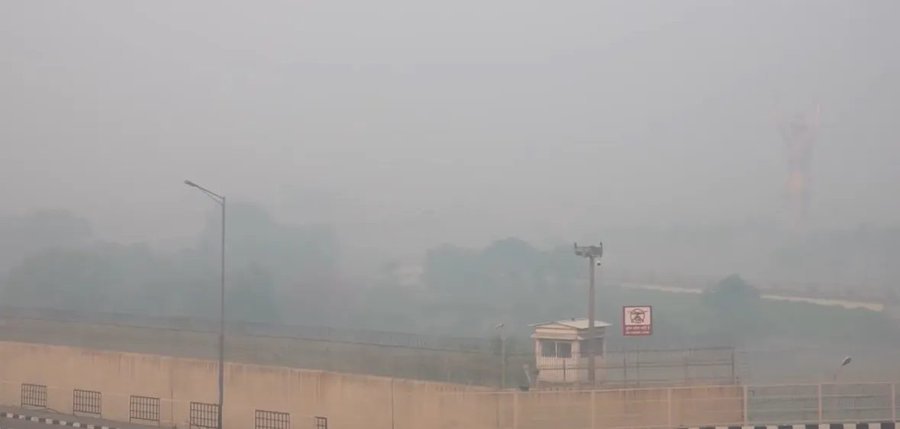
Delhi woke up to a toxic blanket of smog on Monday, with air quality deteriorating sharply after a night of widespread firecracker use in defiance of Supreme Court restrictions. AAP leader Saurabh Bharadwaj claimed that pollution levels in several parts of the capital crossed an alarming AQI of 3,000, accusing the BJP government of concealing the true extent of the crisis.
BY PC Bureau
November 9: The national capital’s annual post-Diwali pollution crisis returned with a vengeance on November 9, as residents struggled with thick smoke, poor visibility and hazardous air following hours of fireworks on Sunday night.
The Central Pollution Control Board (CPCB) recorded a citywide Air Quality Index (AQI) of 368 at 7 am on Monday, placing Delhi in the ‘very poor’ category. However, several monitoring stations reported readings above 400, which fall in the ‘severe’ category.
The situation deteriorated further in several neighbourhoods. According to CPCB readings, Burari Crossing recorded an AQI of 441, Vivek Vihar 437, Delhi Technological University 434, North Campus and Jahangirpuri 433 each, while Rohini registered 430.
Another CPCB snapshot reported the overall AQI touching 483 at around 8.10 am, with at least 15 monitoring stations recording levels above 400.
A thick layer of smog enveloped several parts of the capital, reducing visibility and raising concerns about the health risks for millions of residents.
WATCH: Delhi Chokes In Toxic Smoke After Diwali; AQI Crosses 440! 🚨😷🌫️
Thick smog engulfed Delhi-NCR this morning as 15+ stations hit ‘Severe’ AQI—led by Sonia Vihar (449), Burari (441) & ITO (406). GRAP Stage-III bans remain enforced.
Sources: @the_hindu @IndiaToday https://t.co/je82uGq5WX
— Viral scope official (@ViralScopeOffi) November 9, 2026
Saurabh Bharadwaj claims AQI crossed 3,000
Amid the deteriorating air quality, Aam Aadmi Party’s Delhi president Saurabh Bharadwaj alleged that pollution levels in several parts of the capital had crossed 3,000 during Diwali night.
In posts on social media, Bharadwaj shared images of pollution readings and accused the BJP government of manipulating official air-quality data.
Speaking to ANI on Monday, he alleged that several monitoring stations had been shut down, while 20 new stations had been established in distant, greener areas of the capital. He also alleged that water was being sprinkled around monitoring stations in polluted neighbourhoods to influence readings.
“The government’s data is based on fraud,” Bharadwaj alleged, questioning the credibility of the official figures.
He further accused the government of putting people’s lives at risk by presenting misleading pollution data.
Taking a swipe at those who continued bursting firecrackers despite restrictions, he said: “If you are bursting firecrackers, do it, but take full responsibility for it. You cannot commit fraud.”
In another post on X, Bharadwaj sarcastically wrote: “AQI 3000 paar. Full credit to these brothers who raised pollution beyond 3000.”
His claim of AQI levels exceeding 3,000, however, has not been independently established by CPCB monitoring data. The official Indian AQI scale ranges from zero to 500, and readings from private monitoring devices or alternative platforms should not be directly equated with CPCB figures.
READ: Who Is Alice Huang? The Chinese Woman at the Centre of Nvidia’s Espionage Row
Fireworks continue despite Supreme Court restrictions
The massive use of firecrackers across Delhi on Sunday night raised fresh questions about the enforcement of judicial restrictions.
The Supreme Court had permitted only certified green firecrackers during specified hours over the Diwali weekend. However, fireworks continued across several neighbourhoods well into the night, with residents reporting repeated bursts and thick clouds of smoke.
Areas including Burari, Pitampura, Mayur Vihar and parts of central Delhi witnessed extensive firecracker use. The resulting smoke accumulated over residential colonies and roads, leaving several localities under a visible haze.
The restrictions appeared to have had little impact on large sections of revellers, who continued setting off fireworks beyond the permitted window.
The Commission for Air Quality Management (CAQM) had already invoked Stage III of the Graded Response Action Plan (GRAP) across Delhi-NCR on Friday, ahead of Diwali, anticipating a further deterioration in air quality.
Despite these precautionary measures, the post-festival pollution spike has once again exposed the gap between official restrictions and their implementation on the ground.
PM2.5 levels soar as pollution data comes under scrutiny
The scale of the pollution was also reflected in the concentration of fine particulate matter, particularly PM2.5, which can penetrate deep into the lungs and enter the bloodstream.
Congress leader Ajay Maken, citing CPCB data, raised concerns about missing readings from several monitoring stations during the early hours of Monday.
According to figures shared by him, 25 of 39 monitoring stations did not record PM2.5 readings between 2 am and 3 am. The average PM2.5 concentration at the nine stations reporting data during that hour was 576 micrograms per cubic metre.
Maken said the concentration was 38.4 times the World Health Organization’s 24-hour guideline of 15 micrograms per cubic metre.
His post also showed PM2.5 levels rising sharply through the evening, reaching 610 micrograms per cubic metre at midnight across the nine stations.
The data gaps have added to questions about the adequacy and reliability of the monitoring network at a time when pollution levels are at their highest.
Firecrackers add to Delhi’s existing pollution burden
While fireworks contributed significantly to the post-Diwali deterioration, they are not the sole source of Delhi’s air pollution.
Vehicular emissions, construction dust, industrial activity and agricultural residue burning in neighbouring Punjab and Haryana continue to contribute to the capital’s pollution load.
Unfavourable weather conditions, including low wind speeds and cooler temperatures, further prevent pollutants from dispersing, allowing smoke and particulate matter to remain trapped close to the ground.
The Air Quality Early Warning System has forecast that Delhi’s air quality could remain in the severe category over the next few days.
The latest episode has once again highlighted the limitations of short-term restrictions and emergency measures. Despite repeated judicial interventions, annual warnings and pollution-control campaigns, the capital continues to struggle with the same cycle: a deterioration in air quality before Diwali, a massive release of pollutants during the festivities and a choking aftermath.
For Delhi’s residents, particularly children, senior citizens and people with respiratory ailments, the consequences extend well beyond the festival night.