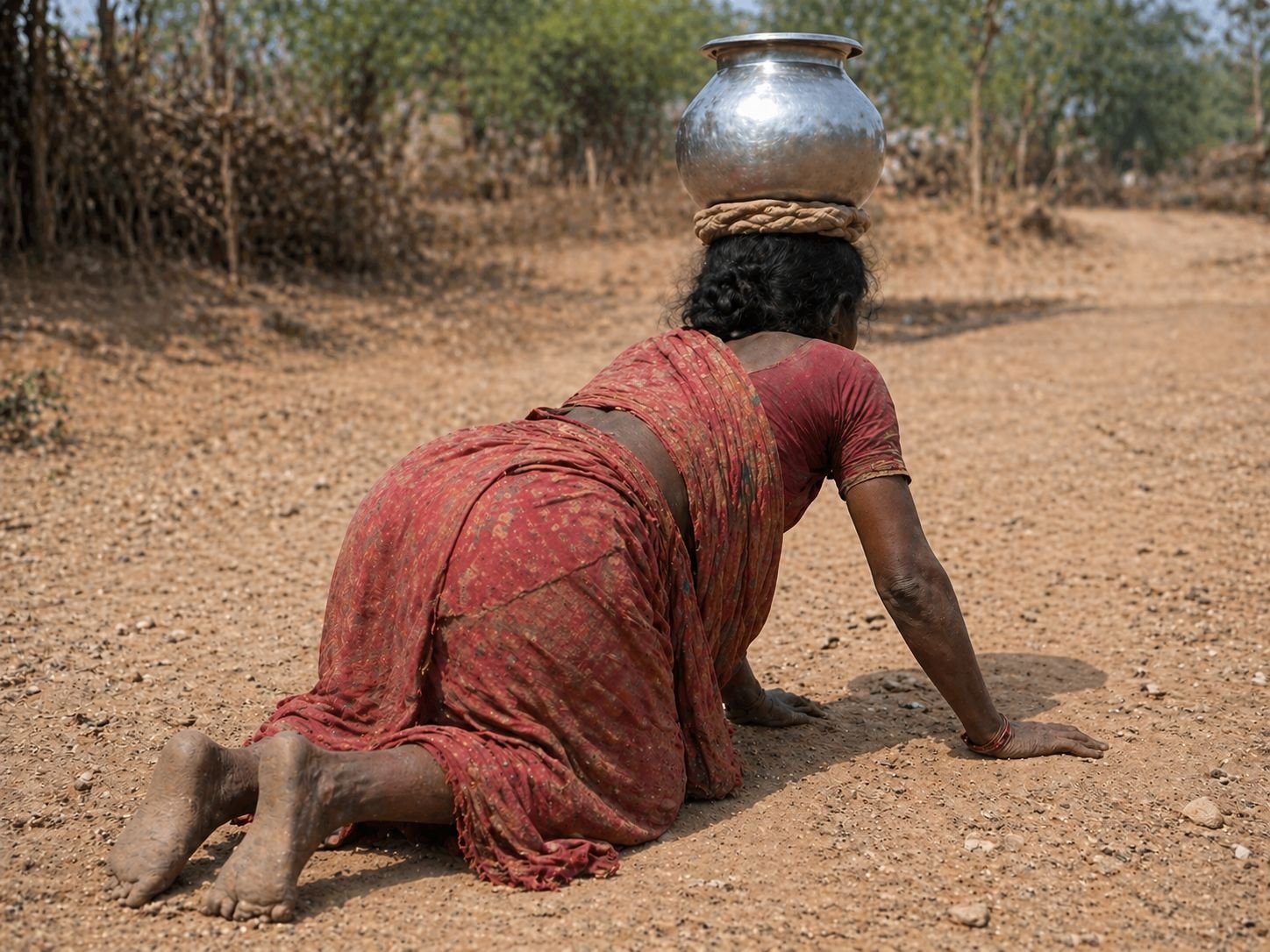
The incident highlights the disproportionate burden borne by tribal women, who continue to struggle for basic necessities in regions marked by poverty, poor infrastructure, and administrative neglect. For many, access to water remains a daily battle.
BY PC Bureau
April 29, 2026: In the remote tribal hamlet of Pipplawand Jamguda in Bastar district, Chhattisgarh, a heart-wrenching reality has come to light—one that underscores the persistent water crisis in India’s hinterlands. A disabled tribal woman, identified as [name withheld for privacy, or a placeholder such as Sukkri Bai in similar reports], is forced to crawl along dusty roads and uneven terrain every day to fetch drinking water, highlighting the stark disconnect between government claims and ground realities under the ambitious Jal Jeevan Mission (JJM).
The woman, who suffers from severe mobility impairment—likely due to polio or untreated injury, conditions not uncommon in under-served tribal regions—relies on family members or neighbours to help her reach a distant water source. Videos and local accounts show her dragging herself across the ground, often under the scorching sun, carrying a small pot or container. This daily ordeal not only endangers her health but also strips her of dignity in a region already grappling with poverty, Naxal influence, and limited infrastructure.
The Promise vs. Reality of Jal Jeevan Mission
Launched in 2019 by the Ministry of Jal Shakti, the Jal Jeevan Mission aims to provide Functional Household Tap Connections (FHTCs) to all rural households by 2024, ensuring safe and adequate drinking water. In Chhattisgarh, the scheme has been widely promoted, with official claims of significant progress in tribal-dominated districts like Bastar. Data suggests thousands of connections have been installed, many powered by solar energy in remote areas to overcome erratic electricity supply.
READ: India Looks Away as Tribal Women Battle it Out in Odisha
However, in villages like Jamguda (under Jagdalpur or Darbha tehsil), the mission appears to have faltered. Residents report that while taps were installed, many remain non-functional due to low water pressure, dried-up sources during summer, poor maintenance, or incomplete pipeline networks. In parts of Bastar district, functionality assessments have reportedly dipped as low as 37% in certain evaluations, with remote hamlets often left out of sustained service.
Locals in Pipplawand Jamguda allege that the promised taps either never materialised or stopped working months ago. “They showed us a tap and took photos for reports, but for most days, there is no water,” said a village elder. Women and girls bear the brunt of this failure, walking kilometres—or, in cases like this, crawling—to reach hand pumps, streams, or wells that often provide unsafe or contaminated water.
Life in a Forgotten Tribal Hamlet
Bastar, known for its dense forests, rich Adivasi culture (primarily Gond, Muria, and other tribes), and long history of Maoist insurgency, presents unique development challenges. Pipplawand Jamguda, a small and relatively inaccessible settlement, lies in a region where infrastructure projects are hindered by terrain, security concerns, and limited administrative reach.
The disabled woman’s family survives on minor forest produce, subsistence farming, and occasional wages under MGNREGA. Water scarcity compounds existing vulnerabilities—waterborne diseases, dehydration, and physical exhaustion are common. Children often miss school, and livelihoods suffer as hours are lost each day in the search for water.
छत्तीसगढ़ के बस्तर के पिपलावंद जमगुड़ा में एक दिव्यांग आदिवासी महिला को पानी के लिए सड़क पर रेंगना पड़ रहा है, यह जल जीवन मिशन की जमीनी हकीकत और विफलता को उजागर करता है। हर घर नल का दावा किया गया, लेकिन दूरदराज़ आदिवासी इलाकों में आज भी लोग पानी के लिए संघर्ष कर रहे हैं। pic.twitter.com/yFuTJTkX8H
— Hansraj Meena (@HansrajMeena) April 29, 2026
This incident is not isolated. Similar struggles have been reported across Bastar and other districts of Chhattisgarh, especially during the summer months when water sources shrink or dry up entirely. While there are success stories in certain villages—such as solar-powered water systems transforming daily life—many remote pockets remain neglected or only partially covered.
The plight of the disabled woman has triggered outrage on social media and among local rights groups, who are demanding urgent action: reliable water access, disability-inclusive infrastructure, and transparent audits of Jal Jeevan Mission implementation.
The story emerging from Pipplawand Jamguda is a stark reminder that large-scale schemes like the Jal Jeevan Mission must move beyond numerical targets to address issues of equity, accessibility, and sustainability. For tribal women—especially those living with disabilities—access to water is not merely a development indicator but a matter of survival, dignity, and basic human rights.
As temperatures rise and political attention sharpens ahead of elections, pressure is mounting on authorities to deliver on their promises. Until then, the image of a woman crawling for water will continue to challenge the narrative of inclusive development and raise uncomfortable questions about the reach of “Sabka Saath, Sabka Vikas” in the heart of tribal India.