The latest rescues follow the recovery of two Nepali workers from another debris-filled tunnel, offering fresh hope for hundreds still believed trapped at hydropower sites.
BY PC Bureau
Rescue teams in Nepal pulled a woman from a collapsed house and a Chinese national from a hydropower tunnel on Saturday, 10 days after devastating floods swept through the Himalayan region, offering a rare breakthrough as thousands remain missing.
The woman was rescued from a house in Nuwakot, the Nepal Army said. She was being airlifted to Kathmandu for medical treatment. The army did not immediately provide further details about her condition.
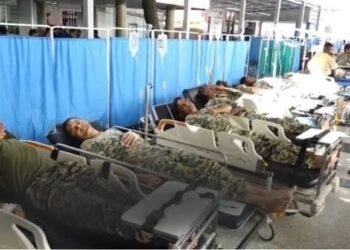
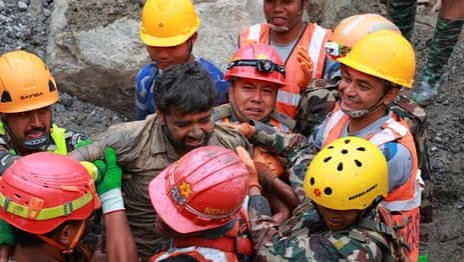
In a separate operation, Nepali soldiers and South Korean disaster specialists rescued a Chinese worker from a 225-metre (738-foot) tunnel at the Trishuli 3A hydropower project. The man was taken out alive and flown by helicopter, with an army medic checking him during the flight. He was undergoing a health assessment, according to the Nepal Army.
The rescue brings to three the number of workers found alive at the Trishuli hydropower project since Friday. Two Nepali workers were rescued from the same hydropower complex a day earlier, after rescuers located them inside a debris-filled tunnel.
The Associated Press reported that the two workers rescued Friday were found after search teams heard voices from inside the tunnel. One survivor said other people were still alive underground, according to Nepal Army spokesperson Brig. Gen. Raja Ram Basnet.
READ: Top US Generals Humiliated, Face Lie-Detector Tests in Iran War Leak Probe
The latest rescues have renewed hopes for others believed to be trapped beneath tonnes of mud and rock. Authorities estimate that about 900 workers are missing from 12 hydropower projects, with roughly 500 believed to be trapped inside tunnels. The floodwaters damaged roads, bridges and access routes, making it difficult for rescuers to reach the underground passages.
The disaster struck on August 26, when massive flooding swept through parts of Nepal along the border with China. The flooding was likely triggered by a glacier collapse, according to Nepal’s disaster management agency and reporting cited by AP.
At least 1,300 people have been killed in Nepal, while more than 5,000 remain missing, according to the country’s disaster management agency. China has separately reported deaths and hundreds of people missing on the Tibetan side of the border.
The destruction has been particularly severe around Rasuwa and Nuwakot, where hydropower projects were inundated and tunnels filled with mud, rocks and debris. The Independent Power Producers Association of Nepal said at least 12 hydropower projects in the two districts were damaged, representing a combined capacity of about 670 megawatts.
Rescuers face major obstacles in reaching those still missing. Many projects are located in remote mountain areas, while flood damage has destroyed or blocked roads. Some tunnel entrances have been buried or damaged, forcing crews to clear large quantities of debris before they can reach deeper sections.
AP reported that drone operators have also joined the search, with volunteers using drones to inspect tunnels and difficult-to-reach areas. At some locations, however, the mud has completely obscured the underground passages and rescuers have found no signs of life.
Disaster expert Anil Pokhrel, a former head of Nepal’s disaster authority, said the catastrophe exposed weaknesses in the country’s capacity to conduct complex tunnel rescues. Nepal has extensive experience building tunnels but remains less prepared for emergencies involving buried underground infrastructure.
The latest recoveries have nevertheless demonstrated that survival remains possible well beyond the initial days of a disaster.
The rescue of the Chinese worker came a day after two Nepali workers were brought out alive, while Saturday’s recovery of the woman from Nuwakot showed that survivors may still be found in collapsed buildings.
With hundreds of workers believed to remain trapped underground, rescue teams from Nepal and international partners continue to search the damaged hydropower sites.
For families waiting for news, the operations offer a fragile measure of hope even as the scale of the destruction becomes clearer. AP reported that the latest rescue operation was continuing amid the search for hundreds of missing workers and thousands of other people still unaccounted for.