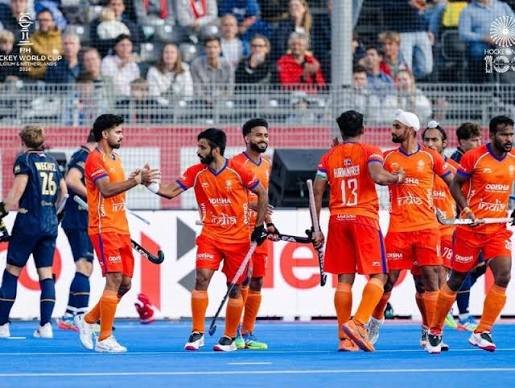
Hockey India said saffron was chosen to improve visibility on blue pitches, but former players and critics questioned the need to abandon the colour associated with India’s hockey legacy.
BY Navin Upadhyay
August 29, 2026: Saffron brought contrasting fortunes for India at the 2026 Hockey World Cup. While the men’s team endured a disappointing campaign and finished eighth, the women’s side enjoyed its best World Cup finish in 52 years, securing fifth place. Both teams wore the new saffron-dominated kits, turning the colour into an unlikely symbol of sharply different fortunes at the tournament.
The contrasting results have also revived the debate over Hockey India’s decision to replace the traditional blue jersey with saffron. What was introduced as a technical and design change became a major controversy before the tournament, with former players and critics questioning the decision to move away from a colour deeply associated with Indian hockey
By the time India’s campaign ended with a 3-3 draw against Belgium followed by a 4-3 penalty shootout defeat in the seventh-place play-off on August 28, the jersey had acquired a new association. For some fans, the saffron kit had become a symbol of a campaign that had failed to live up to expectations.
Of course, a jersey cannot lose a hockey match. India’s eighth-place finish had far more to do with performances on the field than the colour of its clothing. But the controversy exposed a deeper argument about sporting identity, tradition, politics and how decisions involving a national team should be made.
From blue to saffron
Hockey India unveiled the new jersey on July 27, ahead of the World Cup jointly hosted by Belgium and the Netherlands from August 15 to 30.
The predominantly saffron design featured mandala-inspired patterns, navy-blue elements and tricolour detailing. Hockey India presented saffron as a colour representing courage, sacrifice and national pride.
The reaction was immediate.
Former India captain Viren Rasquinha was among the strongest critics. He argued that blue was not merely a colour but part of the identity and history of Indian hockey.
His objection was echoed by other former players and supporters who questioned why a sport with such a strong visual association with blue should abandon it for its primary kit.
The change was particularly striking because Indian hockey’s blue jersey has been associated with generations of players and some of the country’s greatest sporting achievements. For many supporters, seeing India in blue has become almost as instinctive as seeing Argentina in its famous sky-blue-and-white stripes.
The controversy also acquired a political dimension because saffron has strong associations with Hindu nationalism in contemporary India. Opposition politicians criticised the change, while supporters of the decision rejected the suggestion that the colour had been chosen for political reasons.
Former Odisha Chief Minister Naveen Patnaik, whose state has played a major role in supporting Indian hockey, also questioned the move.
India Finished 8th after losing to Belgium in the penalty shootout. Harmanpreet Singh is the only postive in this World Cup. pic.twitter.com/8knSvAvUOr https://t.co/AIvVEMT0SA
— 𝕯𝖆𝖗𝖊𝖉𝖊𝖛𝖎𝖑 ;-) (@timeout_7) August 28, 2026
Hockey India’s explanation
Hockey India insisted that politics had nothing to do with the decision.
The federation said the primary reason was technical. According to Hockey India, the traditional blue playing kit could blend into the blue synthetic turf used at international hockey venues, affecting the ability of players to distinguish teammates quickly. The federation said the issue had been discussed with players and support staff, who considered alternatives including yellow and saffron before settling on saffron.
The explanation is not entirely without logic. Modern international hockey is generally played on blue artificial surfaces, and visual contrast matters in a fast-moving game in which players have only fractions of a second to identify passing options.
Hockey India also pointed out that India’s playing colours have changed before. The team wore yellow at the 2014 World Cup and later used a redesigned sky-blue kit.
But critics questioned why the problem had suddenly become serious enough to warrant abandoning the colour most closely associated with Indian hockey.
The timing also raised eyebrows. Blue synthetic pitches have been standard in international hockey for years, meaning the visibility issue was hardly new.
READ: CNG Price in Delhi-NCR Hiked by ₹3.89 per Kg
A controversy that refused to disappear
The debate intensified after reports suggested that not all players had been consulted before the decision was taken. Hockey India maintained that the change followed discussions with players, coaches and support staff.
The issue also exposed tensions within the federation. Hockey India president Dilip Tirkey, himself a former India captain and Olympian, was reported to have sought clarity over the decision-making process.
That turned what might otherwise have been a routine kit redesign into a broader question about who gets to decide how a national team presents itself.
For many former players, the argument was not about saffron itself. It was about what blue represented.
Blue had become part of India’s hockey memory: the Olympic glory years, the decline that followed, and the revival that eventually saw the men’s team return to the Olympic podium.
For them, changing the colour was akin to tampering with a sporting inheritance.
Then came the World Cup
India entered the tournament with expectations of reaching the latter stages.
The team began its campaign strongly, beating Wales 3-1 before losing 4-2 to England. India then produced one of the most entertaining results of the opening phase by beating Pakistan 5-3.
That left India second in its pool and through to the next stage.
But the campaign then unravelled.
India lost 3-1 to the Netherlands and 5-3 to Argentina, leaving the team without a point in the second-stage group and ending its hopes of reaching the semi-finals.
The performances highlighted problems that had little to do with jersey colour: inconsistency against elite opposition, defensive lapses, difficulty converting opportunities and an inability to maintain control against the strongest teams.
The final match provided both drama and disappointment.
Facing Belgium in the seventh-place classification match at Wavre on August 28, India twice found the net through captain Harmanpreet Singh after Abhishek Nain had opened the scoring. Harmanpreet’s late equaliser forced the game into a penalty shootout after a 3-3 draw.
Belgium eventually prevailed 4-3 in the shootout, condemning India to eighth place.
Was the saffron jersey “inauspicious”?
That question belongs more to superstition than sport.
Once India finished eighth, the jersey controversy inevitably returned to social media. The team had abandoned its familiar blue and failed to make the semi-finals. For supporters already unhappy with the colour change, the sequence was irresistible.
The narrative practically wrote itself: blue had brought glory; saffron had brought disappointment.
But there is no sporting evidence that the colour caused India’s poor campaign.
The more credible explanation lies in the team’s performances. India struggled to compete consistently against the Netherlands and Argentina and then lost to Belgium in a shootout after fighting back to force a draw.
The jersey did not concede five goals to Argentina. It did not fail to convert India’s chances. And it certainly did not take the penalty that was saved by Belgium goalkeeper Vincent Vanasch.
The saffron kit may therefore have been politically controversial, aesthetically unpopular and historically jarring to many fans, but calling it responsible for India’s eighth-place finish would confuse symbolism with causation.
A curious contrast
There is another reason the “inauspicious” argument is difficult to sustain.
India’s women’s team also wore the saffron kit during the World Cup and produced a remarkable result, finishing fifth — their best-ever World Cup position after a 3-1 victory over Germany.
If saffron itself were unlucky, the women’s team’s performance would make the theory rather difficult to defend.
What the contrasting campaigns actually demonstrate is that results depend on preparation, tactics, execution, confidence and the quality of opposition — not the colour of the shirt.
What the controversy really exposed
The jersey debate nevertheless revealed something important about Indian sport.
National-team colours are not merely commercial design choices. They carry memories, emotional associations and a sense of continuity.
Hockey India’s technical explanation may be valid, but the federation underestimated how strongly supporters identify Indian hockey with blue. It also failed to anticipate that replacing a century-old visual identity shortly before a major World Cup would invite questions far beyond technical visibility.
The controversy also showed how easily sport and politics intersect in contemporary India. Saffron is a legitimate colour of the national flag and has a long cultural history, but it also carries a powerful political meaning in today’s public discourse. That made the choice far more sensitive than a simple kit redesign.
What next for Indian hockey?
The eighth-place finish should prompt a much more serious discussion than whether saffron is lucky or unlucky.
India remains a major hockey nation, but its men’s team has yet to convert its recent revival into sustained success at the World Cup. The gap between India and the strongest European and South American teams remains evident.
The federation therefore has bigger questions to answer: tactical consistency, conversion rates, defensive organisation, player development and the ability to perform under pressure against the world’s best.
The jersey debate, however, is unlikely to disappear.
Hockey India may eventually return to blue, retain saffron or adopt a compromise design. Whatever it chooses, the lesson from the controversy is clear: when a colour becomes part of a nation’s sporting identity, changing it requires more than a technical explanation. It requires understanding what that colour means to the people who have watched generations of athletes wear it.
Saffron did not cause India’s eighth-place finish. But the decision to replace blue ensured that every defeat, every missed opportunity and every disappointing result would be viewed through the prism of a jersey that had already become controversial.
In that sense, the saffron experiment may prove memorable not because it was unlucky, but because Hockey India changed the colour of the shirt at precisely the wrong moment — just before a World Cup in which the men’s team failed to meet expectations.