Six Ukrainians arrested by the NIA in the Myanmar training case have secured default bail, while the agency’s chargesheet does not invoke UAPA against them. The development comes after the case was initially presented as a major anti-terror investigation.
BY PC Bureau
New Delhi/ September 23: The Delhi court’s decision to grant default bail to all six Ukrainians arrested by the National Investigation Agency (NIA) in connection with alleged training of ethnic armed groups in Myanmar marks a significant shift in a case that was initially presented as a possible cross-border terrorism and national-security operation.
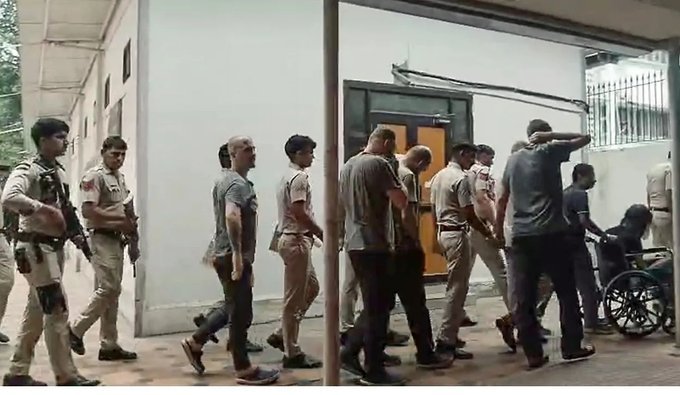
The six foreign nationals — Hurba Petro, Slyviak Taras, Ivan Sukmanovskyi, Stefankiv Marian, Honcharuk Maksim and Kaminskyi Viktor — were arrested in March after the NIA alleged that they had entered Mizoram, crossed into Myanmar and provided training in drone warfare and related technology to Myanmar-based ethnic armed groups.
The NIA had initially arrested the Ukrainians and American national Matthew Aaron VanDyke under the Unlawful Activities (Prevention) Act (UAPA), including Section 18, which relates to conspiracy for terrorist activities. But in its chargesheet filed earlier this month, the agency did not invoke the UAPA against any of the seven accused.
Instead, the chargesheet invoked Sections 21 and 23 of the Immigration and Foreigners Act, 2025 — offences relating to violation of visa conditions and entry into restricted areas. Both offences are compoundable.
The NIA has told the court that its investigation into possible UAPA offences is continuing and that a supplementary chargesheet could be filed if further investigation produces evidence warranting such charges.
READ: ‘Arrest Gyanesh Kumar’: Mamata Demands Fresh Bengal Polls
READ: SC Refers 2023 ECI Law Challenge to Constitution Bench; Justice Datta Questions Appointment Process
From terrorism allegations to default bail
Special Judge Prashant Sharma on Wednesday granted the six Ukrainians default bail on personal cash bonds of Rs 1 lakh each.
The court had earlier granted default bail to VanDyke after observing that the other accused appeared to be on a similar legal footing.
The court has also discharged the six Ukrainians from the offences under the Immigration and Foreigners Act after the Foreigners Regional Registration Office (FRRO) compounded the offences. The FRRO had imposed a penalty of Rs 5.5 lakh on each accused for alleged violations of visa conditions and for entering Myanmar without the required restricted-area permit.
The legal development does not amount to an acquittal on any alleged terrorism offence. At the same time, the present chargesheet is significant because the NIA has, for now, not brought the UAPA allegations into the prosecution against the seven foreign nationals. The agency has itself said that investigation into possible UAPA offences remains open.
What the NIA initially alleged
The case had generated considerable attention in the Northeast because the NIA alleged that the foreigners crossed into Myanmar and provided what it described as “pre-scheduled training” to ethnic armed groups in drone warfare, drone operations, assembly and jamming technology.
The agency had also alleged that the accused had links with armed groups regarded as hostile to India and had been in contact with individuals carrying AK-47 rifles.
But training an ethnic armed group fighting Myanmar’s military does not automatically establish that the trainers committed a terrorist offence against India. The NIA’s own investigation, as reported in September, had not reached that conclusion.
The Manipur connection
The case nevertheless acquired a wider political significance in Manipur, where the question of alleged cross-border support to armed groups has been a central part of the security narrative since the ethnic violence erupted in May 2023.
Former Manipur Chief Minister N. Biren Singh repeatedly argued during his tenure that the conflict had a foreign dimension. In September 2024, after the Assam Rifles announced the arrest of a Myanmar national whom it identified as a member of the Kuki National Army (Burma), Singh publicly welcomed the operation and said it indicated the involvement of foreign elements. However, the Kuki Students’ Organisation disputed the government’s characterisation of the arrested man, saying he was a registered refugee from Myanmar.
Singh had also specifically referred to suspected involvement of KNA(B) and foreign elements in attacks around Moreh. In January 2024, following attacks on security forces, he said there were doubts about the involvement of foreign mercenaries from Myanmar and that KNA(B)’s involvement was “highly possible.”
These statements are important because they illustrate the political and security context in which the subsequent arrest of the six Ukrainians was interpreted in parts of Manipur.