The leadership change that followed Biren Singh’s exit has not ended the BJP’s political troubles in Manipur. As Assembly elections approach, the party must manage his continuing influence, a fragile coalition and persistent ethnic tensions that remain a major test of the government’s credibility.
BY PC Bureau
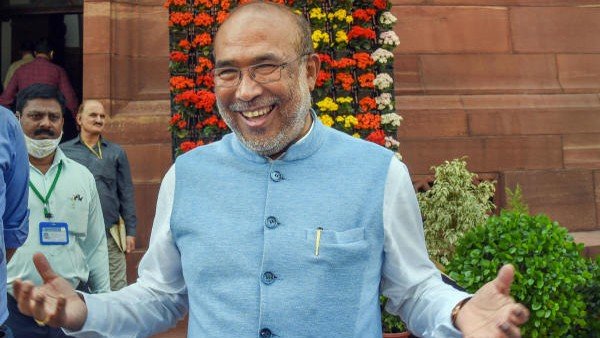
October 30: Former Manipur Chief Minister N. Biren Singh’s interview to a news agency on Friday has reopened the leadership battle within the BJP, exposing divisions that the party has struggled to contain even after replacing him with Yumnam Khemchand Singh. By accusing state BJP leaders of conspiring against him, questioning whether his removal had brought peace and warning that internal disunity could hurt the party electorally,
Biren has brought the unresolved power struggle into the open just months before the Assembly elections.
In his October 30 interview with PTI, Biren alleged that sections of the state BJP leadership had plotted against him since 2017 because they resented a former Congress leader becoming Chief Minister twice. He accused some state leaders of treating the party as their personal property, while carefully absolving the central leadership of involvement in his ouster.
But his sharpest criticism concerned the continuing violence. Questioning the argument that his departure was necessary to restore peace, he asked: “Now Biren is out. So, what happened now? How many Naga brothers have died?” He also referred to the renewed Naga-Kuki clashes and the widening Christian-versus-Christian dimension of the conflict.
The interview was more than an expression of resentment by a former Chief Minister. It was a reminder that Biren, despite losing office in February 2025, remains politically relevant and has not reconciled himself to the circumstances of his departure. His intervention also puts the present leadership in a difficult position: it must defend its record without allowing the former Chief Minister to become the focal point of an internal contest.
Khemchand’s unsettled government
Chief Minister Yumnam Khemchand Singh took office in February 2026 after nearly a year of President’s Rule. Yet, eight months later, his government has not fully consolidated its position. The five-member Council of Ministers, including the two Deputy Chief Ministers, reflects an arrangement that has yet to accommodate the competing interests within the BJP and its allies.
The tensions are visible in the relationship between Deputy Chief Ministers Nemcha Kipgen and Losii Dikho. Kipgen represents the Kuki-Zo community, while Dikho belongs to the Naga People’s Front, an ally of the BJP. Their differences over the renewed Naga-Kuki violence have added to the strain. NPF legislators have also threatened to leave the alliance unless Kipgen is removed from her post.
The government’s limited ministerial strength, unabated violence in the hills, and dissatisfaction among have left Khemchand with little room for political manoeuvre. The challenge is compounded by the fact that Kuki-Zo participation in the government remains constrained by the continuing ethnic divide and the absence of normal political engagement across communities.
Civil society pressure and the Biren factor
The government is also facing mounting pressure from civil society organisations. COCOMI and several Naga organisations have mobilised over security, territorial integrity, the Suspension of Operations agreement with Kuki militant groups, alleged illegal immigration and the protection of civilians. Their demands have increasingly put the government on the defensive.
These organisations are not formally aligned with Biren, though many of them are known to share excellent rapport with him. Several of their demands overlap with positions Biren Singh pursued as Chief Minister, particularly on poppy cultivation, illegal immigration, biometric identification and action against armed groups. His recent statements have amplified concerns over Naga casualties and questioned the present administration’s ability to deal with the security situation.
Biren has also criticised the state leadership for lacking the clarity and vision needed to strengthen Manipur Police and use central forces in support. He has argued that the conflict should be addressed through the state’s own security institutions rather than relying excessively on central forces.
This gives him an opportunity to remain politically active without holding office. His appeal among sections of the Meitei electorate, combined with his public criticism of the incumbent leadership, makes him a factor the BJP cannot simply ignore.
Peace remains the biggest political liability
The continuing violence is perhaps the most damaging issue for the BJP. The leadership change was accompanied by expectations that a new government would help restore normalcy. Instead, Naga-Kuki clashes have continued in districts such as Ukhrul, Kamjong, Kangpokpi and Senapati, while sporadic attacks on civilians have added to insecurity.
Thousands of internally displaced people also remain unable to return to their homes. Kuki-Zo MLAs largely remain disconnected from Imphal, while the state government has struggled to bridge the political and administrative divide.
Biren Singh’s question about what his removal achieved may be politically self-serving, but it touches upon a legitimate test of the government’s performance: whether the change of leadership has translated into greater security and a credible peace process.
A divided party faces an election test
With Assembly elections expected in early 2027, the BJP has limited time to address its internal divisions. The party must manage Biren Singh’s continuing influence, Khemchand’s efforts to establish authority, dissatisfaction among MLAs and tensions with its NPF ally. At the same time, it must respond to civil society groups that are increasingly willing to challenge the government through street mobilisation.
Biren has not called for the fall of the Khemchand government. He has maintained that the BJP must return to power and that policies initiated during his tenure should continue. Yet his public criticism has exposed the gap between the party’s stated unity and its unresolved internal rivalries.
The central leadership may be able to contain the immediate tensions, but a political settlement within the state unit remains elusive. Biren Singh’s interview has made one thing clear: the BJP’s leadership change did not end its internal conflict. With the election approaching, the party faces the challenge of projecting unity while its most recognisable former state leader publicly questions the leadership that replaced him.