

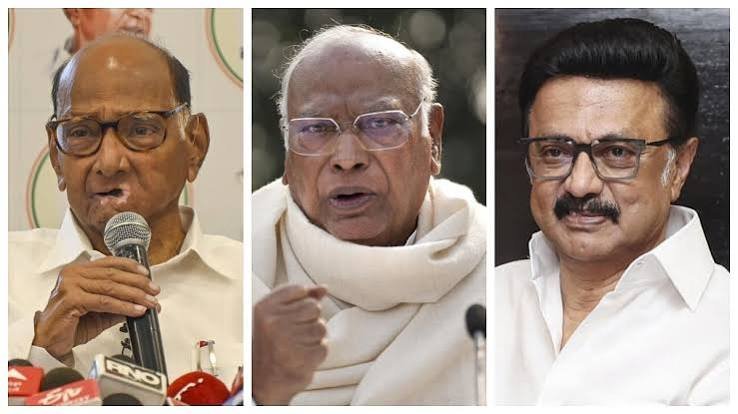
With the DMK and NCP (SP) signalling support, the Kharge-led Oppostion faces an uphill task in building a united Opposition front against the legislation.
BY PC Bureau
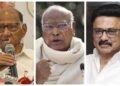
CHENNAI/MUMBAI/ November 29: Congress president Mallikarjun Kharge and Leader of Opposition Rahul Gandhi are stepping up efforts to prevent the DMK and the Nationalist Congress Party (Sharadchandra Pawar) from supporting the Centre’s Delimitation Bill ahead of the special session of Parliament. Kharge is scheduled to meet DMK president and Tamil Nadu Chief Minister M.K. Stalin in Chennai at 2 pm and NCP (SP) chief Sharad Pawar in Mumbai at 8 pm, sources said.
Congress leader Sonia Gandhi is also expected to accompany Kharge. Telangana Chief Minister Revanth Reddy, Karnataka Chief Minister D.K. Shivakumar, Trinamool Congress leaders Mamata Banerjee and Abhishek Banerjee, and representatives of the RJD and Samajwadi Party are likely to participate in the discussions.
The meetings come after both the DMK and NCP (SP) signalled their willingness to support the revised proposals. The NCP (SP) has described its decision as final, while the DMK has backed the new draft after the Centre accepted its demand for a 50 per cent increase in Lok Sabha seats, with safeguards for the representation of southern states.
Announcing the DMK’s decision on Saturday, Stalin said the revised bill incorporated the party’s two principal demands in writing. These include a commitment that Tamil Nadu’s existing 7.18 per cent share of Lok Sabha seats would not be reduced and that the state-wise proportion of parliamentary representation based on the 1971 Census would be maintained.
VIDEO | Delhi: Lok Sabha LoP Rahul Gandhi leaves from his residence.
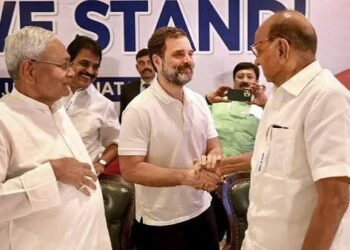
Congress president Mallikarjun Kharge, former party chiefs Sonia Gandhi and Rahul Gandhi, along with other INDIA bloc leaders, are set to meet DMK chief M K Stalin in Chennai and NCP(SP) supremo Sharad Pawar in Mumbai on Sunday, sources said amid efforts by the opposition to shore up numbers to defeat the government’s Constitution amendment bill, involving delimitation.
(Full video available on PTI Videos – https://t.co/bIyFWTfmBd)
— Press Trust of India (@PTI_News) November 29, 2026
The DMK had opposed the earlier version of the bill, introduced in April, arguing that it did not provide adequate assurances on these issues. “This is a victory for the sustained struggles waged by the DMK since 2024. A victory for all the southern states, including Tamil Nadu,” Stalin said, describing the revised draft as “feasible in practice and beneficial to us”.
DMK leader A. Raja said Tamil Nadu’s share of Lok Sabha seats would, in fact, rise marginally to 7.21 per cent under the revised proposal. He added that the demand for safeguards had been shared by several political parties.
READ: Sindarov Defuses Gukesh’s Preparation as Fourth Game Ends in Draw
The DMK’s opposition to the earlier bill had been particularly sharp. In April, hours before the special parliamentary session, Stalin hoisted a black flag and burnt a copy of the proposed legislation. He called it a “black law” and warned that it could turn Tamil people into “refugees” in their own land.
The NCP (SP), which has eight Lok Sabha MPs, has also endorsed the revised proposals, describing delimitation as a constitutional requirement. Its leaders have maintained that any expansion of the Lok Sabha should preserve the existing state-wise allocation of seats while providing for a uniform 50 per cent increase.
The Samajwadi Party, meanwhile, has issued a three-line whip to its Lok Sabha MPs for the forthcoming session, signalling the importance it attaches to the legislation.
The political arithmetic could prove significant. The NDA is estimated to have around 320 Lok Sabha MPs, including the BJP’s 241 members and those of its allies. If the DMK’s 22 MPs and the NCP (SP)’s eight MPs vote in favour, the number of MPs supporting the bill could rise to around 350, assuming the estimates and party positions hold.
Led by Kharge and Sonia Gandhi, the Opposition’s last-minute outreach reflects the difficulty of building a united front against the legislation when key regional parties appear prepared to back the revised draft. The meetings in Chennai and Mumbai will test whether the Congress can persuade its allies to reconsider their positions before the parliamentary session. Kharge shares excellent rapport with both Stalin, and if Sonia Gandhi could make, these could be the most important political meetings of this year.