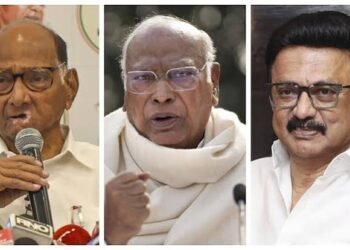


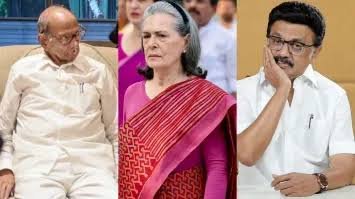
Sonia Gandhi’s decision to join the Congress delegation to Chennai and Mumbai marks a rare public intervention as the party struggles to hold the INDIA bloc together over delimitation.
BY PC Bureau
NEW DELHI/ November 29: Sonia Gandhi’s decision to join the Congress delegation travelling to Chennai and Mumbai to meet key Opposition leaders over the Delimitation Bill marks an unusual intervention by the senior Congress leader and underlines the importance the party attaches to blocking the legislation in its present form.
The Congress Parliamentary Party chairperson is accompanying party president Mallikarjun Kharge and Rahul Gandhi as they reach out to DMK chief M.K. Stalin in Chennai and NCP (SP) president Sharad Pawar in Mumbai. The delegation is seeking to persuade the two regional parties to reconsider their decision to support the Centre’s revised delimitation proposals.
The decsion of Sonia Gandhi to join the delegation is significant because she has kept a relatively low public profile in recent years, particularly during election campaigns.join the delega She has also curtailed her participation in public rallies and has rarely been seen undertaking high-profile political tours. In February 2024, she announced that she would not contest the Lok Sabha election, citing her age and health concerns. She subsequently moved to the Rajya Sabha from Rajasthan.
VIDEO | Delhi: Lok Sabha LoP Rahul Gandhi leaves from his residence.
Congress president Mallikarjun Kharge, former party chiefs Sonia Gandhi and Rahul Gandhi, along with other INDIA bloc leaders, are set to meet DMK chief M K Stalin in Chennai and NCP(SP) supremo Sharad Pawar in Mumbai on Sunday, sources said amid efforts by the opposition to shore up numbers to defeat the government’s Constitution amendment bill, involving delimitation.
(Full video available on PTI Videos – https://t.co/bIyFWTfmBd)
— Press Trust of India (@PTI_News) November 29, 2026
READ: Sonia, Kharge, Rahul, Mamata to Meet Stalin, Pawar to Oppose Delimitation Bill
Sonia Gandhi shares a long political association with M.K. Stalin, whose DMK has been one of the Congress’s most important allies in Tamil Nadu and at the national level. The two parties have worked together through successive electoral cycles, including the 2019 and 2024 Lok Sabha elections, and have been part of the INDIA bloc’s efforts to build a common Opposition platform. Sonia and Stalin have also shared the stage at several Opposition meetings. Their relationship has generally been marked by political cooperation, though the present disagreement over delimitation has placed the alliance under fresh strain.
Her relationship with Sharad Pawar goes back several decades and has weathered major political differences. Pawar was among the Congress leaders who broke away in 1999 after opposing Sonia’s elevation as party president, subsequently forming the NCP. Yet the two leaders later worked together when the Congress and undivided NCP shared power in Maharashtra and at the Centre under the UPA government. Their political paths converged again in the formation of the INDIA bloc. Sonia and Pawar have since been among the senior figures involved in Opposition coordination, making the present effort to persuade him particularly significant.
Sonia Gandhi’s decision to travel beyond Delhi suggests that the party views the emerging differences within the INDIA bloc not as an ordinary disagreement between allies, but as a serious challenge to its attempt to mount a united Opposition response to the government’s legislative agenda.
The Congress is particularly concerned that the DMK and NCP (SP), both important constituents of the Opposition alliance, have indicated support for the revised proposals. The DMK has backed the draft after securing assurances on Tamil Nadu’s share of Lok Sabha seats and the continuation of the existing state-wise proportion of representation. The NCP (SP) has also described its support as final.
For the Congress, the issue extends beyond the arithmetic of increasing the strength of the Lok Sabha. It has argued that linking the implementation of women’s reservation to delimitation and an expansion of Parliament could alter the balance of representation among states. The party and several Opposition allies have demanded that the 33 per cent reservation for women be implemented without making it conditional on a fresh delimitation exercise.
The stakes are particularly high for southern states, which fear that a delimitation exercise based on population could reduce their relative political influence because of their success in controlling population growth. The revised proposal’s assurances have, however, persuaded the DMK to change its position, exposing a major difference within the Opposition.
Sonia Gandhi has previously taken part in high-profile Opposition campaigns against government legislation, including the protest against the Land Acquisition Bill in 2015, when she led a delegation of Opposition leaders to meet then President Pranab Mukherjee. The present initiative is distinctive because senior Congress leaders are travelling to regional centres to negotiate directly with allies whose support is crucial to the Opposition’s parliamentary strategy.
The meetings in Chennai and Mumbai will thus be more than consultations between alliance partners. They will test whether the Congress can reconcile sharply differing regional interests and persuade its allies to oppose the Delimitation Bill despite the concessions incorporated in the revised draft.
Sonia’s participation is a measure of the political importance the Congress leadership has attached to that task.