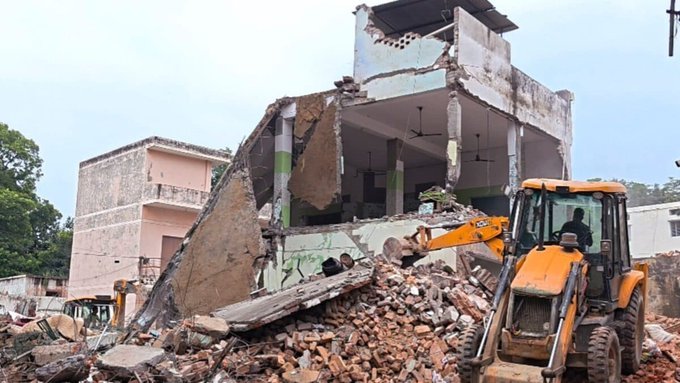
Akhilesh Yadav questioned the haste, saying the mosque management should have had an opportunity to seek relief from the High Court. The administration said it was enforcing a court order.
BY PC Bureau
September 5, 2026: A mosque inside the Saharanpur Collectorate complex was demolished early Saturday, September 5, a day after a district court upheld an order declaring the structure an encroachment on government land. The action, carried out under heavy security, triggered sharp protests from Opposition leaders, who accused the Uttar Pradesh government of acting with undue haste and denying the mosque management time to seek relief from the Allahabad High Court.
The administration, however, maintained that it was enforcing a judicial order after the mosque committee had lost its challenge before the City Magistrate and subsequently before the District Judge.
The dispute centres on about 315 square metres of land in Khasra No. 539, recorded in revenue documents as Collectorate/Kachahri land belonging to the state government.
The proceedings began after a complaint by Vikas Tyagi, a former Bajrang Dal provincial coordinator, who alleged that the mosque occupied government land inside the sensitive Collectorate complex. He also alleged that portions of the premises were being used commercially, including rented rooms and a post office.
Proceedings were initiated under the Uttar Pradesh Public Premises (Eviction of Unauthorised Occupants) Act, 1972. On July 16, City Magistrate Kuldeep Singh ordered removal of the structure within 30 days and imposed damages of about ₹6.41 crore for alleged unauthorised occupation.
READ: Nepal Flood: Miracle Rescue for Chinese Worker and Woman
Saharanpur, Uttar Pradesh: The more-than-70-year-old mosque situated within the Saharanpur collectorate premises was bulldozed and flattened by the administration at around 5 a.m. this morning.
After news spread last night that the mosque was to be demolished, a large number of… pic.twitter.com/arldqOruRi— The Muslim Matter India (@TheMuslimMatter) September 5, 2026
The mosque management disputed the government’s claim, maintaining that the structure was several decades old and that the property was waqf land. It relied on older revenue records and documents to argue that the mosque had existed before the present Collectorate complex. The magistrate’s court, however, held that the documents produced did not establish a valid title overriding the government’s claim over the land.
The committee appealed against the order before the District Judge. After hearings over several dates, District Judge Satendra Kumar dismissed the appeal earlier this week and upheld the City Magistrate’s order.
The administration moved swiftly after the district court ruling. The Collectorate was placed under heavy security, with police, Provincial Armed Constabulary and Rapid Action Force personnel deployed around the complex. The gates were sealed and demolition work began in the early hours of Saturday.
Saharanpur Deputy Inspector General Abhishek Singh said the action was taken after following the legal process and described the structure as an illegal construction on government land.
Officials also cited the location of the mosque inside the Collectorate, a sensitive government complex, and alleged commercial use of the premises as reasons for treating the matter seriously.
Akhilesh questions the haste
The timing of the demolition became the principal focus of the Opposition’s criticism.
Samajwadi Party chief Akhilesh Yadav questioned why the administration acted immediately after the district court ruling instead of allowing the mosque management an opportunity to approach the High Court and, if necessary, the Supreme Court.
Yadav said the government’s foremost responsibility was to preserve communal harmony. He argued that those who disrespect another person’s faith could not claim to represent the values of Sanatan tradition and invoked the principle of Vasudhaiva Kutumbakam.
He also questioned whether the purpose of the judicial system was being undermined when an administrative action was carried out before the affected party could seek relief from a higher court.
The SP chief’s criticism was echoed by party leaders in western Uttar Pradesh. Kairana MP Iqra Hasan said she was placed under house arrest at her residence when she attempted to travel to Saharanpur following the demolition. She condemned the action as politically motivated and questioned the purpose of courts if an administration could act before a higher court was approached.
Congress MP Imran Masood, who represents Saharanpur, described September 5 as a “black day”. He claimed the mosque had existed before 1911 and alleged that the administration surrounded the area overnight before bringing in demolition machinery. He said the matter would be pursued before the higher courts.
AIMIM chief Asaduddin Owaisi also attacked the demolition, arguing that the mosque management had produced historical records showing long-standing religious use of the site. He questioned the administration’s decision to remove the structure before the dispute could be examined by the High Court.
BSP chief Mayawati similarly criticised what she described as hurried demolition of mosques declared illegal by the authorities. She urged the Uttar Pradesh government to explore other ways of resolving such disputes while respecting the rule of law.
What about the High Court?
The most contentious issue is whether the administration should have waited before executing the demolition.
The mosque committee and Opposition leaders argue that, having lost before the City Magistrate and District Judge, the management should have been given time to move the Allahabad High Court for an interim stay.
The administration’s position is that no such stay existed when the demolition was carried out. Once the district court upheld the removal order, officials treated it as executable and proceeded with enforcement.
The administration has maintained that the operation was an enforcement action based on judicial findings concerning government land, rather than a decision taken solely on religious grounds.
The mosque, however, is now gone, leaving the dispute to the courts. The mosque committee and Opposition leaders have indicated that they will challenge the orders before the Allahabad High Court and potentially the Supreme Court.
What began as a dispute over 315 square metres of land inside a government complex has therefore become a larger political and legal confrontation over property rights, religious places, due process and the limits of administrative action.