



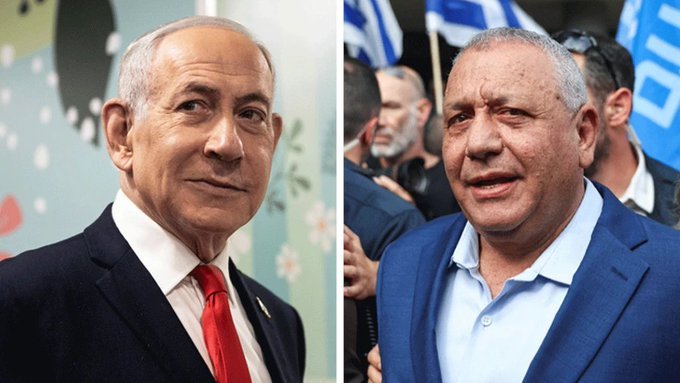
Israel’s Opposition leader Gadi Eisenkot’s Yashar party is projected to emerge as the largest opposition force, but ideological differences could prevent the rival parties from forming a government.
BY PC Bureau
October 28: Israel’s parliamentary election has produced a political stalemate, with exit polls indicating that Prime Minister Benjamin Netanyahu’s right-wing alliance has suffered substantial losses but the opposition remains short of a clear path to power. Neither camp appears to have secured the 61 seats required to command a majority in the 120-member Knesset, setting the stage for potentially prolonged coalition negotiations.
Projections released by Israel’s three main television networks put Netanyahu’s bloc at 51–52 seats, down sharply from the 68 seats held by the outgoing coalition. His Likud party is projected to remain the largest single party, with 25–27 seats. The opposition camp is expected to secure 68–70 seats collectively, but its divisions across the political spectrum could make it difficult to translate that numerical advantage into a functioning government.
The Yashar party, led by opposition figure Gadi Eisenkot, is projected to emerge as the largest opposition force, with 21–23 seats. However, the figures remain preliminary, and the final results could take several days to establish the precise balance of power.
Channel 14, which is generally supportive of Netanyahu, offered a more favourable projection, giving his bloc 60 seats and Likud 30. Most other television projections, however, pointed towards a hung parliament, leaving the prime minister’s political future uncertain.
Netanyahu and Eisenkot claim competing mandates
Addressing supporters at Likud headquarters in Jerusalem, Netanyahu stressed that his party remained the largest political force and argued that the right-wing bloc retained substantial support among Jewish and Zionist voters. He thanked voters for what he described as a renewed mandate but stopped short of declaring victory.
Netanyahu also ruled out a government dependent on Arab parties, accusing them of opposing Israel’s existence and criticising their positions on Hamas and Israeli soldiers. He called for the formation of a strong national right-wing government, signalling that he would seek to assemble a coalition despite the projected shortfall.
Eisenkot, speaking at his headquarters in Tel Aviv, presented the results as a rejection of Netanyahu’s continued leadership. He described the outgoing administration as a “coalition of failure” that had lost public confidence and argued that a responsible leader should recognise the verdict of voters and step aside.
The former Israel Defence Forces chief of staff, who lost a son in the Gaza war, did not claim victory. His challenge will be to bring together ideologically disparate parties and secure the support needed to form a government.
Arab parties make gains, complicating coalition arithmetic
Voter turnout reached at least 77.7%, the highest level since 1999, according to the exit-poll figures. Participation among Palestinian citizens of Israel, who constitute roughly one-fifth of the population, was particularly strong, with Arab parties reporting turnout above 75%.
The Joint List and Raam are projected to win a combined 17–19 seats, potentially marking their strongest showing to date. Their gains appear to have contributed to Netanyahu’s failure to secure a parliamentary majority, underlining the importance of Arab voters in determining the election’s outcome.
Leaders of the two parties said the results demonstrated that Arab citizens could not be excluded from national political calculations. They attributed the mobilisation in their communities partly to opposition to Netanyahu’s hardline coalition partners, particularly Itamar Ben-Gvir and Bezalel Smotrich. They have linked the government’s policies to rising crime and what they describe as prolonged neglect of Arab communities.
Yet the Arab parties’ gains also present a challenge for Eisenkot. Although the opposition has a numerical advantage in the projected seat count, it is far from a unified bloc.
Eisenkot has set conditions for potential coalition partners, including recognition of Israel as a Jewish state and the dismantling of Hamas as a terrorist organisation. These demands could complicate cooperation with Arab lawmakers, many of whom are unlikely to accept his terms.
Meanwhile, potential opposition allies Avigdor Liberman and Naftali Bennett have ruled out forming a government dependent on Arab parties. Their positions could leave Eisenkot unable to convert the opposition’s projected majority into the 61 seats required to govern.
READ: Drone Hunt Nets 13 of 17 Fugitives After Tamil Nadu Jailbreak
#Israel election Exit polls: Anti-Netanyahu bloc leads, Likud biggest party, neither side has clear path to a majority.
Voter turnout: 74,3^ https://t.co/ppb6nvtBHE
— MIBAWI (@RealMiBaWi) October 27, 2026
Coalition negotiations could prolong the deadlock
The next stage will begin after the official results are certified. President Isaac Herzog will consult political parties and then nominate the candidate he believes has the best chance of assembling a parliamentary majority. The task does not automatically go to the leader of the largest party.
The candidate receiving the mandate will have 28 days to form a government, with a possible 14-day extension. If the attempt fails, the president can give another candidate an opportunity to build a coalition. Failure to produce a viable government through the available constitutional process could ultimately trigger another election.
A national unity government bringing Likud and Yashar together remains theoretically possible, but the political obstacles are considerable. Eisenkot has ruled out serving in a government led by Netanyahu, while the two camps remain sharply divided over the direction of Israel’s policy and the leadership of the country.
Israel’s election has therefore left Israel facing a familiar but increasingly difficult dilemma: a fragmented parliament in which neither side can govern alone, and where ideological divisions may prove more decisive than the overall distribution of seats.
Unless one camp can persuade smaller parties to abandon their red lines, coalition talks could drag on, leaving the country without a clear governing majority and raising the prospect of another election.






Comments 1