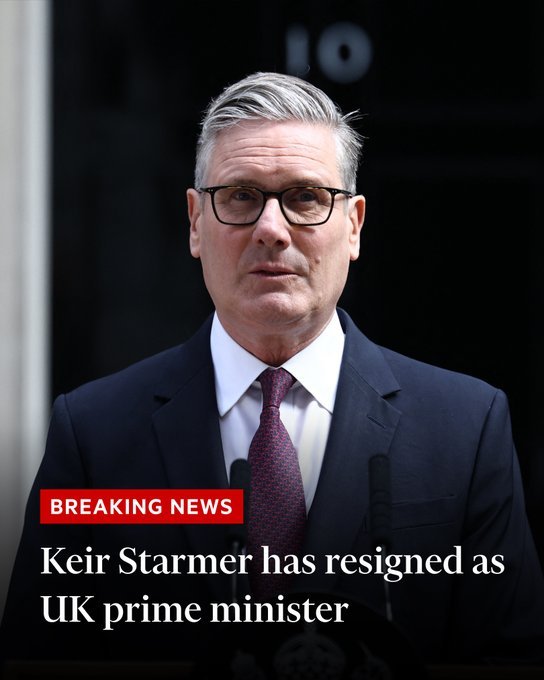
Keir Starmer’s exit marks a dramatic turning point for the Labour government, with senior party figures now preparing for a closely watched leadership contest.
BY PC Bureau
June 22, 2026 — In a stunning development that has sent shockwaves through British politics, Prime Minister Keir Starmer announced on Monday that he is stepping down as both Prime Minister of the United Kingdom and Leader of the Labour Party.
Starmer, who led Labour to a commanding general election victory in 2024, bowed to mounting political pressure following a turbulent period marked by internal party divisions, declining public support, and growing questions about his leadership. His resignation comes after weeks of speculation over his future and a weekend of intense discussions with family members, senior advisers, and key Labour allies.
The immediate catalyst for Starmer’s departure appears to be the decisive victory of Andy Burnham in last week’s parliamentary by-election. The former Mayor of Greater Manchester, a prominent figure on Labour’s left wing and a longtime critic of Starmer’s centrist approach, entered the contest openly positioning himself as a potential challenger for the party leadership.
UK PM Keir Starmer has officially announced his resignation. In a speech
outside 10 Downing Street, Starmer stated he will step down as leader of
the Labour Party. He will remain in office as PM until a successor is chosen.
pic.twitter.com/W3O9fpnyGP— Vyom Pallav 🇮🇳 (@VyomPallav) June 22, 2026
Mounting Pressure
According to sources close to Downing Street, Starmer spent the weekend reflecting on his position amid increasing unrest within Labour ranks. Backbench rebellions, disappointing polling figures, and criticism over issues such as the cost-of-living crisis, NHS waiting times, and immigration policy had steadily weakened his authority.
Burnham’s by-election triumph was widely viewed as a direct challenge to Starmer’s leadership. Often referred to as the “King of the North,” Burnham enjoys strong support among Labour’s grassroots members, trade unions, and traditional working-class voters. His campaign focused on tackling regional inequality, expanding public ownership of key services, and pursuing a more decisive break from policies associated with previous Conservative governments.
READ: Pakistan Warns of War if India Threatens Indus Water Supply
Starmer’s Farewell
In his resignation statement, Starmer is expected to thank voters, party members, and colleagues for their support while acknowledging the significant challenges faced by his administration. He is likely to argue that stepping aside is in the best interests of both the Labour Party and the country, allowing a new leader to take Labour forward ahead of the next general election.
Starmer’s departure automatically triggers a Labour leadership contest, with Burnham emerging as the early favourite. However, several senior Labour figures could also enter the race, including Deputy Prime Minister Angela Rayner, Chancellor Rachel Reeves, and Health Secretary Wes Streeting.
Party officials are expected to move quickly to establish a timetable for the contest, given the leadership vacuum at the top of government.
Political Uncertainty Ahead
The resignation introduces a fresh period of uncertainty in British politics at a time when the country continues to face economic challenges, international tensions, and demands for domestic reform. Financial markets are expected to closely monitor developments, while opposition parties, including the Conservatives and Reform UK, are likely to intensify criticism of Labour’s internal divisions.
Starmer’s resignation marks the end of a premiership that lasted just under two years. His tenure began with enormous optimism following Labour’s historic 2024 election victory but ultimately concluded amid internal conflict, political setbacks, and growing voter dissatisfaction.