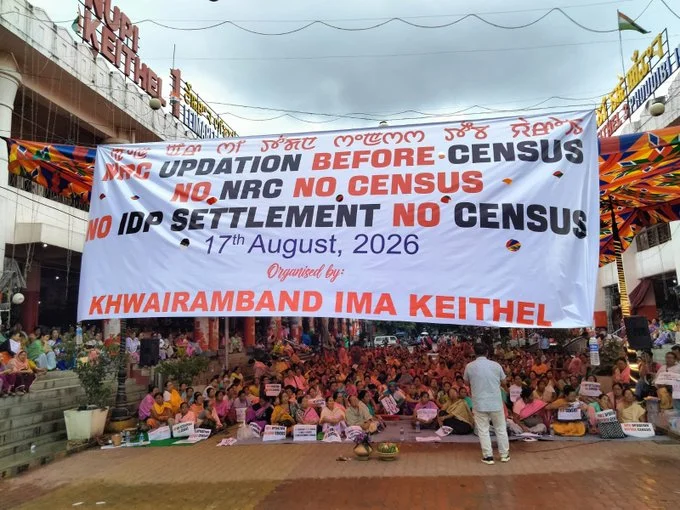
Meitei and Naga groups want citizenship verification before the census and delimitation, while Kuki-Zo organisations oppose the sequencing and say the population count should come first.
BY PC Bureau
August 30: The battle over who should be counted as a citizen of Manipur is moving from the streets to the courtroom, with the Manipur High Court set to hold a special sitting on Monday to consider petitions seeking directions for an updated National Register of Citizens (NRC).
A bench comprising Chief Justice M. Sundar and Justice A. Guneswar Sharma will hear a PIL filed by the Kangleipak Students’ Association and a writ petition filed by Shanta Singh Nahakpam, who is associated with 14 Valley-based civil society organisations.
Both petitions seek judicial directions to the authorities to undertake an NRC exercise in Manipur, using 1951 as the cut-off year. They also seek action against what the petitioners describe as illegal migration, particularly from Myanmar.
The petitions come amid growing pressure from Meitei and Naga organisations, which want an NRC exercise completed before the Census 2027 process and any subsequent delimitation exercise.
Their central argument is that population figures cannot provide an accurate basis for governance or political representation unless citizenship is first verified. They contend that conducting the census without determining who is a legitimate citizen could institutionalise existing patterns of displacement and disputed settlement arising from the prolonged Meitei-Kuki conflict.
The demand has also fuelled protests in the Valley. Meira Paibi groups have organised torch marches, while civil society organisations have called for office boycotts and campaigned under the slogan that there should be no census without an NRC.
The house-listing phase of Census 2027 is currently scheduled for September 1 to 30. Enumerator training, however, has already faced disruptions in parts of the state.
Petitioners argue that counting residents first and addressing citizenship later could have consequences for welfare entitlements, political representation and the delimitation of constituencies.
Kuki-Zo organisations have opposed the sequencing demanded by the Valley groups. They have described an NRC-before-census exercise as premature and argued that the regular population census should be conducted first.
READ: NEET-PG 2026: Power failure at two Jaipur centres forces retest for 2,445 candidates
The Centre has yet to resolve the dispute. Delegations from different communities have met Union ministers, while Chief Minister Yumnam Khemchand Singh has said the NRC demand would be discussed. A review of the issue is understood to be under way, but the Centre has announced no timetable for an NRC exercise in Manipur.
That leaves Monday’s hearing with significance beyond the two petitions themselves.
The High Court will be called upon to consider whether it can direct the government to initiate a process that has major implications for citizenship, migration, population data and political representation — and whether the demand for an NRC can be legally placed ahead of the approaching census.
For Manipur, the question is no longer confined to competing political demands. It is now before the judiciary, with the Census 2027 calendar rapidly approaching.