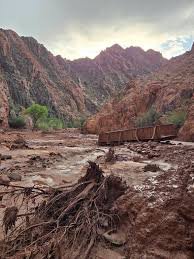
At least 62 people were evacuated from Phantom Ranch after intense rainfall sent boulders, metal debris and wreckage surging towards the Colorado River.
BY PC Bureau
August 31: A flash flood swept through a drainage in Grand Canyon National Park on Saturday afternoon, leaving more than 20 people unaccounted for, destroying footbridges and forcing the evacuation of dozens from the Phantom Ranch area.
The National Park Service said the torrent sent large boulders, metal debris and other wreckage into the Colorado River. Park officials are working with Arizona authorities to locate people still reported missing and evacuate visitors from areas affected by the flooding. Authorities have also appealed to anyone with information about hikers who were in the area to contact officials.
The flood struck Bright Angel Creek at around 2:30 p.m. Saturday after intense rainfall. The force of the water destroyed several footbridges and significantly altered the surrounding landscape. Images from the area suggest that the creek channel has widened and that the surge may have created a new rapid in the Colorado River.
“This is a reminder of what a dynamic and active landscape the Grand Canyon is,” said Jack Schmidt, director of the Centre for Colorado River Studies at Utah State University.
ARIZONA
🚨 Flash Flood Rips through Phantom Ranch at Grand Canyon National Park
Aug 30, 2026
Urgent search underway for more than 20 people after Grand Canyon flash flood
Approximately 15 people may be missing and dozens have been evacuated following a flash flood in Grand… pic.twitter.com/22r2QWiwrM
— Sid (@Trending_Sid) August 30, 2026
READ: UP Police Kill 2 Suspects in Haryanvi Singer Murder Case
Erica Viola, one of the survivors, said she was at Bright Angel Campground with about 50 other hikers when rain began falling. The group watched the creek rise rapidly before debris came rushing downstream, including what appeared to be part of a bunkhouse. The hikers were subsequently evacuated by helicopter, cutting Viola’s trip short by two days.
National Weather Service meteorologist Justin Johndrow, based in Flagstaff, said between half an inch and one inch (1 to 2.5 cm) of rain fell in roughly 30 minutes over steep, rocky terrain. “Most of it ran off instantly,” he said.
Bright Angel Creek runs down the canyon’s north side, dropping about 6,000 feet (1,828 metres) between the North Rim and the Colorado River. The combination of intense rainfall, steep terrain and limited soil allowed water to accumulate and rush rapidly through the drainage.
By Sunday morning, 62 people had been evacuated from Phantom Ranch, the historic Colorado River outpost with a canteen and dormitories that is a popular stop for hikers and river rafters. Further evacuations were continuing. No injuries had been confirmed at the time.
Authorities warned that additional thunderstorms and heavy rain could hit the region through Monday, raising the risk of further flash floods, debris flows, rockfalls and sudden changes in trail and river conditions.
Bright Angel Campground, Phantom Ranch and sections of the North Kaibab Trail remained closed Sunday while crews assessed the damage. Commercial rafting trips on the Colorado River were also suspended temporarily.
How a Flash Flood Forms
A flash flood can develop within minutes when intense rainfall overwhelms the ground’s ability to absorb water. In steep, rocky terrain such as the Grand Canyon, rainwater can run almost immediately into narrow washes and creek channels.
As water rushes downhill, it gains speed and volume, picking up rocks, trees and other debris along the way. The resulting surge can transform a normally shallow creek into a powerful torrent with little warning.
Grand Canyon Safety Protocols
Park officials advise visitors to check weather forecasts before entering canyon terrain and to avoid narrow drainages, washes and creek beds when thunderstorms are possible. Hikers should never assume that clear skies overhead mean they are safe, as heavy rain can fall miles away and send a sudden wall of water downstream.
Visitors caught in a storm should move to higher ground and stay away from creek channels and low-lying areas. Because conditions can change rapidly, hikers should also follow closure orders and evacuation instructions issued by park authorities.