BY PC BUreau
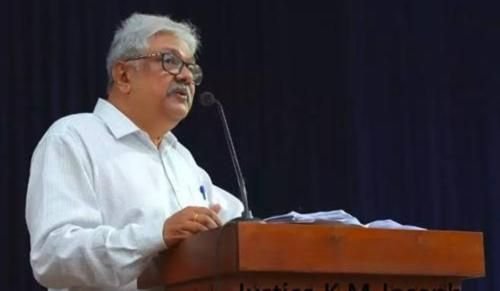
August 19, 2024: Former Supreme Court judge Justice K.M. Joseph has raised concerns over the growing nexus between large business groups and major media organisations, warning that partisan television debates can undermine public discourse and make it increasingly difficult for citizens to separate fact from opinion.
Speaking at a lecture organised by the Kerala High Court Bar Association to mark the 250th anniversary of the US Declaration of Independence, Justice Joseph said a functioning democracy depends on citizens having access to credible and impartial information. He linked the issue to the democratic principle of “consent of the governed”, arguing that such consent has meaning only when people are adequately informed.
“I am really concerned about the way the majority of the national media houses that I get to listen, how it reveals the close inexorable link between the business houses and the media,” Justice Joseph said.
He argued that such relationships can damage what should otherwise be a healthy democratic discourse.
Justice Joseph also referred to the Supreme Court’s recognition of the right to be informed as an important component of the freedom of speech. Major media organisations, he said, possess resources that enable them to collect and disseminate information that ordinary citizens may not be able to access themselves.
However, he expressed concern over the manner in which television debates are conducted, particularly when anchors intervene in ways that favour one side.
He said an anchor who fails to provide participants with a level playing field could manipulate the discussion, exposing personal or institutional bias and leaving viewers uncertain about what the truth actually is.
“The ultimate right of every citizen in any democracy is to pursue truth and find truth,” he said, adding that this basic democratic principle was increasingly being compromised.
Justice Joseph said he continued to watch television news with the expectation that the situation would improve.
“I am just pouring out my heart before you because I watch every day with the hope that they change,” he said.
He also flagged another potential vulnerability: the dependence of media organisations on government advertising.
Describing government advertising as capable of creating a “carrot and stick” situation, Justice Joseph referred to programmes in which chief ministers or other government representatives highlight their achievements while the fact that the programme is sponsored is disclosed only through small on-screen disclaimers.
He questioned whether such practices could compromise editorial independence and called for greater institutional attention to the functioning of the broadcasting sector.
“I really wish the authorities will take notice because we do have a broadcasting authority,” he said, while acknowledging the need to balance any regulatory intervention with constitutional protections for freedom of speech and the press.
Justice Joseph also invoked the Constitution Bench judgment in Kaushal Kishore v. State of Uttar Pradesh, which examined the application of fundamental rights under Articles 19 and 21 beyond the traditional state-citizen relationship.
Applying that principle to televised debates, he suggested that a participant whose views are deliberately suppressed or distorted could potentially have grounds to invoke constitutional protections.
READ: Two Deaths in 24 Hours Fuel Rage Over Kangpokpi Road Blockade
“If I am actually snuffed out, if what I want to say I am not permitted to say, I am tortured out of shape in what I have said,” Justice Joseph said.
He argued that such conduct could implicate not only the rights of the person participating in the debate but also those of viewers who rely on the programme to understand competing viewpoints.
His remarks place the spotlight on a broader question confronting Indian journalism: whether concentrated ownership, dependence on advertising and increasingly combative television formats are weakening the media’s role as an independent platform for democratic debate.
For Justice Joseph, the issue ultimately goes beyond journalism. It concerns a citizen’s ability to obtain information, evaluate competing claims and arrive at the truth — a function he described as fundamental to any democracy.