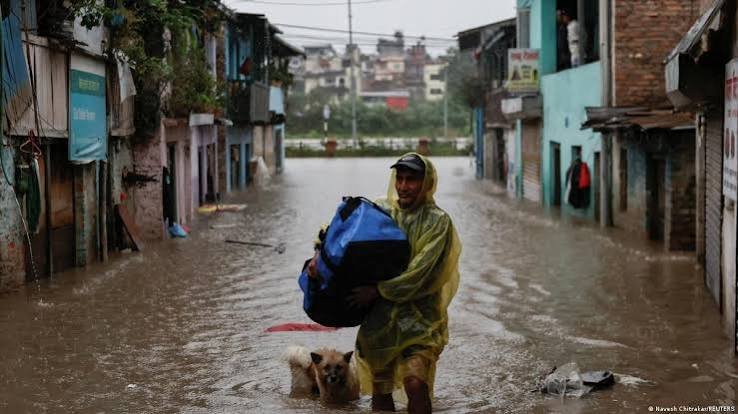
Authorities are investigating whether the sudden surge in the Bhote Koshi was caused by the draining of a supraglacial lake in Tibet. A similar flood last year killed nine people and destroyed a key Nepal-China bridge.
BY PC Bureau
A massive flash flood swept through Nepal’s Rasuwa district along the Bhote Koshi River on Wednesday, killing at least eight people and leaving 41 security personnel unaccounted for, according to the latest reports. The disaster devastated settlements and infrastructure near the Tibet border, while search-and-rescue teams raced to locate those missing.
The worst-hit areas were Timure and Syapru Besi, where floodwaters and debris tore through homes, markets, vehicles, roads, bridges and hydropower facilities. Three police offices in the district were also damaged. The scale of the destruction remains difficult to assess because communications and access to several affected areas have been disrupted.
READ: 15 Newborns Die in Nursery Fire at Islamabad Hospital
🇳🇵 Horrifying footage from Nepal’s northern Rasuwa district, which was hit by a massive flash flood.
At least seven people have been confirmed dead, and 20 people are reported missing. pic.twitter.com/m4PuqGqxJ2
— Visegrád 24 (@visegrad24) August 26, 2026
Among those unaccounted for are 32 Nepal Police personnel and nine members of the Armed Police Force (APF). Officials cautioned that some personnel may have moved to safer locations and could still be unreachable because of disrupted communications. Search teams are continuing efforts to establish contact and determine their whereabouts.
The flood also caused extensive damage to Nepal’s energy infrastructure. Several hydropower projects were affected, disrupting electricity supplies in the region. Reuters reported that damage to power facilities has knocked out around 430 MW of generating capacity, equivalent to more than 12% of Nepal’s total capacity.
Prime Minister Balendra Shah ordered the immediate deployment of police, the Nepal Army and other emergency teams for rescue and relief operations. Authorities have directed residents in vulnerable and low-lying areas to move to safer ground and warned communities along the Bhote Koshi and downstream Trishuli River basin to remain on high alert.
Two Nepal Army helicopters, accompanied by medical teams, have been deployed to assist with search, rescue and relief operations, while private helicopters have also been placed on standby. However, difficult terrain, damaged roads and high water levels have complicated access to some of the worst-affected areas.
Today, a devastating sudden surge in the Bhotekoshi River has caused widespread destruction, with fears that several people may have been killed or swept away. 📍Rasuwa District, Nepal, along the China border. pic.twitter.com/52if8LGlO9
— Weather Monitor (@WeatherMonitors) August 26, 2026
The precise cause of the sudden surge in the Bhote Koshi remains under investigation. A regional climate monitor has linked the event to the draining of a supraglacial lake in Tibet. A similar disaster struck the same river last year and was also attributed to the draining of a glacier lake, killing nine people, leaving 24 missing and destroying the Friendship Bridge linking Nepal and China.
The Bhote Koshi originates in Tibet before flowing into Nepal, where it eventually joins the Trishuli River. The Trishuli continues southwards into India as the Gandak, raising concerns over possible downstream impacts as floodwaters move through the river system.
The disaster has also affected areas across the border in Tibet. A mudslide at Gyirong county caused casualties and left people missing, while roads, communications and electricity were disrupted. Chinese President Xi Jinping ordered an intensified search-and-rescue operation and called for stronger monitoring and early-warning systems to prevent further disasters.
As the death toll remains uncertain and dozens of security personnel are still unaccounted for, authorities in Nepal are continuing to assess the destruction. With entire sections of settlements and infrastructure swept away, officials have warned that the human and economic cost of the disaster could rise further as rescuers reach areas cut off by the flood.