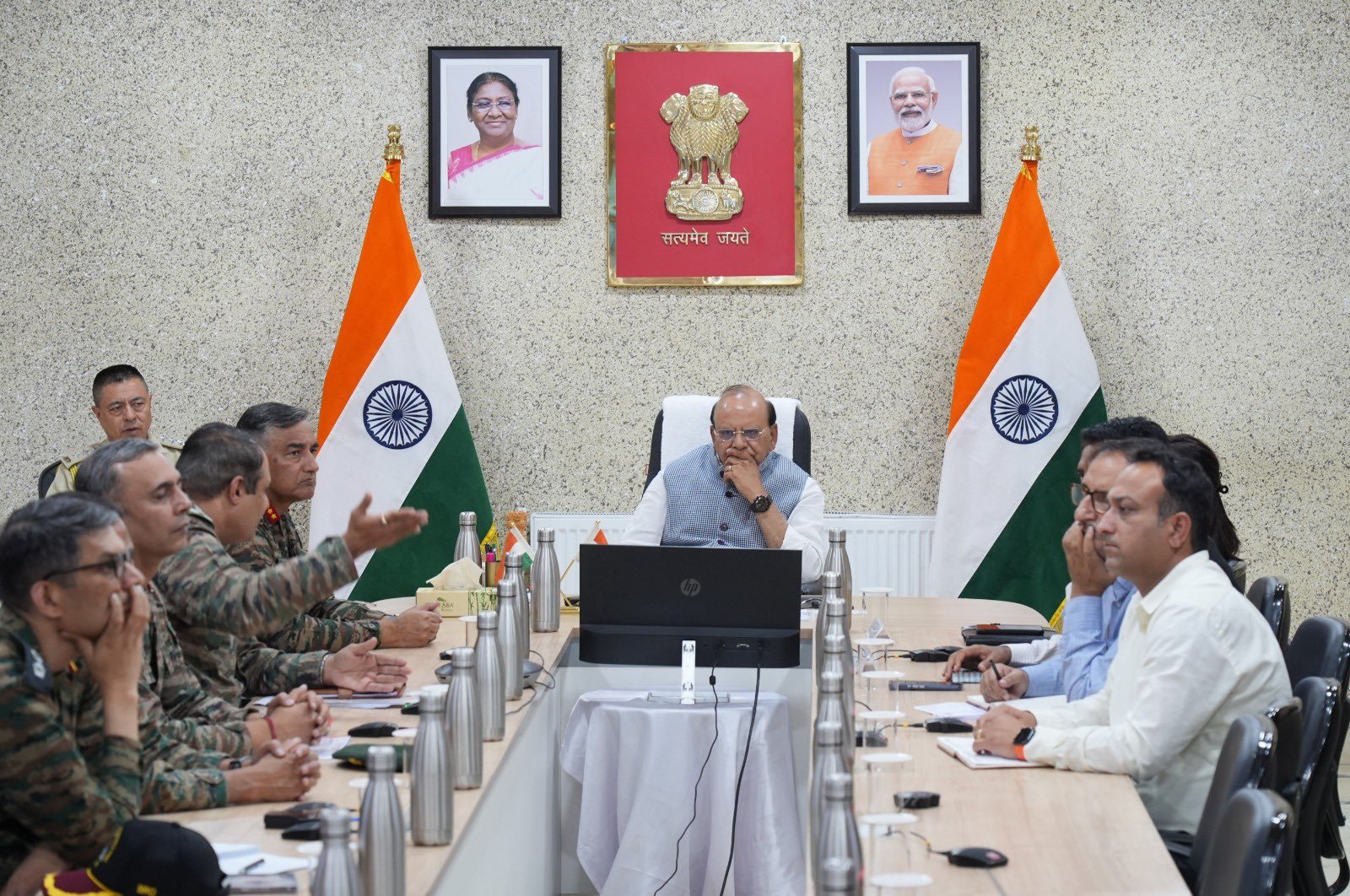
Calling for a shift from reactive disaster response to proactive prevention, Saxena stressed that safeguarding lives, protecting infrastructure and ensuring uninterrupted connectivity remain the administration’s top priorities.
By PC Bureau
August 7, 2026: In the wake of a series of flash floods, landslides and rockfalls that have disrupted traffic and damaged property in Ladakh, Lieutenant Governor Vinai Kumar Saxena on Friday directed the Border Roads Organisation (BRO) and the Public Works Department (PWD) to undertake immediate safety audits of vulnerable road stretches and implement advanced slope-stabilisation measures to minimise future risks.
Chairing a high-level review meeting in Leh, the Lieutenant Governor stressed that the Union Territory must move from a reactive approach to a preventive strategy to safeguard lives, protect critical infrastructure and ensure uninterrupted connectivity across the region, particularly along strategic highways that serve both civilian populations and the armed forces.
The meeting was attended by senior officials of the Army, BRO and the UT Administration, including General Officer Commanding (GOC), 14 Corps, Lt Gen Madanraj Pande, Chief Engineer, HQ 14 Corps, Brig Aditya Harshey, Chief Engineer, Project Vijayak, Brig Rahul Oberoy, Chief Engineer, Project Himank, Brig Rajiv Ahlawat, and the Secretary, Public Works Department.
The review comes after recent episodes of landslides and rockfalls triggered by intense rainfall damaged homes in several villages and repeatedly blocked key highways, affecting civilian movement, tourism and military logistics.
Focus on High-Risk Corridors
During the meeting, Saxena ordered a comprehensive safety audit of the most vulnerable road stretches in the Union Territory.
He directed agencies to immediately inspect nearly 15 identified landslide-prone locations on the Leh-Kargil National Highway, one of Ladakh’s most important transport corridors, as well as four to five critical points on the Khardung La Pass along the Leh-Nubra Road, a vital route connecting Leh with the Nubra Valley and strategically important border areas.
The agencies have been asked to assess unstable slopes, identify loose and overhanging rocks, and remove hazardous formations before they pose a threat to commuters or trigger fresh disruptions.
‘Move Beyond Reactive Response’
Emphasising the need for long-term mitigation, the Lieutenant Governor said the recent disasters highlighted the growing vulnerability of Ladakh’s fragile mountain terrain.
“The recent flash floods, landslides and rockfalls have once again underlined the need to strengthen our preparedness and move beyond reactive response to proactive prevention. I have directed the concerned agencies to identify vulnerable locations, undertake detailed safety audits and use the best available technologies for slope stabilisation and rockfall protection. Our priority is to ensure the safety of people, protect critical infrastructure and maintain uninterrupted connectivity across Ladakh,” Saxena said.
READ: Monsoon Mayhem in Delhi-NCR: Roads Submerged, Commuters Stranded
Army, BRO Praised for Swift Response
The Lieutenant Governor commended the Army and the BRO for their rapid response during recent natural disasters, particularly their efforts in clearing blocked roads, restoring traffic and assisting affected residents.
He noted that while emergency response mechanisms had worked effectively, increasing instances of cloudbursts, flash floods and slope failures made preventive engineering interventions essential.
Experts Explain Causes of Landslides
During the presentation, BRO engineers highlighted several factors contributing to the recent rise in landslides and rockfalls across Ladakh.
These included changing rainfall patterns in the high-altitude desert region, fragile geological formations, steep slope gradients, weathering of rocks, construction activities, seismic vibrations and increasing pore-water pressure within mountain slopes following heavy rainfall.
Officials noted that while Ladakh traditionally experiences low rainfall, recent years have witnessed more frequent episodes of intense precipitation linked to changing weather patterns, making the region increasingly susceptible to slope failures.
#Watch: Kharu Police in Ladakh rescued 35 stranded passengers, including foreign nationals, after a landslide blocked the Shang Sumdo to Chokdo road.
Reported by : @UmarRaina9 @DGP_Ladakh @lg_ladakh pic.twitter.com/0BVmKpAqnn
— Rising Kashmir (@RisingKashmir) August 7, 2026
Advanced Technologies to Be Deployed
BRO engineers also presented a range of modern engineering solutions available for slope stabilisation and rockfall mitigation.
These include the construction of retaining walls and breast walls, installation of flexible steel ring nets, rock bolting, soil nailing, anchoring systems, rockfall embankments, rock sheds, and high-energy impact barriers designed to arrest falling boulders before they reach highways.
The agencies also discussed deploying smart rockfall detection systems capable of providing real-time alerts, along with advanced geosynthetic materials such as geogrids, geotextiles, geomembranes and geocells to reinforce unstable slopes and improve long-term stability.
Officials said the choice of technology would depend on the geological characteristics of each vulnerable site.
BRO, PWD to Begin Immediate Action
The Chief Engineer of Project Vijayak assured the Lieutenant Governor that safety audits and mitigation work on both the Leh-Kargil National Highway and the Leh-Nubra Road would begin on priority.
Saxena also instructed the Public Works Department to conduct similar assessments on road stretches under its jurisdiction and prepare an action plan for slope protection and long-term risk reduction.
The review assumes significance as Ladakh remains in the middle of the monsoon season, when sudden cloudbursts and flash floods frequently trigger landslides that cut off remote areas and hamper the movement of civilians, tourists and defence personnel.
With climate variability increasing the frequency of extreme weather events in the Himalayan region, the administration hopes that systematic safety audits and the use of advanced slope-stabilisation technologies will significantly reduce the risk of future disasters while ensuring safer and more reliable road connectivity across Ladakh.