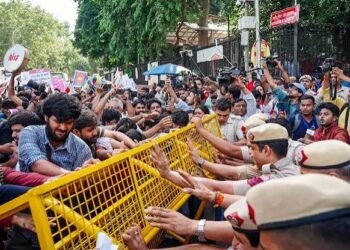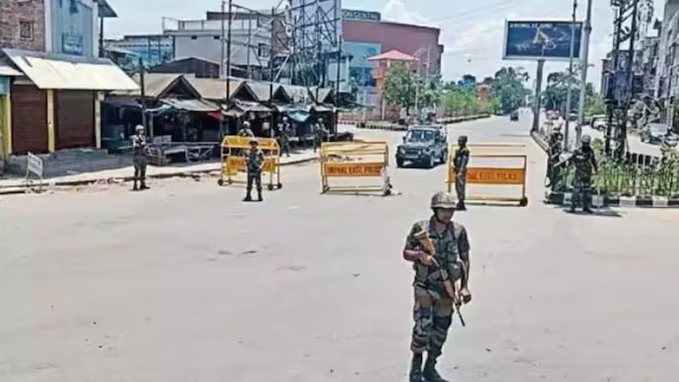
The twin shutdowns highlighted Manipur’s continuing divide, with the valley focused on identity and demography and the hills grappling with killings, displacement and fears of renewed ethnic violence.
BY PC Bureau
September 2, 2026: Manipur fell silent for two very different reasons on Tuesday. In the Imphal Valley, markets, schools and public transport shut down over a demand to update the National Register of Citizens before the Census. In the Kangpokpi hills, shops closed and roads emptied as Kuki-Zo groups mourned three villagers killed in a shooting, while fresh arson and gunfire hit nearby Naga settlements.
The parallel shutdowns underscored the depth of Manipur’s continuing divide: in the valley, the dispute centred on identity, documentation and demography; in the hills, it was driven by killings, displacement and fears of another cycle of retaliation.
Kangpokpi: Three killings, a bandh and fresh violence
A 24-hour shutdown called by the Committee on Tribal Unity (CoTU) began at 5am across Kangpokpi district and was scheduled to end at 5am on Wednesday. Shops remained closed and traffic on key routes, including stretches of National Highway-2 and the Imphal-Tamenglong Road, was sharply reduced.
Volunteers were reported to have placed boulders and felled trees along parts of the Imphal-Tamenglong road, slowing traffic and, in some places, affecting the movement of security convoys.
CoTU called the bandh after three Kuki-Zo villagers were killed in an August 31 attack on N. Teikhang village in the Twilang area of T. Waichong subdivision. Police said three civilians were shot dead and four others injured.
The deceased were identified as Tingneichin Lhouvum, 40, Hoineineng Lhoujem, 21, and Lamtinthang Lhoujem, 35-36. Two women were among the injured. Several houses were also reported burnt. The bodies were brought to Kangpokpi District Hospital late Monday night, where relatives gathered at the morgue.
Kuki organisations alleged that cadres of the NSCN-IM and ZUF-K were behind the attack. The allegations have not been independently verified, and neither group has publicly claimed responsibility.
Chief Minister Yumnam Khemchand Singh, who was in New Delhi, condemned the killings and said those responsible would be arrested.
The shutdown, however, did little to halt the violence.
In the early hours of Tuesday, armed men attacked several Liangmai Naga villages along the same Imphal-Tamenglong road, including Tapon Khullen, Tapon Khunou/Tapon Namsan and Makui Pipuram, according to reports.
Police and village authorities said houses were torched, vehicles and a rice mill destroyed and church property damaged. Around 30 houses were estimated to have been burnt or damaged. A village pastor and at least one other resident were reportedly injured in firing. No deaths were reported in the Tuesday attacks.
Kuki and Naga organisations traded accusations over the violence. Police described the attacks as the work of armed Kuki militants, while Kuki groups rejected the allegation and blamed Naga actors.
CoTU spokesperson Ng Lun Kipgen said repeated clashes since the beginning of the year had pushed Twilang “on the verge of a full-scale conflict”. He urged the Khemchand government not to repeat what he described as the failures that preceded the violence of May 3, 2023.
CoTU said it had already submitted its demands to Deputy Chief Minister Nemcha Kipgen and would assess the government’s response before deciding whether to launch what it called “more extreme democratic forms of agitation”.
READ: Five Killed, 63 Wounded in US Strike on Iran Wedding
Valley: Census deferred, bandh continues
Across the five valley districts — Imphal East, Imphal West, Thoubal, Bishnupur and Kakching — a 24-hour general strike called by the Campaign for Just and Fair Delimitation (CJFD) shut markets, schools and public transport.
At several places, including Yairipok, protesters erected bamboo and wooden barricades. At Khwairamband Ima Keithel, women vendors joined the protest, enforcing the shutdown and raising slogans opposing the Census without an updated NRC.
The bandh continued despite New Delhi’s decision on Monday to defer Census operations in Manipur. House-listing had been scheduled to begin on Tuesday.
A review meeting chaired by Union Home Minister Amit Shah, attended by Governor Ajay Kumar Bhalla, Chief Minister Singh and Union Home Secretary Govind Mohan, concluded that proceeding with the exercise could create another flashpoint in a state still grappling with ethnic violence and approaching Assembly elections.
Separately, the Manipur High Court ordered that the house-listing exercise remain on hold until at least October 12.
The CJFD said the strike would continue until the Centre issued a formal gazette notification rather than merely announcing the deferment. Its principal demand is an updated NRC before the Census and any delimitation exercise. Several valley-based organisations have advocated 1951 as the base year, citing concerns over demographic change and alleged undocumented migration from Myanmar.
Chief Minister Singh and Home Minister Konthoujam Govindas Singh appealed to civil society organisations to withdraw the bandh, warning that such shutdowns hurt students, daily-wage workers and other ordinary residents. Singh also thanked valley civil society groups and BJP MLAs who had pressed the Centre over the issue.
The Kuki-Zo Council, meanwhile, rejected the demand for a Manipur-specific NRC. Its spokesperson, Ginza Vualzong, argued that the Constitution did not provide for a state-specific NRC and said the Assam exercise had emerged from the 1985 Assam Accord. A separate NRC for Manipur, he said, would be “discriminatory” and “unconstitutional”.
Imphal, Manipur: The state observed a 24-hour statewide strike called by the Campaign for Just and Fair Delimitation, demanding NRC updation before the Census. Markets, schools and public transport remained shut, while protesters blocked roads. Essential, emergency and religious… pic.twitter.com/OHyZcBNjXM
— IANS (@ians_india) September 1, 2026
Two shutdowns, one unresolved crisis
By Tuesday night, Manipur’s two protests were speaking almost entirely different languages.
In the valley, the dispute was about documents, base years, demographic change and delimitation. In the hills, it was about funerals, burnt homes, armed attacks and competing claims over who opened fire.
Yet the immediate consequence was the same: roads were emptied, businesses closed and ordinary life was disrupted.
The parallel shutdowns also exposed the challenge facing the Khemchand government. A response to the valley’s demands risks deepening the hills’ fears, while failure to contain violence in the hills could trigger another cycle of mobilisation and retaliation.
CoTU said the ball was now in the government’s court. CJFD said a verbal deferment of the Census was not enough.
Between those two positions, Manipur spent September 1 largely shut down — divided by two demands, but united by the fear that the next spark could once again engulf the state.