Nemcha Kipgen’s decision to accept the office of Deputy Chief Minsiter and Kimneo Haokip Hangshing’s return to the Manipur Assembly have exposed a troubling contradiction in Kuki-Zo politics — even as civilians remain displaced and demand a political settlement.
BY Navin Upadhyay
September 2, 2026: For more than three years, Kuki-Zo civilians have been asked to endure displacement, insecurity and the loss of their homes while maintaining a hard political line against the Manipur establishment. Their Armed leaders have demanded a separate administration, their civil society organisations have called for political justice, and their people have stayed away from Imphal.
Yet the conduct of two prominent Kuki-Zo women — Deputy Chief Minister Nemcha Kipgen and Saikul MLA Kimneo Haokip Hangshing — presents a strikingly different picture.
Both are politically connected to men associated with Kuki armed groups under the Suspension of Operations (SoO) arrangement. In Kuki-Zo politics, there is a widely held perception that little of political consequence happens without, at the very least, the tacit approval or acquiescence of the SoO groups. To borrow the old cliché, not even a leaf can stir without their knowing it.
Nemcha’s husband, S.T. Thangboi Kipgen, has been identified as the chairman/supremo of the Kuki National Front (President), an armed group under the SoO framework. Kimneo’s husband, David Hangshing, has been identified in previous reporting as the chief of the Kuki Revolutionary Army (KRA), an armed organisation that has also operated under the SoO framework.
That makes the conduct of Nemcha Kipgen and Kimneo Haokip Hangshing all the more significant. If the SoO groups wield as much political influence as is widely believed, the contrasting choices of the two women raise uncomfortable questions about the deeper motives and political calculations of the armed groups themselves.
Are they genuinely committed to maintaining pressure for a separate political arrangement? Or are some elements within the SoO establishment quietly pursuing accommodation with the Manipur political system while allowing Kuki-Zo civilians to remain committed to a harder line?
Incidentally, for months, the Kuki armed groups operating under the SoO agreement have remained conspicuously silent on the question of justice for their community. They have also made little or no public push for a Union Territory, even as hundreds of Kuki-Zo homes have been destroyed and dozens of people killed during the conflict.
The silence raises a difficult question: if these groups claim to speak for the political aspirations and security of the Kuki-Zo people, why have they not been more vocal in demanding accountability for the violence or pressing for the political solution they say the community needs?
KUKI-ZO MLAS MAKE HISTORIC PHYSICAL RETURN
8th SESSION OF 12th MANIPUR LEGISLATIVE ASSEMBLY BEGINS.@PMOIndia @narendramodi @AmitShah @YKhemchandSingh @KipgenNemcha @LDikho51792 @LokBhavManipur @ministryofhome1 pic.twitter.com/axjUGRPevE— DIPR Manipur (@dipr_manipur) September 2, 2026
There is no evidence to establish that the SoO groups directed either Nemcha or Kimneo to act as they did. But that is precisely why the question becomes political rather than merely personal. When two prominent Kuki-Zo women with close family links to SoO leadership independently move towards engagement with the Manipur establishment, it inevitably invites scrutiny of the larger political strategy operating behind the scenes.
The contrast is becoming increasingly difficult for ordinary Kuki-Zo civilians to ignore.
Nemcha: From the hills to the heart of the establishment
Nemcha Kipgen’s political position is unique. She is a senior Kuki political leader in the Manipur government, even though the Kuki-Zo community has largely withdrawn from the state capital and rejected the existing political arrangement.
What made her recent conduct particularly jarring for many in her community was Chief Minister Yumnam Khemchand Singh’s recent visit to Kangpokpi — and, according to her critics, her silence on the suffering of her community’s people.
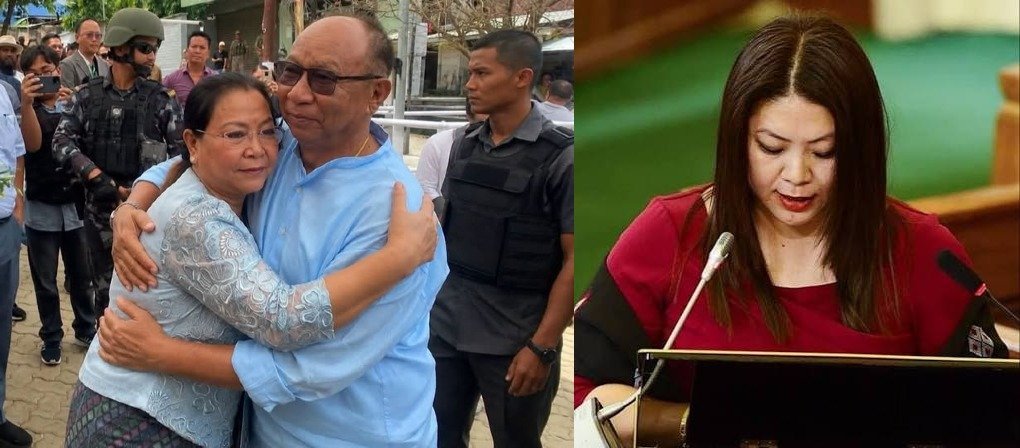
When Khemchand Singh arrived in the Kuki-dominated district, Nemcha received him, presented him with a bouquet and was seen embracing him.
For the Manipur government, it may have been a perfectly normal gesture of political courtesy.
For many Kuki-Zo civilians, however, the optics were stark.
For more than three years, ordinary members of the community have not felt safe enough to return to Imphal. They have lived away from their homes, faced violence and watched villages being burned and communities uprooted. The Kuki-Zo political position has been that the existing Manipur establishment cannot guarantee their security or political future.
Against that backdrop, seeing one of the community’s most senior political figures warmly receive and embrace the chief minister can understandably be viewed as a profound political contradiction.
The question is not whether Nemcha has the right to meet the chief minister. She does.
The question is what message such gestures send to a community that has been asked to maintain a political boycott of the very system she represents.
And now Kimneo
Kimneo Haokip Hangshing’s return to the Manipur Assembly brings the contradiction into even sharper focus.
The Saikul MLA entered the Assembly in Imphal along with Saitu MLA Haokholet Kipgen, ending a three-year period during which Kuki-Zo legislators had stayed away from physically attending the House.
Their return came despite a directive from the Kuki Inpi Manipur asking Kuki-Zo legislators to stay away until a political settlement was reached.
Kuki-Zo civilians have expressed anger on social media over Kimneo’s decision. The question being asked is blunt: how could the wife of a man associated with an SoO group now physically participate in the Manipur legislature at precisely the time when the community’s principal political body has called for disengagement?
That does not prove a secret political arrangement.
It does, however, raise questions about whether the interests of political families connected to the SoO leadership are beginning to diverge from the position being maintained by ordinary Kuki-Zo civilians.
Two women, one uncomfortable pattern
Taken separately, Nemcha’s meeting with Khemchand Singh and Kimneo’s return to the Assembly can each be defended as an exercise of constitutional politics.
Taken together, they create a much more uncomfortable picture.
Nemcha has remained inside the Manipur government while the community she represents has largely rejected the state’s political framework.
Kimneo has now returned to the Assembly despite the KIM boycott directive.
And in both cases, the political engagement is taking place against the backdrop of a community that has paid an enormous price for refusing to accept what it sees as an unacceptable status quo.
This is where the role of the SoO leadership becomes difficult to avoid.
Again, there is no basis to claim that either husband controls his wife’s political decisions.
But the family connections raise a larger structural question: what exactly is the political strategy of the SoO establishment?
Is the objective still to maintain maximum pressure for a political settlement outside the existing Manipur arrangement? Or is a section of the political network surrounding the armed groups gradually becoming comfortable with accommodation inside that arrangement?
READ: First in 3 Years: Two Kuki-Zo MLAs Defy Community Call, Enter Manipur Assembly
While civilians remain displaced
That question becomes especially uncomfortable when measured against the experience of ordinary Kuki-Zo civilians.
For three years, the community has remained divided geographically from Imphal. Thousands have been displaced. Villages have been destroyed or burned. Families have lost homes, livelihoods and, in many cases, the possibility of returning to their ancestral land.
And despite the scale of the violence, the community continues to point to the absence of convictions in cases involving the perpetrators of the violence.
For civilians who have been told that their sacrifice is necessary to secure justice and a political settlement, images of their leaders embracing government representatives or returning to the Assembly can therefore carry a very different meaning.
It can look less like strategic engagement and more like a widening gap between those who make political decisions and those who bear their consequences.
Who benefits from the contradiction?
This is ultimately the question that the Kuki-Zo political leadership needs to answer.
If political engagement is part of a carefully designed strategy to secure a separate administration, then the strategy needs to be explained to the people.
If participation in the Manipur Assembly is intended to protect the interests of Kuki-Zo voters, that too is a legitimate argument.
But the community cannot simultaneously be asked to believe that the Manipur political system is fundamentally incapable of protecting Kuki-Zo interests while its most influential political representatives increasingly engage with that same system as if political normalcy were returning.
That contradiction benefits the establishment more than it benefits the displaced.
Every photograph of political warmth, every return to the Assembly and every gesture of accommodation gives Imphal an opportunity to project an image of political normalcy.
The civilians, meanwhile, remain displaced.
The real cost of political games
The danger for the Kuki-Zo movement is not necessarily that its leaders will suddenly abandon the demand for separate administration.
Political positions rarely disappear overnight.
They weaken gradually.
They weaken when collective decisions become individual choices. They weaken when civil society directives are ignored. They weaken when political representatives pursue their own institutional interests. And they weaken when the people are asked to sacrifice while those closest to power appear increasingly comfortable engaging with it.
On one side are Kuki-Zo civilians who have spent three years outside Imphal, thousands languishing in relief camps after violence destroyed their homes and uprooted their lives.
On the other are political figures with access to the establishment — including women whose husbands have been associated with SoO armed groups — who can meet, embrace and negotiate with the same establishment.
The question the Kuki-Zo movement must confront is simple but uncomfortable:
How long can civilians be expected to pay the price of a political struggle while those closest to its leadership increasingly find accommodation within the system they are being asked to resist?