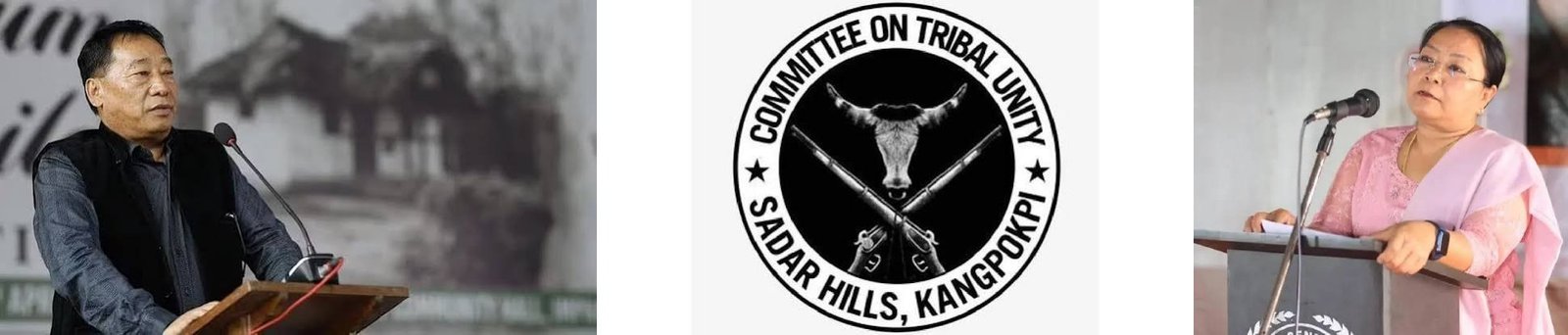
COTU warned against what it described as attempts to turn the government’s reconciliation arrangement into a fresh community confrontation.
BY PC Bureau
September 4, 2026: The Committee on Tribal Unity (COTU), Sadar Hills, on Thursday mounted a strong defence of Manipur Deputy Chief Minister Nemcha Kipgen and hit back at fellow Deputy Chief Minister Losii Dikho, accusing Naga legislators of adopting “double standards” in their response to the escalating Naga–Kuki-Zo violence in the hill districts.
In a statement issued from its administrative office at Kangpokpi DHQ, COTU said it was “constrained to rebut” Dikho’s recent remarks against Kipgen. The statement came in response to an interview Dikho gave to The Deccan Herald, in which the Naga People’s Front leader warned that Naga MLAs could “refrain from the government” unless the Centre took action against Kipgen.
Nine Naga legislators, including Dikho and Awangbow Newmai, had earlier written to Union Home Minister Amit Shah seeking action against Kipgen and the arrest of her husband, Thangboi Kipgen, who heads the Kuki National Front–Presidential (KNF-P) faction.
COTU argued that Dikho’s position as Deputy Chief Minister, alongside Kipgen, was part of a political arrangement made by the BJP leadership in New Delhi after President’s Rule ended in February 2026 and a popular government was formed under Chief Minister Yumnam Khemchand Singh.
The power-sharing formula followed nearly three years of turmoil that began with the Meitei–Kuki-Zo conflict in May 2023 and later evolved into a separate confrontation between Naga and Kuki-Zo groups in parts of the hill districts.
Litan flashpoint and competing claims
COTU traced the latest hill conflict to a drunken brawl on February 7, 2026, in Litan, Ukhrul district, involving Tangkhul Naga and Kuki youths. The incident quickly assumed a communal character, with houses on both sides reportedly set ablaze.
The tribal body claimed Kipgen was not involved in the negotiations that followed and alleged that the talks broke down after Tangkhul representatives rejected Dikho.
COTU further alleged that two Kuki-Zo farmers were subsequently killed in Litan by NSCN-IM cadres. It also claimed that around 21 “Kacha Naga Tangkhul” men detained by angry villagers over the disappearance of five residents were released following Kipgen’s intervention.
Independent reports have described the Litan violence as a flashpoint that revived longstanding land and demographic tensions between Tangkhuls and Kukis following the formation of the new government. Both communities have since accused the other of arson, abductions and targeted killings.

‘Condemn all killings, not only those of one’s own community’
COTU said the loss of lives, homes and property was “condemnable by all civilized society”, irrespective of ethnicity.
It accused Dikho and Newmai of displaying a “shameful and irresponsible” preference for their own community while holding public office. The organisation cited several incidents that it claimed Naga politicians had failed to condemn with equal force.
These included the alleged killing of three Kuki-Zo church pastors on May 13, 2026, which COTU attributed to “Kacha Tangkhul-led NSCN-IM and ZUF Kamson”; the killing of three other civilians at Loibol; and what the organisation put at 19 Kuki-Zo civilians killed in violence that also allegedly left villages in Noney, Kamjong, Ukhrul and Tadubi either destroyed or deserted.
Naga leaders, meanwhile, have focused on the abduction and killing of six Naga civilians whose mutilated bodies were recovered in June. They have attributed the killings to KNF-P cadres allegedly linked to Thangboi Kipgen and have also highlighted subsequent attacks on Naga villages.
Dikho has alleged that Kipgen “switched off her phone” following the May 13 abductions and did not visit affected Naga areas. The allegations remain politically contentious and have not been conclusively established in public proceedings.
READ: Detained, Beaten, Abused: Journalists Seek Action Against Delhi Cops
COTU warns against political walkout
COTU said it understood that Dikho and Newmai were under “political duress of the Kacha Tangkhul supremacist”, but urged them not to become “stooges” of Tangkhul interests in Ukhrul and Kamjong.
The organisation also appealed to the two leaders not to “belittle the aged old relationship” between the southern and northern hills and Kangpokpi.
It rejected any move by Naga legislators to withdraw from the government unless Kipgen was removed, arguing that such a decision could not be equated with the earlier resignation of Kuki-Zo MLAs from the government headed by former Chief Minister N. Biren Singh.
The dual Deputy Chief Minister arrangement — a Meitei Chief Minister supported by one Naga and one Kuki-Zo deputy — was unveiled in February as part of an effort to project reconciliation after nearly a year of President’s Rule.
Seven months later, however, the arrangement has come under visible strain. The two Deputy Chief Ministers have publicly clashed, Naga legislators have threatened to withdraw support, and Kuki-Zo organisations have rallied behind Kipgen.
Meanwhile, armed groups from both sides continue to operate amid a landscape marked by checkpoints, blockades and allegations of retaliatory violence.
COTU’s statement does not settle the competing claims surrounding the violence. But it underscores how the political compromise forged in Imphal and New Delhi is increasingly being contested in the hills — through public statements, community mobilisation and competing narratives over the violence.