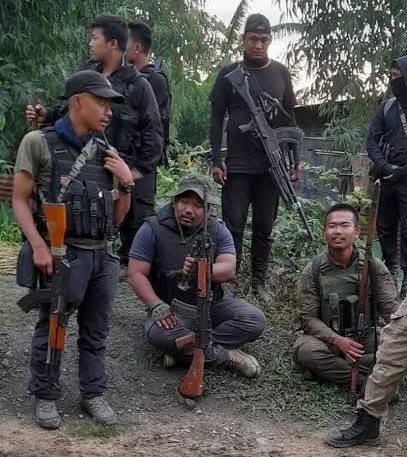
From the surrender of 246 firearms to NIA cases involving its alleged leaders, Arambai Tenggol has left a paper trail that goes far beyond that of a conventional cultural organisation.
By PC Bureau
When Manipur Chief Minister Yumnam Khemchand Singh told the Assembly on September 7 that Arambai Tenggol is not a banned organisation and that police action is directed against individuals, not the organisation, he drew a sharp legal distinction.
But the record surrounding Arambai Tenggol is considerably more complicated.
The group has described itself as a socio-cultural organisation. Yet since the outbreak of the Manipur conflict in May 2023, it has also been associated in police and National Investigation Agency investigations with armed mobilisation, possession of weapons, attacks on security personnel and the looting of arms. Its members have appeared in organised formations carrying firearms, and its representatives have negotiated collectively with the Governor over the surrender of weapons.
None of that automatically makes every member criminally liable. Nor does it establish that Arambai Tenggol itself is legally a banned organisation.
But it raises a fundamental question about the Chief Minister’s formulation: can an organisation remain legally unbanned while its leadership, cadres, weapons and activities are repeatedly the subject of criminal investigations?
This is korounganba Khuman, C-in-C of militant group Arambai tenggol. The group has challenged all Central forces including the NIA against his arrest. pic.twitter.com/XquOUsI9kP
— Ritesh Singh (@Duorope) June 17, 2024
The 246-weapon convoy
Perhaps the clearest evidence of Arambai Tenggol’s organised armed character came on February 27, 2025.
Two days earlier, on February 25, Arambai Tenggol’s self-styled commander-in-chief Korounganba Khuman, also known as Tyson Ngangbam, and other representatives met Governor Ajay Kumar Bhalla at Raj Bhavan.
The meeting followed the Governor’s February 20 appeal for the surrender of looted and illegally held weapons. The Arambai Tenggol delegation did not simply agree to hand over its arms. Its representatives said they had placed conditions before the Governor, including demands relating to the NRC, border fencing, action against Kuki armed groups, poppy cultivation, opposition to a separate Kuki-Zo administration and protection from arrest or legal action against village volunteers.
The following day, February 27, vehicles associated with the group arrived at the 1st Manipur Rifles complex in Imphal carrying a large quantity of firearms.
READ: Eiffel Tower shut after female staff told to stay out of sight for Hindu group visit
READ: BAPS: The Gujarat-based Hindu group behind Eiffel Tower Row
The number surrendered: 246.
This was the largest single surrender of illegally held weapons in the conflict up to that point. Around 6,000 weapons had been looted from state armouries during the conflict.
The composition of the 246-weapon cache is also important. It included 110 single- or double-barrel guns, 30 country-made weapons and 106 sophisticated weapons. Thus, it would be inaccurate to describe all 246 as sophisticated service rifles or as weapons proven to have been looted from state armouries.
But the broader fact remains striking: an organisation described by the Chief Minister as not banned had an organised cache of 246 illegally held weapons that was surrendered collectively at a state security installation.
That is not proof of collective criminal liability. It is, however, evidence of an organisation that had acquired and controlled substantial quantities of firearms.
“REMOVE CENTRAL FORCES AND WE WILL FINISH KUKIS IN A WEEK”
-Korounganba, Arambai Tenggol Leader.
He further exerts that his militias has 46 thousand trained Arambai Tenggol across all sectors. He even claimed to easily obtain state armouries to attack the Kuki people. pic.twitter.com/SVgeyvWF2c— Alice Ngaipilhing (@haokip_alice) September 3, 2024
The guns did not appear out of nowhere
The weapons question cannot be separated from the wider collapse of security in Manipur after May 2023.
More than 6,000 weapons and over one lakh rounds of ammunition were looted from state armouries and security-force facilities during the conflict, according to figures subsequently cited by security officials and the media. By September 2024, Security Adviser Kuldiep Singh had said about 1,200 of the looted weapons had been recovered.
Arambai Tenggol has repeatedly figured in reporting about the circulation of those weapons.
The group itself later surrendered 246 firearms. But the surrender did not establish that every weapon had been looted from a government armoury. Indeed, most of the weapons in the surrendered cache were single- or double-barrel and country-made guns.
The distinction matters.
The stronger and supportable point is that Arambai Tenggol had possession of a large quantity of illegally held firearms and was able to organise their collective surrender.
That is substantially different from the image of a conventional cultural association.
The commander in the photographs
Korounganba Khuman is central to the story because he is not merely an ordinary member.
He has publicly represented Arambai Tenggol, led its delegations and appeared in photographs and videos associated with the organisation’s activities.
The NIA case record cited in reporting on the organisation alleges that Khuman led a large armed group during an incident on November 1, 2023.
According to the FIR in RC-03/2024/NIA/IMP, a large number of Arambai Tenggol members allegedly assembled at the Palace Compound in Imphal East at about 5.30 pm. The FIR said some were carrying sophisticated weapons and other deadly weapons and that members were wearing camouflage, Manipur Police uniforms and black shirts.
The case record also refers to a Facebook post attributed to Khuman calling on people to assemble and “teach them a final lesson”.
According to the FIR, when the group was stopped by police at the Palace Gate, firing took place and the group allegedly overpowered police personnel before proceeding towards Imphal West in several vehicles.
The charges reported in connection with the case include rioting, unlawful assembly, obstruction of public servants, attempt to murder, dacoity, criminal conspiracy, criminal intimidation, offences under Section 18 of the UAPA, the Official Secrets Act and the Arms Act.
These are allegations contained in an investigation. They are not convictions.
But they are also not allegations originating solely from political opponents. They form part of an NIA case record.
The Palace Compound and 1st MR allegations
The significance of the NIA investigation goes beyond one alleged confrontation.
The reported case concerns allegations of an armed mobilisation that moved through Imphal and was subsequently linked to the ransacking and looting of weapons from a Manipur Rifles complex.
That creates an uncomfortable coincidence.
The same organisation whose members were allegedly involved in an armed incident and weapons-related offences in the NIA record later arrived at the 1st Manipur Rifles complex in a convoy and surrendered 246 firearms.
The two events cannot automatically be treated as proof that the surrendered weapons were the same weapons involved in the earlier alleged looting.
But together they demonstrate why the organisation’s relationship with firearms has become a central issue.
The jungle camps and black-shirted cadres
There is another part of the public record that the Chief Minister’s formulation does not address: the visual record of Arambai Tenggol’s cadres.
Photographs and videos published by news organisations have shown young men associated with the group in black T-shirts bearing its insignia, as well as men in military-style clothing carrying firearms.
India Today reported on Arambai Tenggol’s training activities and described the organisation as having developed a structure that extended into security and political mobilisation after the May 2023 violence. It also reported the existence of training camps and organised units.
The significance of such images should not be overstated. A photograph of an armed person does not establish when, where or why the weapon was obtained, nor does it prove participation in a particular crime.
But when photographs of armed formations, reports of training camps, weapons seizures and a subsequent surrender of 246 firearms are considered together, they present a picture considerably more organised than that of an ordinary cultural association.
Uniforms and government-pattern weapons
The NIA-related reporting is even more specific.
The FIR in RC-03/2024/NIA/IMP alleges that members of the group appeared in camouflage, Manipur Police uniforms and black shirts during the November 1, 2023 incident.
That allegation is significant because the use of police or military-style clothing by armed civilians can create the appearance of official authority and complicate the ability of security forces and civilians to distinguish between state personnel and armed non-state actors.
Again, the allegation must be tested through the judicial process.
But it is part of the formal criminal investigation—not merely a social-media accusation.
Kangla and the political power of the group
Arambai Tenggol’s activities have also extended beyond the carrying of weapons.
In January 2024, the organisation summoned elected Meitei legislators to Kangla for a meeting on the conflict and the defence of the Meitei community. Reports described pressure being brought on legislators to support the group’s demands.
That episode demonstrated the extent to which Arambai Tenggol had acquired political influence.
The issue is not whether a civil-society organisation is entitled to make political demands. It is.
The issue is whether an organisation capable of summoning legislators, mobilising cadres, maintaining armed units and negotiating collectively with the Governor over weapons can still be understood adequately through the label of a purely socio-cultural body.
The Kanan Singh case
The arrest of Asem Kanan Singh in June 2025 added another layer.
Singh, described as an Arambai Tenggol leader, was arrested by the CBI at Imphal airport in connection with criminal cases related to the 2023 violence. His arrest triggered protests in Imphal and parts of the Valley.
Manipur Police subsequently said Singh had previously been a head constable and had been terminated from the force in March 2025 for involvement in criminal activities, including alleged cross-border arms smuggling.
Other reports described Singh as the head of Arambai Tenggol’s armed wing and linked him to allegations surrounding an attack on the residence of Additional Superintendent of Police Moirangthem Amit and the subsequent kidnapping of the officer.
His arrest is important to the present debate because it illustrates precisely the distinction the Chief Minister has drawn: the state has prosecuted an individual associated with Arambai Tenggol rather than banning the organisation itself.
But it also demonstrates why the organisation’s structure matters. Singh was not presented as an anonymous member of a cultural association. He was publicly identified as an Arambai Tenggol leader.
The NIA’s wider record
The NIA’s investigations also extend to other serious cases involving alleged Arambai Tenggol members.
One NIA FIR, RC-13/2024/NIA/IMP, registered on November 13, 2024, invokes Section 20 of the UAPA along with provisions of the Bharatiya Nyaya Sanhita and the Arms Act. The FIR concerns the killing of Zosangkim in Jiribam and alleges that she was raped and burnt alive by armed militants identified in the FIR as Arambai Tenggol and the Manipur People’s Army.
That is an allegation in an FIR and must not be treated as a judicial finding. But it is another example of the organisation’s name appearing in a formal national-security investigation.
The legal distinction is therefore crucial: an FIR naming an organisation or its alleged members does not establish guilt. A UAPA charge does not equal conviction. And neither does a weapons surrender establish that every member of the organisation participated in the acquisition of those weapons.
But the existence of these cases cannot simply be erased by describing criminal liability as entirely individual.
What the Chief Minister’s clean chit actually means
Khemchand Singh’s statement should therefore be read carefully.
He did not say that every Arambai Tenggol member was innocent.
He said the organisation is not banned and that police action is against individuals for offences they are alleged to have committed.
That is a legally defensible distinction.
India does not automatically criminalise membership of every organisation that has members accused of crimes. A formal ban requires action under the applicable law, and prosecution still requires evidence against particular accused persons.
But the Chief Minister’s statement does not answer a different question: whether the organisation itself has operated in ways that warrant scrutiny beyond individual criminal cases.
The unanswered questions
The Chief Minister’s statement leaves three questions hanging.
First: How did an organisation described as socio-cultural acquire and collectively surrender 246 illegally held firearms?
Second: How should the state distinguish between crimes committed by individuals acting independently and conduct undertaken through an organised command structure?
Third: If the government has evidence sufficient to prosecute individuals in NIA and CBI cases, what criteria is it applying to determine whether organisational conduct itself warrants investigation?
The answer does not have to be a ban.
It does, however, have to be evidence-based.
Arambai Tenggol is not formally a banned organisation. That is a matter of legal fact.
But “not banned” is not synonymous with “not armed”, “not organised” or “not implicated in serious criminal investigations.”
The February 2025 weapons surrender, the NIA cases, the documented armed formations and the political role the organisation has assumed since May 2023 make that distinction impossible to ignore.