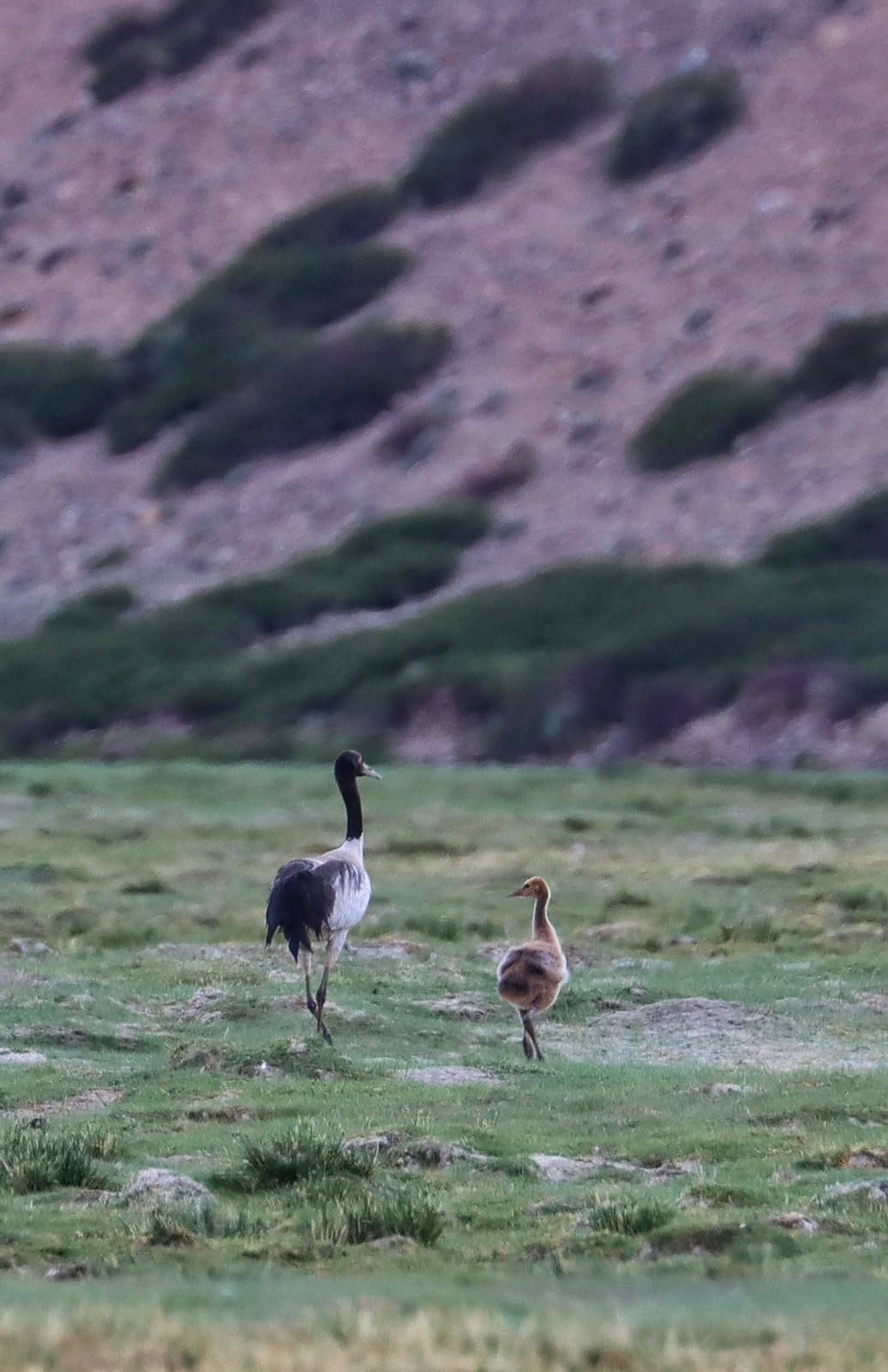
A proud moment for Ladakh. Thanks to the Environment Protection Force and local communities, the black-necked crane count has reached 108, including 22 juveniles. The species continues its steady recovery.
BY PC Bureau
November 17: Ladakh’s black-necked crane population has reached 108 birds in 2026, marking a nearly 25 per cent increase from the 87 recorded last year and offering a rare conservation success for the Union Territory’s endangered state bird.
The 2026 breeding-season survey counted 86 adults and 22 juveniles, compared with 70 adults and 17 juveniles in 2025. Among the breeding sites surveyed in the Changthang Range, Chushul recorded the highest number with 16 birds, followed by Tsokar and Kargyam with 15 each and Korzok with 14. These four locations together accounted for 60 birds — nearly 56 per cent of the total count.
The rise in Black-necked Crane number continues a steady upward trend. Adult numbers grew at an average annual rate of about 12.9 per cent between 2021 and 2025. Breeding success has also improved: the survey recorded 22 juveniles this year, up from 17 in 2025, while the number of hatchlings has climbed significantly from just 9 in 2021 and 7 in 2022.
READ: Was Epstein Killed? New Forensic Analysis Challenges Suicide Theory
Lieutenant Governor VK Saxena credited the Environment Protection Force, particularly the ex-servicemen who form a core part of the force, for protecting nesting sites, eggs and hatchlings from free-ranging dogs — one of the biggest threats to the species. He also praised local communities, especially young people, for actively participating in conservation efforts.
A monumental milestone for Ladakh.
Delighted to share that the population of our State Bird, the revered and endangered Black-necked Crane, has reached 108 in 2026, increasing by nearly 25% from 87 birds in 2025.
Compared to 70 adult and 17 juveniles in 2025, the count has gone up to 86 adults and 22 juveniles this year, with breeding sites at Chushul (16), Tso Kar and Kargyam (15 each) and Korzok (14) recording the maximum birds’ abundance; i.e. nearly 56% of the total 108 bird population in 2026.
This milestone follows a steady, monotonic growth from 2021 to 2025, where adult population of Black-necked Cranes rose by an average 12% annually.
I appreciate the ex-servicemen inducted in our Environmental Protection Force for protecting birds’ nests and hatchlings from the severe threat of free-ranging dogs.
I also commend the local communities, especially the youth, whose active participation in initiatives like the first-ever Black-necked Crane Festival, has been vital to our conservation success.
The UT Administration remains fully committed to preserving Ladakh’s ecological heritage and ensuring these majestic birds continue to thrive in the years to come.
— LG Ladakh (@lg_ladakh) November 17, 2026
“This is a monumental milestone for Ladakh and a matter of immense pride for all of us,” Saxena said. “The Black-necked Crane is not merely our State Bird; it is a cherished symbol of Ladakh’s unique ecological heritage. The encouraging rise in its recorded numbers reinforces our resolve to protect this magnificent species and its natural habitat.”
He added that the Environment Protection Force played a key role in safeguarding Black-necked Crane nests from dogs, and stressed that protecting wildlife and fragile ecosystems remains a shared responsibility.
Earlier this year, the UT Administration held the first-ever Black-necked Crane Festival to raise awareness about the bird and its high-altitude wetland habitats in Changthang. Officials hope the combination of better protection and growing community involvement will help the population continue to recover.