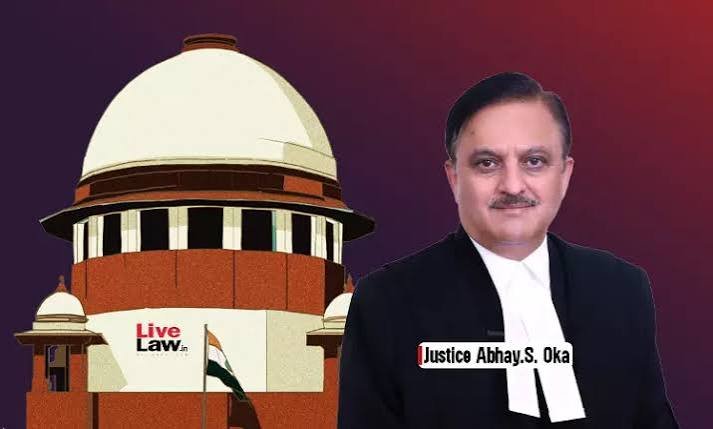
In an interview with BBC Marathi, Oka raised questions about the legality of simultaneous revisions, voter deletions for non-submission of enumeration forms and the ECI’s authority to modify prescribed application forms.
BY PC Bureau
October 14: Former Supreme Court judge Justice Abhay Oka has called for the reconsideration of the apex court’s May 2026 judgment upholding the Election Commission of India’s (ECI) Special Intensive Revision (SIR) of electoral rolls, arguing that several aspects of the exercise raise serious questions about the legality of the process.
In an interview with BBC Marathi, Justice Oka outlined what he considers key legal flaws in the judgment, including the simultaneous revision of electoral rolls across constituencies, the introduction of a pre-filled enumeration form, the possibility of deleting voters for failing to submit it, and the Election Commission’s authority to modify prescribed application forms.
He also stressed that the ECI cannot assume that the Supreme Court’s decision to uphold SIR gives it unrestricted powers to implement the exercise. Even when a process is legally valid, its implementation can still be challenged if it is arbitrary or violates statutory safeguards.
Can SIR be conducted simultaneously across all constituencies?
One of Justice Oka’s principal objections concerns the interpretation of Section 21(3) of the Representation of the People Act, 1950, which provides for special revisions of electoral rolls.
According to Oka, the law does not envisage an intensive revision being conducted simultaneously across every constituency. He argued that the statutory framework permits an intensive or partial revision and that the provision must be interpreted within the limits set by Parliament.
He also pointed to the requirement concerning the completion of revisions before general elections, arguing that the statutory provisions cannot be read as granting the ECI unlimited discretion over the timing and scale of the exercise.
His interpretation raises a fundamental question: how far can the Election Commission extend its powers to revise electoral rolls without exceeding the authority granted by law?
Pre-filled enumeration forms and voter deletions
Justice Oka also questioned the legal basis for the pre-filled enumeration forms introduced by the Election Commission during SIR.
Under the ECI’s instructions, voters who fail to submit the prescribed enumeration form risk having their names excluded from the draft electoral rolls. Oka argued that neither the Representation of the People Act, 1950, nor the Registration of Electors Rules, 1960, expressly provides for automatic deletion on this ground.
He maintained that failure to submit an enumeration form cannot, by itself, justify the deletion of a voter’s name.
According to his interpretation, the name should remain on the draft electoral roll until the prescribed legal procedure is followed. If the authorities have grounds to question a voter’s eligibility, they must issue an appropriate notice, provide an opportunity to respond and conduct the necessary hearing before taking a decision.
The concern, therefore, is not simply about filling out a form. It is about whether an administrative requirement can become a basis for excluding voters without the procedural safeguards mandated by law.
Can the Election Commission modify Forms 6 and 8?
Another objection concerns the ECI’s authority to modify Forms 6 and 8, which are used for the inclusion of names and correction of electoral-roll entries.
Justice Oka argued that the Election Commission cannot independently alter forms prescribed under the statutory rules. According to him, changes to these forms, including the addition of new declarations, must be made by the authority legally empowered to frame the relevant rules.
He specifically raised concerns about the modified Form 6, which contains an additional declaration. Oka noted that this particular issue was not specifically argued before the Supreme Court during the earlier round of litigation, meaning the court did not have an opportunity to examine the legality of the modification in that context.
He suggested that the question could now be examined separately.
The issue is significant because changes to voter-registration forms can affect the documents and declarations citizens are required to provide when seeking inclusion in electoral rolls.
Even a valid SIR cannot be implemented arbitrarily
Justice Oka emphasised that the legal validity of SIR and the manner in which it is implemented are two separate questions.
Even if the Supreme Court does not reconsider its earlier judgment, he argued, the ECI’s actions remain subject to judicial scrutiny. A process upheld as constitutionally valid cannot be implemented arbitrarily or in a manner that disregards legal safeguards.
This distinction is important because a court’s approval of an administrative exercise does not necessarily mean that every decision taken during its implementation is automatically lawful.
According to Oka’s reasoning, affected voters can still approach the courts if they believe that the process has been applied unfairly or in violation of the law.
ECI cannot decide citizenship, says Oka
Justice Oka also stressed that the Election Commission does not have the authority to make a final determination of an individual’s citizenship.
He argued that a voter’s name cannot be deleted merely because the person fails to satisfy the ECI’s demands for proof of citizenship. Questions of citizenship must be dealt with by the competent authorities under the applicable law.
The distinction is crucial because electoral-roll revision and citizenship determination are separate legal functions. The ECI is responsible for preparing and maintaining electoral rolls, but it cannot assume powers that Parliament has assigned to other authorities.
A renewed debate over SIR
The Supreme Court’s May 2026 judgment upheld the ECI’s authority to conduct SIR, relying on Section 21(3) of the Representation of the People Act and Article 324 of the Constitution. The court held that the exercise served the objective of maintaining accurate electoral rolls. <Cite refs={[“turn624710search5″,”turn624710search7”]}/>
Justice Oka’s observations challenge aspects of the legal reasoning and implementation that, in his view, require closer scrutiny. They do not themselves overturn the Supreme Court’s judgment, which remains binding unless reconsidered or modified through the appropriate judicial process.
His intervention adds to the debate over the balance between the Election Commission’s responsibility to maintain accurate electoral rolls and the need to protect citizens from arbitrary exclusion.
At the heart of the dispute is a basic question: can the drive to clean up electoral rolls be allowed to weaken the legal safeguards that protect a citizen’s right to remain on the voter list?
For Justice Oka, the answer depends on whether every stage of SIR is carried out strictly within the limits imposed by the law.