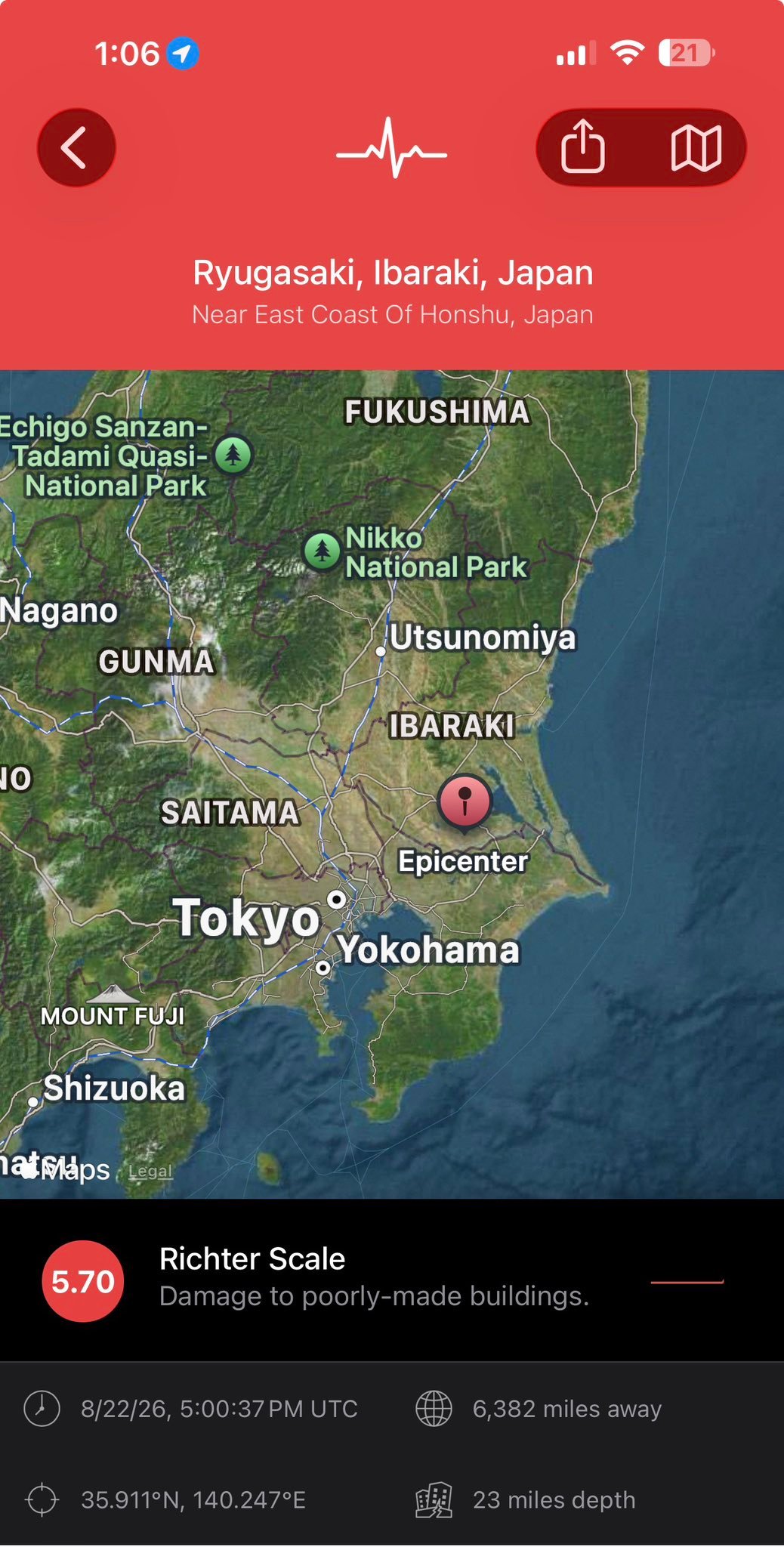
The pre-dawn quake rattled Tokyo and surrounding prefectures, with lower-5 shaking recorded in parts of Ibaraki, Saitama, Chiba and the capital. Train services were disrupted and minor damage was reported at several locations.
BY PC Bureau
August 23, 2026: A magnitude 5.9 earthquake struck southern Ibaraki Prefecture early Sunday, sending powerful tremors across Tokyo and much of the Kanto region, injuring at least 23 people and disrupting rail services, although there were no reports of deaths or a tsunami.
The earthquake struck at around 2 a.m. local time, with the Japan Meteorological Agency (JMA) placing its epicentre in southern Ibaraki at a depth of about 70 kilometres. The US Geological Survey measured the quake at a preliminary magnitude of 5.8.
The strongest shaking registered lower 5 (5-) on Japan’s seven-level seismic intensity scale. The level was recorded in parts of Ibaraki, Saitama, Chiba and Tokyo, including Tokyo’s Adachi Ward. The tremor was felt across a much wider area, with intensity 4 recorded in parts of Tochigi, Gunma and Kanagawa as well as other parts of Tokyo.
The JMA said there was no danger of a tsunami from the earthquake.
23 injured across Kanto
The number of people injured in the earthquake has risen to 23, according to prefectural officials.
The reported casualties include nine people in Saitama Prefecture, nine in Kanagawa, four in Chiba and one in Ibaraki. Most suffered relatively minor injuries after being thrown off balance, falling from beds or stairs, or colliding with furniture and other objects during the shaking.
A more serious injury was reported in Yokohama, where an elderly woman suffered a hip injury after falling from her bed. Other cases included people suffering cuts and bruises after falling or being struck by objects.
Emergency services in Tokyo also received numerous calls following the quake, including reports involving people trapped in elevators and residents unable to get out after furniture such as refrigerators and wardrobes toppled over.
There were no immediate reports of fatalities.
🚨🇯🇵#BREAKING | NEWS ⚠️
Additional footage out of Honshu Japan after a powerful 5.8 magnitude earthquake struck around 2 AM audible alerts throughout the city heard.Thousands of people have been evacuating large apartment buildings and building after the earthquake rocked the… pic.twitter.com/sBluUZIdxz
— Todd Paron🇺🇸🇬🇷🎧👽 (@tparon) August 22, 2026
Strong shaking felt across Tokyo
The earthquake was particularly notable because it produced lower-5 shaking in Tokyo’s 23 special wards, something not recorded in the capital for about five years.
Long-period ground motion of Class 2 was also observed in Tokyo’s 23 wards, southern Saitama and northwestern Chiba. Such prolonged movement can cause high-rise buildings to sway for an extended period and make it difficult for people to remain standing.
Earthquake early-warning alerts were sent to mobile phones shortly before the strongest shaking reached some areas, giving residents at least a brief warning to take cover.
5.9 earthquake strikes eastern Japan today, strong jolt felt in Tokyo. pic.twitter.com/EZ5Iopqg9B
— LEXIT (@LexitMovement1) August 22, 2026
Damage reported in Tokyo and Ibaraki
Although the earthquake did not cause widespread structural destruction, several incidents were reported.
At Ushiku City Hall in Ibaraki, part of a ceiling reportedly collapsed. No injuries were reported there.
In Tokyo’s Koto Ward, a water pipe ruptured following the earthquake, flooding part of a road. Authorities were investigating the exact cause and extent of the damage. Temporary water outages were also reported in parts of Adachi Ward.
A supermarket in Adachi Ward experienced a malfunction involving its fire-suppression system, releasing a large quantity of foam.
Temporary power outages affected hundreds of households in Tokyo, although electricity supplies were largely restored later in the morning.
Train services disrupted
The earthquake also disrupted transport across the Kanto region.
JR East reported delays and temporary suspensions on several lines, including the Joban, Keihin-Tohoku, Shonan-Shinjuku, Musashino, Chuo-Sobu, Sotobo, Utsunomiya and Takasaki lines.
Some services to Tokyo and Narita Airport were also delayed. Bullet train services were affected by temporary power-related disruptions in some areas but largely resumed operations without major problems.
No problems reported at nuclear plants
The earthquake prompted checks at nuclear facilities in the region, but operators reported no abnormalities.
No new problems were reported at the Tokai No. 2 nuclear power plant in Ibaraki, or at the Fukushima Daiichi and Fukushima Daini nuclear facilities. Authorities said there were no reported changes in radiation levels.
READ: Leaked Video: Goldy Brar Admits Role in Nijjar Killing
Government activates emergency response
The Japanese government established a liaison office at the Prime Minister’s Office Crisis Management Center to gather information, assess damage and coordinate the response.
Officials urged residents in areas that experienced strong shaking to remain alert, particularly because aftershocks can occur following an earthquake of this strength.
The JMA has warned that another earthquake producing shaking of around lower 5 could occur during the coming week, with particular caution advised over the next two to three days.
Authorities warn of aftershocks
The agency is urging residents to secure furniture, check emergency supplies and remain prepared for additional tremors. Authorities have also cautioned that landslides or slope failures could pose an additional risk in areas where recent heavy rainfall has weakened the ground.
The earthquake struck at a depth of around 70 kilometres, allowing the shaking to spread over a broad area of eastern Japan. The JMA’s latest data confirms a magnitude of 5.9 and a depth of approximately 70 km.
As of Sunday morning, the situation remained under assessment, but there was no indication of catastrophic damage. With 23 people injured and no deaths reported, authorities were continuing to inspect infrastructure, monitor transport networks and assess the possibility of further seismic activity.
Japan’s National Research Institute for Earth Science and Disaster Resilience has also recorded the event through its seismic monitoring network, underscoring the significant depth and strength of the earthquake beneath southern Ibaraki.