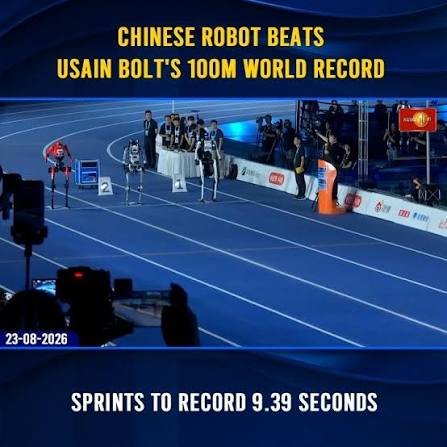
The stunning sprint highlights China’s rapid advances in humanoid robotics, although the robot’s time does not replace Bolt’s official athletics record, which remains the fastest 100 metres run by a human.
BY PC Bureau
August 23, 2026: A Chinese humanoid robot has clocked a startling 9.39 seconds in the 100 metres, finishing faster than Usain Bolt’s official human world record of 9.58 seconds and offering a striking demonstration of how quickly robotic running technology is advancing.
The run was recorded by Tiangong Ultra, developed by the Beijing Humanoid Robot Innovation Centre, during the opening day of the World Humanoid Robot Games in Beijing on Saturday, August 22.
Tiangong Ultra posted the 9.39-second time in its preliminary heat, immediately turning one of the world’s most iconic measures of human athletic performance into a benchmark for machines.
Bolt’s 9.58-second world record was set at the 2009 World Athletics Championships in Berlin and remains the official men’s 100-metre record under human athletics rules.
Another Chinese robot has gone even faster
Tiangong Ultra’s performance was not the first reported instance of a humanoid robot breaking the 9.58-second barrier.
Honor’s Lightning has reportedly completed a 100-metre run in 9.32 seconds during testing, reaching a peak speed of around 14.5 metres per second.
However, Lightning was slower in the official Beijing competition, finishing its heat in 9.47 seconds, behind Tiangong Ultra.
The results underline the rapid improvement in robotic locomotion. Just a year ago, Tiangong Ultra reportedly needed 21.50 seconds to cover the same distance.
Going from more than 21 seconds to under 10 seconds in roughly a year represents a dramatic leap in speed, balance and control.
READ: Japan Quake: 23 Injured After 5.9 Quake Rattles Tokyo Region
Robots get their own Olympics-style competition
The World Humanoid Robot Games are designed as a multi-sport showcase for humanoid machines, with events ranging from athletics to football and table tennis.
This year’s competition features 2,056 humanoid robots representing 666 teams from 16 countries. Organisers have scheduled 51 events and more than 1,300 individual contests, creating one of the largest public demonstrations of humanoid robotics to date.
The machines are being tested not only for speed but also in disciplines such as weightlifting and tug-of-war. Other scenario-based competitions are intended to demonstrate how humanoid robots could eventually operate in areas such as logistics, hospitality and domestic services.
Bolt’s record remains untouched
Despite the dramatic headline, the 9.39-second run does not replace Bolt’s world record.
Human athletics records are governed by strict regulations covering the athlete, track, timing systems, starting procedures and other conditions. Humanoid robots compete under an entirely different framework designed for machines.
The comparison is therefore illustrative rather than official.
Still, it is an extraordinary benchmark. Bolt’s 9.58 seconds represents the fastest officially recorded 100 metres by a human athlete. Tiangong Ultra’s 9.39 seconds shows that a machine designed to reproduce human-like movement can now cover the distance in less time — at least under its own competition conditions.
China’s push into humanoid robotics
The sprint is part of China’s broader effort to establish humanoid robotics as a major strategic industry.
The Beijing event is intended to showcase advances in artificial intelligence, mechanical engineering, sensor technology, balance, motion planning and autonomous control.
Humanoid robots have traditionally struggled with the basic mechanics of running. Maintaining balance while repeatedly placing two feet on the ground at high speed requires extremely precise coordination between motors, sensors and control systems.
The dramatic improvement in Tiangong Ultra’s reported performance illustrates how quickly those systems are developing.
WATCH: Robot beats human's world record
A Chinese humanoid robot ran 100 meters in 9.39 seconds, faster than Usain Bolt's legendary world record 9.58 seconds. pic.twitter.com/160vYMQDR3
— Insider Paper (@TheInsiderPaper) August 23, 2026
From laboratory demonstrations to competition
Most humanoid robots remain experimental machines rather than commercially deployed general-purpose workers. Their abilities in controlled demonstrations can also differ considerably from what would be required in unpredictable real-world environments.
But the speed of recent progress is attracting growing attention.
A machine that required 21.50 seconds to complete 100 metres last year has now reportedly broken the 10-second barrier. Another Chinese humanoid has recorded an even faster time in testing.
The achievement does not mean robots are about to replace elite human sprinters. Human athletes still compete under a completely different set of rules and physical constraints.
But it does suggest that humanoid robotics is moving rapidly from laboratory experimentation towards increasingly sophisticated physical performance.
For now, Usain Bolt remains the undisputed human 100-metre world-record holder.
But in Beijing, the machines have begun running their own race — and they are getting remarkably fast.