With hundreds of vacancies in the Excise Department and illegal liquor networks operating across districts, Manipur faces growing questions over whether regulation and quality control would serve public health better than prohibition.
BY Navin Upadhyay
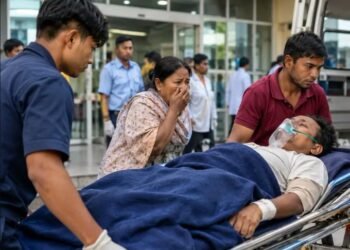
November 22: The deaths of 16 people and the hospitalisation of around 600 others following the consumption of suspected spurious liquor in Manipur have brought the state’s 35-year-old prohibition policy under fresh scrutiny. The tragedy in Chandel district has raised fundamental questions about the effectiveness of a ban that was introduced to curb alcohol abuse but has failed to eliminate the production, sale and consumption of illicit liquor.
The scale of the latest seizure operation offers an indication of the challenge facing enforcement agencies. Between November 17 and 21, 2026, police and the Excise Department registered 48 cases and seized 2,419 litres of distilled illicit country (DIC) liquor. As many as 1,967 litres were seized on November 21 alone, when 33 cases were registered.
Six people have been arrested in connection with the suspected illicit liquor supply network. Samples collected from locations linked to the supply chain have been sent to the Forensic Science Laboratory for chemical examination. The exact toxic substance responsible for the deaths and illnesses is yet to be established through medical and forensic findings.
The scale of the suspected poisoning, however, raises a larger question: if prohibition has been in force for more than three decades, how has an underground liquor trade continued to operate on such a scale?
Has Manipur not suffered enough? Now more lives have been lost, this time to spurious liquor.
❌Since May 2023, the BJP government has failed to contain the ethnic conflict and has only deepened the divisions. Hundreds have been killed, tens of thousands displaced, homes destroyed, and women sexually assaulted and paraded naked.
❌The Prime Minister has offered no meaningful leadership and no sustained effort to restore peace.
❌An entrenched inter-state drug-trafficking network continues to flourish.
❌And now innocent people are dying from poisoned liquor.
How many ways can the BJP fail in Manipur?
The governments at the Centre and in the state are endangering not just the lives of Manipuris, but the security of the entire country.
When a strategically vital border state is consumed by ethnic conflict, drug trafficking, spurious alcohol and insecurity, India’s national security, social cohesion and territorial integrity are all at stake.
The government must wake up and act instead of issuing fresh threats to the opposition every day.
— Pawan Khera 🇮🇳 ಪವನ್ ಖೇರಾ (@Pawankhera) November 21, 2026
An underground liquor economy
The initial police investigation points to a supply network extending beyond the affected villages in Chandel district.
According to preliminary reports, the liquor consumed by the victims was allegedly procured from several suppliers in Andro, in Kakching district, and stored by intermediaries in Sugnu before being distributed. Six people from Sugnu and Andro have been arrested as investigators attempt to establish the supply chain.
The geographical spread of the suspected supply network is significant. The incident has affected people in Chakpikarong subdivision and adjoining areas, while the alleged procurement and storage points are located in another district.
This suggests that the problem cannot be treated merely as isolated instances of illegal brewing in remote villages. Investigators need to establish how illicit liquor is produced, transported, stored and distributed, and whether organised networks are involved.
READ: Six Meiteis Arrested in Manipur Liquor Tragedy That Killed 16
The latest seizures are also not an isolated enforcement development.
The Excise Department’s 2018-19 annual administrative report recorded 3,197 prohibition-related cases during that financial year. Liquor worth more than Rs 1.10 crore, including Indian-made foreign liquor, beer and country liquor, was confiscated and destroyed.
During enforcement operations associated with the 2019 Lok Sabha election, authorities conducted 943 raids, registered 788 Excise cases and confiscated 13,373 litres of liquor worth approximately Rs 29.62 lakh.
More recently, during the 2024 Lok Sabha elections, enforcement agencies seized a total of 50,923.59 litres of liquor across Manipur, valued at approximately Rs 60.31 lakh. This included seizures by the state Excise Department as well as election surveillance and police teams.
These figures do not represent the total volume of illicit liquor circulating in Manipur. Seizures indicate what enforcement agencies have detected, not the actual size of the underground market. Nevertheless, they demonstrate that illegal liquor has remained a persistent enforcement challenge.
A prohibition introduced in 1991
Manipur became a dry state after the Manipur Liquor Prohibition Act, 1991, came into force on April 1, 1991.
The legislation followed sustained campaigns by women’s organisations, particularly the Meira Paibis, against alcohol consumption and its social consequences.
Domestic violence, family breakdown, alcoholism and the economic hardships faced by families were among the principal concerns raised by campaigners. The movement reflected a genuine social demand for restrictions on alcohol.
The prohibition policy was subsequently amended, but its implementation remained uneven.
In 2002, the government amended the legislation to provide for exemptions in certain areas. The prohibition was subsequently relaxed in five hill districts — Chandel, Churachandpur, Senapati, Tamenglong and Ukhrul — while restrictions continued elsewhere.
In September 2022, the then N Biren Singh government decided to partially lift prohibition. The decision was formally notified on December 6, 2023.
The exemptions covered Greater Imphal, district headquarters, tourist locations and registered hotels with at least 20 rooms. The government argued that regulating liquor sales would help address the health risks associated with unregulated alcohol and generate revenue.
However, the partial relaxation left large parts of the state under prohibition, creating a system in which legal availability and restrictions coexist across different geographical areas.
An enforcement system struggling with vacancies
The manpower position of the Excise Department raises further questions about its capacity to enforce prohibition across the state.
According to its 2025-26 annual administrative report, the department had 115 personnel against 707 sanctioned posts as of February 28, 2026, leaving 592 vacancies.
The shortage was particularly acute in enforcement positions:
- Only four of 47 sanctioned Excise Inspector posts were filled.
- Just 17 of 88 Sub-Inspector posts were occupied.
- Only 17 of 414 sanctioned constable posts were filled.
- All five Deputy Superintendent posts were vacant.
The department has 41 Excise stations across Manipur. Recruitment for 358 additional posts was reported to be under process.
The staffing figures point to a serious institutional challenge. A department with such a large number of vacancies faces obvious difficulties in monitoring illegal manufacturing, transportation, storage and distribution across the state.
The government must therefore examine whether prohibition can be meaningfully enforced without adequate personnel, intelligence networks, laboratory facilities and coordination between the Excise Department and police.
The economic cost of prohibition
Prohibition has also carried a substantial fiscal cost.
A 2024 study titled Evaluation of State Finances of Manipur, prepared by researchers from Manipur University for the Sixteenth Finance Commission, examined the economic consequences of the policy.
The study noted that before prohibition Manipur had 63 foreign liquor shops and three bonded warehouses. Revenue from liquor taxation was approximately Rs 30 crore at the time.
Following prohibition, the traditional liquor tax revenue largely disappeared. The state’s excise receipts stood at Rs 19.24 crore in 2022-23, according to the study.
The report argued that prohibition had not been properly implemented and had failed to eliminate drinking, while the state incurred significant revenue losses.
The economic argument for regulated liquor sales also featured prominently in the government’s decision to partially lift the ban. The government had projected annual revenue of Rs 600-700 crore when announcing the policy change in 2022-23.
The Excise Department’s own administrative report shows total departmental revenue collection rising from Rs 19.20 crore in 2022-23 to Rs 23.78 crore in 2024-25 and Rs 25.94 crore in 2025-26 up to February.
These figures include multiple revenue streams, including duties and licence-related collections, and should not be confused with revenue from retail liquor sales alone.
Nevertheless, they illustrate the potential for a regulated excise system to contribute to the state exchequer.
Ending prohibition does not mean promoting drinking
Any debate over ending prohibition must recognise why the law was introduced in the first place.
Women’s organisations and civil society groups have long opposed alcohol consumption because of its impact on families, public health and social welfare. Their concerns cannot be dismissed simply because enforcement has been difficult.
Nor would removing prohibition automatically eliminate illicit brewing or alcohol-related deaths.
The experience of states with legal liquor markets demonstrates that regulation must be accompanied by effective licensing, quality control, taxation and enforcement against illegal manufacturers.
For Manipur, a comprehensive review would need to address several issues:
Strict quality control: All liquor manufactured, imported or sold in the state should meet prescribed standards. Random sampling and mandatory laboratory testing should be strengthened.
A regulated distribution network: Licensed manufacturers, wholesalers and retailers should operate under strict monitoring. Illegal brewing and the sale of adulterated liquor should attract stringent penalties.
Protection of vulnerable communities: Restrictions could be retained in areas where communities, particularly women’s organisations and village authorities, seek protection from alcohol-related social problems.
Public health measures: De-addiction services, counselling and awareness campaigns should become an integral part of the state’s alcohol policy.
Accountability and enforcement: The government must strengthen the Excise Department, fill vacancies and establish an effective system to monitor the movement of liquor across districts.
A policy debate Manipur can no longer avoid
The Chandel tragedy has exposed the human cost of a system in which prohibition and underground liquor distribution have coexisted for decades.
The deaths in Chandel must first be investigated thoroughly. The source of the suspected adulterated liquor, the substances used in its manufacture and the distribution network must be established. Those responsible must face the law.
But the investigation should also trigger a wider examination of the prohibition policy.
The central question is not whether alcohol consumption is desirable. It is whether a blanket ban, in the circumstances prevailing in Manipur, remains an effective instrument of public health and social protection.
A policy introduced in 1991 to protect families deserves an honest assessment of its outcomes 35 years later. The state must consider whether a regulated system, backed by strict quality controls, public health safeguards and strong enforcement against illicit production, can protect people more effectively than the present arrangement.
The tragedy has made that debate unavoidable.