The collapse of a railway station canopy that killed 16 people in Novi Sad in November 2024 ignited a student-led uprising against corruption and political impunity, eventually threatening Aleksandar Vučić’s decade-long grip on power.
BY PC Bureau
October 25, 2026 —A concrete canopy collapsed at the railway station in Novi Sad, Serbia’s second-largest city, on November 1, 2024, killing 16 people. What followed was far more than public grief over a deadly infrastructure failure. The disaster became a rallying point for a nationwide movement challenging corruption, demanding accountability and questioning the political system built around President Aleksandar Vučić.
Nearly two years later, that anger has developed into a formidable political challenge to Vučić’s ruling establishment. The student-led movement, initially driven by demands for transparency and justice over the tragedy, has emerged as a major force in Serbia’s political contest, turning a local disaster into a broader struggle over the country’s future.
The collapse raised immediate questions about construction standards, infrastructure safety and possible failures of oversight. Critics argued that the tragedy reflected deeper problems in a system where political connections, opaque decision-making and weak accountability had allegedly allowed public institutions to evade scrutiny.
The government faced growing demands to release documents related to the station’s renovation and establish who was responsible for the disaster. For many protesters, the issue was no longer confined to the building or the officials directly involved. It had become a test of whether those in power could be held accountable when public safety was compromised.
Students turn grief into a national movement
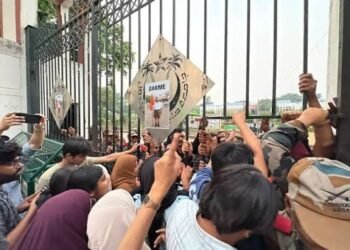
Students became the driving force behind the protests, organising demonstrations, blocking roads and university campuses, and demanding transparency over the station project. Their mobilisation drew support from citizens who had become increasingly frustrated with corruption allegations, political pressure on institutions and the concentration of power in the ruling establishment.
The movement’s strength lay partly in its ability to move beyond conventional party politics. Students presented their demands as a call for accountability rather than simply a campaign to replace one political faction with another. That approach helped attract support from sections of society that had grown disillusioned with established opposition parties.
The protests spread across Serbia, putting sustained pressure on the government. Demonstrators demanded the publication of relevant documentation, accountability for those responsible for the collapse and action against corruption. As the movement expanded, its demands increasingly challenged the broader political system associated with Vučić and his Serbian Progressive Party.
The authorities faced a growing crisis of credibility. Attempts to contain the protests did little to extinguish public anger. Instead, the continuing mobilisation reinforced the movement’s central argument: that the disaster could not be treated as an isolated accident without examining the institutions and decisions that preceded it.
From accountability to regime change in Serbia
What began as a campaign for justice over the deaths in Novi Sad gradually evolved into a wider challenge to the government. The protesters’ demands came to encompass democratic accountability, institutional independence and an end to political impunity.
Vučić, who has dominated Serbian politics for more than a decade, found himself confronting a movement that was not easily neutralised through ordinary party competition. Its roots in a specific tragedy gave it a powerful moral claim, while its nationwide reach transformed that claim into a sustained political challenge.
The government’s critics accused it of presiding over a system in which public institutions were insufficiently independent and political loyalty carried greater weight than accountability. The student movement gave these grievances a common focus, linking the railway disaster to wider concerns about governance.
The shift was significant. The demand was no longer only to determine who was responsible for the canopy collapse. It was increasingly about whether Serbia’s political leadership could retain public confidence in the face of allegations of corruption and institutional failure.
READ: Trump Baiter Lula Halts Right-Wing Advance in Brazil Poll
BREAKING NEWS: Students in Serbia have voted out their authoritarian leadership by winning the country’s parliamentary election.
They started with months of student protests against corruption and have translated street mobilisation into electoral legitimacy. https://t.co/Egj29ffIft
— Rinu Oduala 🔥🔫 (@SavvyRinu) October 25, 2026
Election becomes a test of public anger Across Serbia
The movement’s emergence as an electoral force marked a new phase in the confrontation. According to projections cited in the election account, the student-backed Student List was positioned to secure a parliamentary majority, while Vučić’s ruling bloc faced a substantial setback. Official results and the final distribution of seats remained subject to confirmation.
If confirmed, the outcome would represent a dramatic reversal for a political establishment that has held power for years. It would also demonstrate how a protest movement rooted in a public-safety disaster can reshape national politics when demands for justice broaden into a challenge to the legitimacy of those governing.
The projected result reflects more than dissatisfaction with a single policy or political decision. It points to the ability of sustained civic mobilisation to turn public outrage into an organised alternative. The students’ anti-corruption message has become a vehicle for voters seeking greater transparency and stronger democratic accountability.
The scale of the movement also complicates any attempt to portray the protests as a temporary reaction to one tragedy. The deaths in Novi Sad provided the catalyst, but the campaign drew strength from grievances that had accumulated over years.
A disaster that changed Serbia political equation
The Novi Sad collapse illustrates how a failure of infrastructure can expose much deeper failures of governance. When a public disaster is followed by demands for answers that citizens believe remain inadequately addressed, the consequences can extend far beyond the immediate site of the tragedy.
In Serbia, the canopy collapse brought questions of public safety, transparency and political responsibility into the centre of national debate. Students transformed those questions into a sustained campaign, attracting support well beyond university campuses and placing the ruling establishment under unprecedented pressure.
The movement’s potential electoral breakthrough would not, by itself, resolve Serbia’s institutional problems. Delivering transparency, establishing accountability for the disaster and rebuilding public trust would require sustained action beyond the ballot box.
But the political significance of the uprising is already clear. A collapsed roof became a symbol of a system that protesters said had failed to protect its citizens and answer their questions. What began with demands for justice for 16 people in Novi Sad developed into a national challenge to Vučić’s rule.
The tragedy did not automatically produce a regime-change movement. It gave a broad public discontent a focal point, a demand around which people could organise and a test of whether those in power could be held responsible. The students turned that opening into a political force—and in doing so, changed the terms of Serbia’s political struggle.